
Digital Marketing Glossary 2026: 46 Terms Explained
Whether you've just graduated and want to break into digital marketing, you're a traditional marketer trying to keep pace with a digital team, or you've just hired an agency and want to actually follow what they're saying — this page has you covered. We've ordered the terms from the ground up, in four groups: core concepts → 2026 AI tools → tracking and data → metrics. Each term gets a sentence or two, in plain English. This glossary was first written in 2023 and given a major 2026 overhaul, adding the terms that have genuinely reshaped the industry over the past two years — Performance Max, Smart Bidding, GA4, Consent Mode and AI Overviews among them.
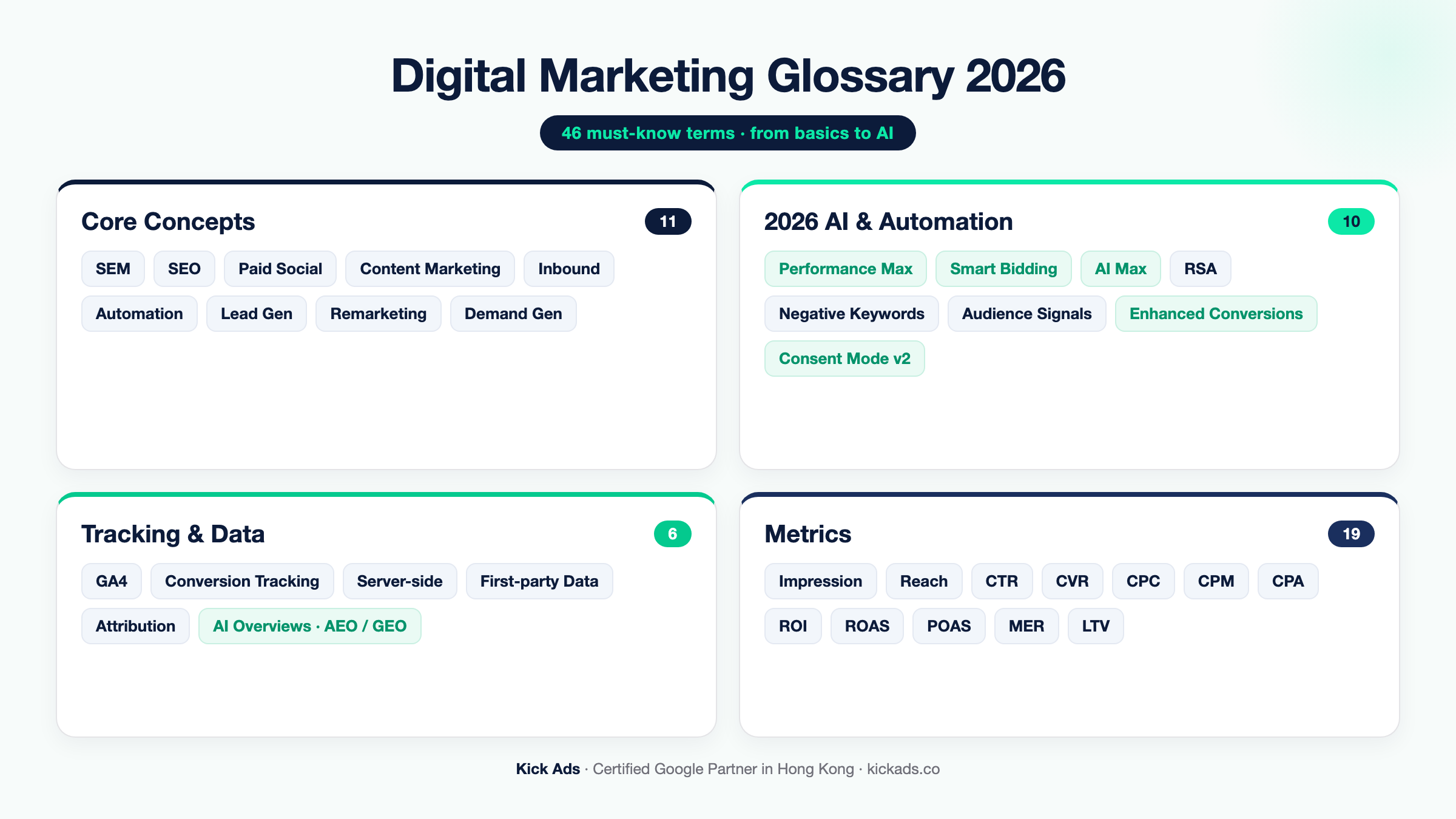
Group 1: Core concepts
SEM (Search Engine Marketing)
SEM is the practice of paying to place your web pages higher on search engine results pages to win more traffic, charged per click (PPC). It's also known as Paid Search, keyword advertising or search advertising, and it's one of the highest-intent channels in digital marketing. Further reading: the complete SEM & Google Ads guide 2026.
SEO (Search Engine Optimization)
SEO is the practice of improving your website's content and structure so its pages rank higher in the "free" organic search results. Unlike SEM, SEO doesn't charge per click — but it takes time to compound, rather than delivering results instantly.
Paid Social
Paid Social is advertising bought through social platforms' own ad systems to promote a page, post or website. In Hong Kong the common platforms are Facebook, Instagram, LinkedIn and Xiaohongshu, and marketers often refer to it casually as "boosting a post".
Banner / Display Ads
Display ads are the image-based ads shown on websites and apps, most commonly served through the Google Display Network (GDN). They're built for reach and awareness rather than the high purchase intent of search. Further reading: the complete guide to the Google Display Network (GDN).
YouTube Ads
YouTube Ads are the video ads that run on YouTube, chiefly In-Stream ads (skippable and non-skippable, played before or during videos) and In-Feed ads (shown within feeds and search results). Further reading: the complete YouTube Ads guide 2026.
Content Marketing
Content marketing is the practice of attracting your target audience with genuinely useful, relevant content — articles, videos, guides — to build trust and authority, rather than selling to them directly. In 2026, generative AI makes content faster to produce, but "useful, authentic and first-hand" is still what wins.
Inbound Marketing
Inbound marketing draws customers to you with valuable content, in contrast to "interruptive" tactics like cold calls and hard-sell ads. SEO, blogging and ebooks are classic inbound plays — the very page you're reading now is one.
Marketing Automation
Marketing automation is the use of software to run repetitive marketing tasks automatically — for example, syncing a new lead's email across platforms, sending timed nurture emails, or triggering remarketing. The marketer sets the logic once, and it runs on its own from there.
Lead Generation
Lead generation is the practice of attracting potential customers to your product or service and capturing their contact details. Think of it as fishing: you put out bait (a free guide, a webinar, an offer), and when someone hands over their email, you've landed a lead.
Remarketing / Retargeting
Remarketing is the practice of showing ads again to people who visited your website or app but didn't complete a goal — a purchase or sign-up — to bring them back to convert. It's one of the most cost-effective ways to recover interested-but-undecided visitors.
Demand Gen
Demand Gen is Google's AI-driven image and video campaign type that replaced Discovery ads, running across YouTube, Discover and Gmail. It's built to create demand among people who aren't searching yet but can be nudged into interest, sitting between brand awareness and conversion.
Group 2: 2026 AI and automation
Performance Max (PMax)
Performance Max is Google's fully automated, cross-channel AI campaign type that covers Search, Display, YouTube, Gmail, Discover and Maps from a single campaign. You supply the assets and goals, and the system allocates spend for you — powerful for businesses with clean conversion data, though it offers less transparency than manual campaigns.
Smart Bidding
Smart Bidding is the umbrella term for Google's AI bid strategies that adjust bids for each auction based on the likelihood of conversion. It includes Target CPA (tCPA), Target ROAS (tROAS), Maximise Conversions and Maximise Conversion Value — all of which depend on accurate conversion tracking to work.
Broad Match + Smart Bidding
Broad Match + Smart Bidding is the combination Google pushes hardest in 2026: broad match widens your reach, while Smart Bidding uses conversion data to filter out the searches that actually matter. Without accurate conversion tracking, don't use it — you'll simply burn budget.
AI Max for Search
AI Max for Search is Google's 2026 feature set that brings AI into Search campaigns, automatically expanding keywords and dynamically generating headlines and landing-page matches. In effect, it makes Search advertising behave more like the automated, hands-off Performance Max. Further reading: the complete SEM & Google Ads guide 2026.
RSA (Responsive Search Ads)
RSA is a Search ad format where you supply multiple headlines and descriptions, and Google automatically tests and assembles the best-performing combinations. As of 2026 it is the default (and effectively the only) text-ad format on Google Search.
Keyword Match Types
Keyword match types are the settings that decide how broadly or narrowly a keyword triggers your ad: broad match (widest reach, least control), phrase match (a balance) and exact match (most precise). Further reading: the complete guide to keyword match types.
Negative Keywords
Negative keywords are the terms you tell Google you don't want to trigger your ads, used to block irrelevant searches and save budget. In the age of broad match plus Smart Bidding they matter more than ever — they're your main hands-on lever for steering where the automation goes.
Audience Signals
Audience signals are the starting hints you give Google inside Performance Max or Demand Gen about who your ideal customer is likely to be — their interests, your data, your existing customer lists. They aren't hard targeting restrictions; they're a way to speed up the AI's learning.
Enhanced Conversions
Enhanced Conversions is a Google feature that sends hashed first-party data (such as an email address) back to Google to recover conversions lost to cookie restrictions. The more complete conversion data helps Smart Bidding make sharper decisions.
Consent Mode v2
Consent Mode v2 is Google's framework for adjusting how Google tags behave based on the consent choices a user makes in your cookie banner. It's a requirement for using Google and Meta audience features in regions like the EU, and any Hong Kong or Asian business with EU traffic should take note.
Group 3: Tracking and data
GA4 (Google Analytics 4)
GA4 is Google's current analytics platform, which replaced the older Universal Analytics (that stopped collecting data in 2023). It's built around events rather than sessions, tracks across devices and platforms, and integrates deeply with Google Ads. Further reading: the essential GA4 guide.
Conversion Tracking
Conversion tracking is the mechanism that records when a user completes a goal — a purchase, sign-up, enquiry or download — and it's the foundation of all smart bidding and performance measurement. Without accurate conversion tracking, Smart Bidding and Performance Max are flying blind. Further reading: the complete guide to Google Ads conversion tracking.
Server-side Tracking
Server-side tracking is the practice of routing tracking data through your own server (for example, GTM server-side) instead of sending it straight from the browser. It improves data accuracy and works around some browser and ad-blocker limitations, making it the mainstream approach in the post-cookie era.
First-party Data
First-party data is the data you collect directly from your own customers — email lists, purchase history, on-site behaviour. As third-party cookies are phased out through 2026, first-party data has become the single most valuable asset for precise targeting and remarketing.
Attribution Model
An attribution model is the set of rules that decides how credit for a conversion is shared across the different touchpoints — ads and channels — a customer met along the way, such as last-click or data-driven attribution (DDA). It shapes how you judge which channels are actually working. Further reading: the essential guide to attribution models.
AI Overviews / AEO / GEO
AI Overviews are the AI-generated summary answers Google places at the top of the search results, and AEO (Answer Engine Optimization) and GEO (Generative Engine Optimization) are the emerging disciplines of optimising your content to be cited in those AI answers. The playbook: clear question-style headings, a direct answer in the opening sentence, and structured data. This glossary is itself written to be quotable by AI Overviews.
Group 4: Metrics
Impression
An impression is counted every time your ad is displayed, once per display, regardless of whether anyone actually looked at it. It measures how often an ad was served, not how many people it reached.
Reach
Reach is the number of distinct people your ad reached. The difference from impressions: reach counts people, while impressions count displays — if one person sees an ad three times, reach counts one and impressions count three.
Clicks / Traffic
Clicks are the number of times users clicked your ad, and it's clicks that send traffic through to your website. No clicks, no traffic.
Engagement
Engagement is the core social media metric covering how users interact with your content — likes, comments, shares and clicks. It signals how well your content resonates with an audience.
Landing Page
A landing page is the first page a user sees after clicking your ad or link. Its quality directly affects your conversion rate and your Quality Score, making it one of the highest-leverage things to get right.
Placement
A placement is the specific spot where an ad is actually shown — a particular website on the GDN, a specific YouTube video, or an individual app. Reviewing placements lets you cut the ones that waste budget.
Quality Score
Quality Score is Google's 1–10 rating of how relevant and useful your keyword, ad and landing page are, and it directly affects your ad rank and cost per click. A high score means you pay less for the same position. Further reading: the in-depth guide to Quality Score.
Ad Rank
Ad Rank is the value that decides where your ad appears on the results page, calculated mainly from your bid (CPC bid) multiplied by your Quality Score, plus factors like ad assets. It's why the highest bidder doesn't automatically win the top spot.
CTR (Click-Through Rate)
CTR is a measure of how compelling an ad is, calculated as clicks divided by impressions. A high CTR usually signals that your ad copy and targeting are on the mark.
CVR (Conversion Rate)
CVR is the number of successful conversions divided by clicks, reflecting how persuasive your landing page and product are. It's the bridge between traffic and results.
CPC (Cost Per Click)
CPC is the average amount you pay for each click on your ad. It's the headline price of Search advertising, and it varies widely by industry and competition. Further reading: our SEM guide includes Hong Kong CPC benchmarks by industry.
CPM (Cost Per Mille)
CPM is the cost per thousand impressions, commonly used for awareness-focused, brand-building campaigns. It prices reach rather than clicks or conversions.
CPE (Cost Per Engagement)
CPE is the average cost of each user engagement — a like, view, click or other interaction. It's most often used to gauge the efficiency of social campaigns built around interaction.
CPA (Cost Per Acquisition)
CPA is the average cost to win one conversion — an enquiry, an order or a sign-up — and it's one of the metrics lead-gen and ecommerce advertisers watch most closely. Lower CPA means more results for the same spend.
ROI (Return On Investment)
ROI is (revenue minus cost) divided by cost, reflecting the overall profitability of an investment. It's the broadest measure of whether the money you put in paid off.
ROAS (Return On Ad Spend)
ROAS is the revenue generated by your ads divided by your ad spend, measuring how many dollars back you get for every dollar spent. It's one of the core metrics in ecommerce.
POAS (Profit On Ad Spend)
POAS is ROAS calculated on profit rather than revenue — the gross profit your ads generate divided by your ad spend. Because a high ROAS doesn't always mean you're making money (think low-margin products), more ecommerce businesses are switching to POAS as a truer measure of profitability in 2026.
MER (Marketing Efficiency Ratio)
MER is total revenue divided by total ad spend across all channels combined. As attribution grows harder, MER is used to judge whether the whole business is healthy, filling the blind spots left by any single platform's ROAS.
LTV / CLV (Customer Lifetime Value)
LTV (or CLV) is the total value a customer is expected to bring you over the entire relationship. A high LTV means you can afford a higher CPA to win a customer — it's the key to judging how much it's worth paying to acquire one.
Ready to put these terms to work?
Kick Ads is a Hong Kong certified Google Partner, delivering data-driven, ROI-focused paid media management for SMBs in Hong Kong and Malaysia. Whether you want to go deeper on Google Ads or get an expert second opinion on your account, we help you turn the theory above into results. Get a free Paid Media Health Check — no sales pitch, just honest findings.
FAQ
What is SEM? SEM (Search Engine Marketing) is paid keyword advertising on search engines like Google, charged per click (PPC), and it's one of the highest-intent channels in digital marketing.
What is Performance Max? Performance Max (PMax) is Google's fully automated, cross-channel AI campaign type that covers Search, Display, YouTube, Gmail, Discover and Maps from a single campaign — you supply the assets and goals, and the system allocates spend.
What's the difference between ROAS and POAS? ROAS measures revenue divided by ad spend, while POAS measures profit divided by ad spend; POAS is the more honest figure because a high ROAS on a low-margin product can still lose money.
What is AEO / GEO? AEO (Answer Engine Optimization) and GEO (Generative Engine Optimization) are the emerging disciplines of optimising your content so it gets cited in AI-generated answers like Google's AI Overviews, using clear question-style headings, direct opening answers and structured data.
What is Smart Bidding? Smart Bidding is Google's umbrella term for AI bid strategies — Target CPA, Target ROAS, Maximise Conversions and Maximise Conversion Value — that adjust bids for each auction based on the likelihood of conversion, and they all depend on accurate conversion tracking.
What replaced Universal Analytics? GA4 (Google Analytics 4) replaced Universal Analytics, which stopped collecting data in 2023; GA4 is event-based, tracks across devices and platforms, and integrates deeply with Google Ads.