
Google Ads in Hong Kong (2026): The Complete SEM & PPC Guide
By Frankie Chan, Co-Founder · Updated 30 July 2026 · 25 min read
Jump to section
- SEM vs Google Ads vs PPC vs paid search — what's the difference?
- What is SEM, and how is it different from SEO?
- Is SEM only Google in Hong Kong?
- How much does SEM cost? What's the CPC in Hong Kong?
- What does SEM cost in Hong Kong? (ad budget vs agency fee)
- Which businesses does SEM suit?
- Is SEM worth it, and what budget do you need?
- What decides your ad rank and CPC?
- Negative keywords: how to cut waste without cutting sales
- SEM vs Meta (Facebook / Instagram) — not rivals
- What's changed in SEM for 2026? (Smart Bidding, RSA, AI Max)
- How do AI Overviews affect SEM?
- How to set up Google Ads search ads, step by step (2026 interface)
- DIY, or hire an agency? How to choose a Google Ads / SEM agency in Hong Kong
- Real SEM results
- SEM glossary: the terms you will meet in the interface
- FAQ
As every industry crowds into Google's auction, search advertising (SEM / Google Ads) in Hong Kong is more competitive than it was a few years ago, and CPCs have climbed with it. Yet with the right structure and bidding, SEM remains one of the highest-intent channels there is — the one most likely to turn a search into an enquiry or a sale. In Hong Kong, SEM means Google in practice: StatCounter put Google at 91.33% of Hong Kong search in June 2026, against 3.05% for Yahoo and 2.94% for Bing. This guide takes you from zero through SEM in 2026: what it is, what it costs, how to set it up, how to bid, and how to optimise.
SEM vs Google Ads vs PPC vs paid search — what's the difference?
Quick answer: They mostly point to the same thing. Google Ads is Google's advertising platform (formerly Google AdWords); the search ads you run on it are called keyword ads, search ads or paid search, and SEM (Search Engine Marketing) is the umbrella term for paying to compete on a search engine. PPC (pay-per-click) is the pricing model behind it. In short: SEM is the concept, Google Ads is the platform you actually use, and PPC is how you're charged.
This guide uses these terms interchangeably, because they describe one thing: bidding, on a cost-per-click basis, on the keywords your customers are searching on Google. (Google Ads also runs Display, YouTube and Performance Max, but this guide focuses on the highest-intent format — search.)
What is SEM, and how is it different from SEO?
Quick answer: SEM (Search Engine Marketing) is the paid keyword ads you run on Google and other search engines — charged per click. SEO is the work of optimising your site to earn "free" organic rankings. SEM is instant, controllable and measurable; SEO is slower but compounds. They aren't an either/or choice.
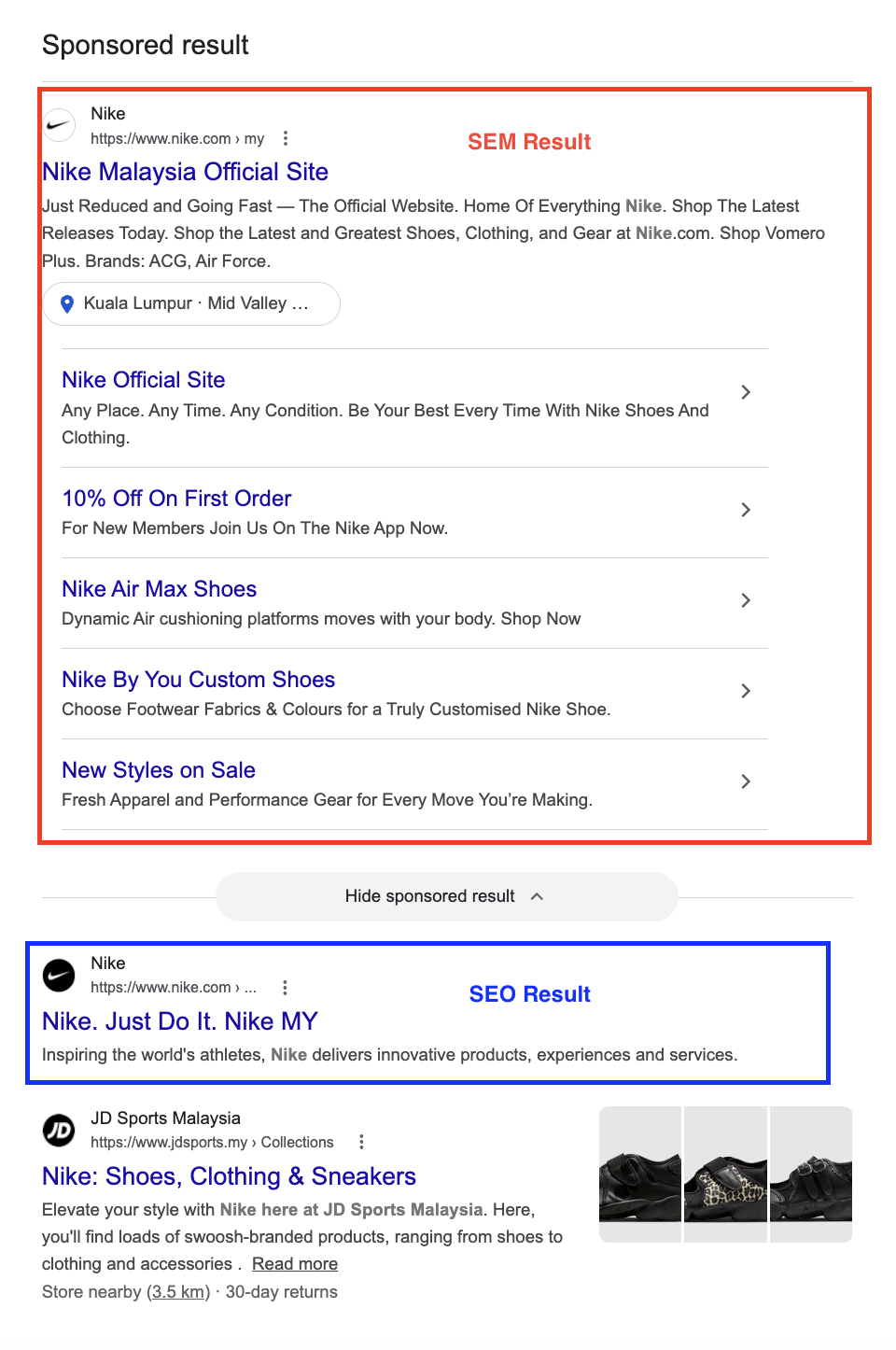
SEM is "pull" marketing: people search when they have a need, then click an ad to enquire — much like the old Yellow Pages. So keep one thing in mind: if a keyword has little search volume (say, an obscure brand term of your own), no bid or budget will save it — with no one searching, the ad simply won't show. SEM only works when people are already looking.
| SEM (keyword ads) | SEO (organic) | |
|---|---|---|
| Cost | Pay per click | No direct spend (invested in content & optimisation) |
| Speed | Instant | Slower, compounds over time |
| Control | High — bids, budget and targeting adjust instantly | Lower |
| Placement | The "Sponsored" slots | Organic results |
Is SEM only Google in Hong Kong?
Quick answer: In practice, yes. SEM as a term covers paid ads on any search engine, but StatCounter put Google at 91.33% of Hong Kong search in June 2026, with Yahoo on 3.05%, Bing on 2.94% and Baidu on 0.34%. Every other engine put together is under 9% of the market.
That is why an SEM plan for a Hong Kong business is a Google Ads plan, and why this guide treats the two as one thing. Guides written for other markets often split the two, because in some countries the share is genuinely divided.
The practical read for Hong Kong:
- Google is where you build the plan. On these numbers there is no serious alternative.
- Microsoft Advertising (Bing) is worth a small test if you sell B2B or professional services to a desktop-heavy audience, because the auction is thinner. Bing and Yahoo together are under 6% of Hong Kong search, so treat it as an experiment on a high-value keyword set rather than a second channel.
- Baidu only enters the conversation if you are selling into the mainland. That is a separate account, a separate compliance process, and a different exercise from the one in this guide.
How much does SEM cost? What's the CPC in Hong Kong?
Quick answer: SEM is pay-per-click (PPC) — you're charged only when someone clicks, not when the ad shows. Hong Kong CPCs swing widely by industry: retail can sit near HK$1, competitive verticals like medical aesthetics and overseas-study education run HK$15–30, and finance or law can top HK$40.
Because you pay per click, you use keyword matching and negative keywords to decide who sees the ad and on which searches — putting the right ad in front of the right person at the right moment.
Reference Hong Kong CPCs for generic (non-brand) search, measured from our own Kick Ads accounts over the trailing 12 months:
| Industry (generic search) | Hong Kong CPC (HK$) |
|---|---|
| Fashion / sports retail | ~0.5–2 |
| Jewellery | ~3.5 |
| Electronics / ecommerce | ~3.5–4 |
| Tutoring / education | ~5–6 |
| TCM / medical services | ~6–12 |
| Fitness | ~8–9 |
| Beauty / medical aesthetics (treatments) | ~10–25 |
| Overseas-study education | ~14–30 |
These are real CPCs from our Hong Kong accounts (non-brand generic keywords). The most competitive verticals — finance, law, insurance — can exceed HK$40. A full Hong Kong CPC benchmark is coming soon. For a fuller breakdown of pricing and how to plan a budget, see our guide to Google Ads costs in Hong Kong.
What does SEM cost in Hong Kong? (ad budget vs agency fee)
Quick answer: SEM in Hong Kong usually has two cost parts. The first is your ad budget — paid directly to Google, bid on a cost-per-click (CPC) basis, with the total driven by your daily budget and how competitive your industry is. The second is the agency management fee: if an agency runs the account, it's typically charged as a percentage of ad spend, commonly around 10–20%. What ultimately moves the cost is industry competition, keyword CPCs, the locations you target, and your Quality Score. For Hong Kong SMEs, ad budgets commonly start from a few thousand dollars a month, with more competitive verticals often running five-figure monthly budgets.
- Ad budget (paid to Google): bid on CPC; how far it goes depends on your daily budget and keyword competition — higher-CPC verticals buy fewer clicks for the same spend. The Hong Kong CPC table above is a fair starting reference.
- Agency management fee (if you outsource): when a specialist team runs the account, it's usually a monthly retainer or a percentage of ad spend — commonly around 10–20% — covering account setup, bidding and keyword optimisation, reporting and ongoing adjustments.
Note that this is the cost structure, not a flat quote: the real numbers for any account depend on the industry, the goal and the competition. If you'd rather hand the full setup, tracking and optimisation to a specialist team, see our Hong Kong SEM / Google Ads agency service.
Which businesses does SEM suit?
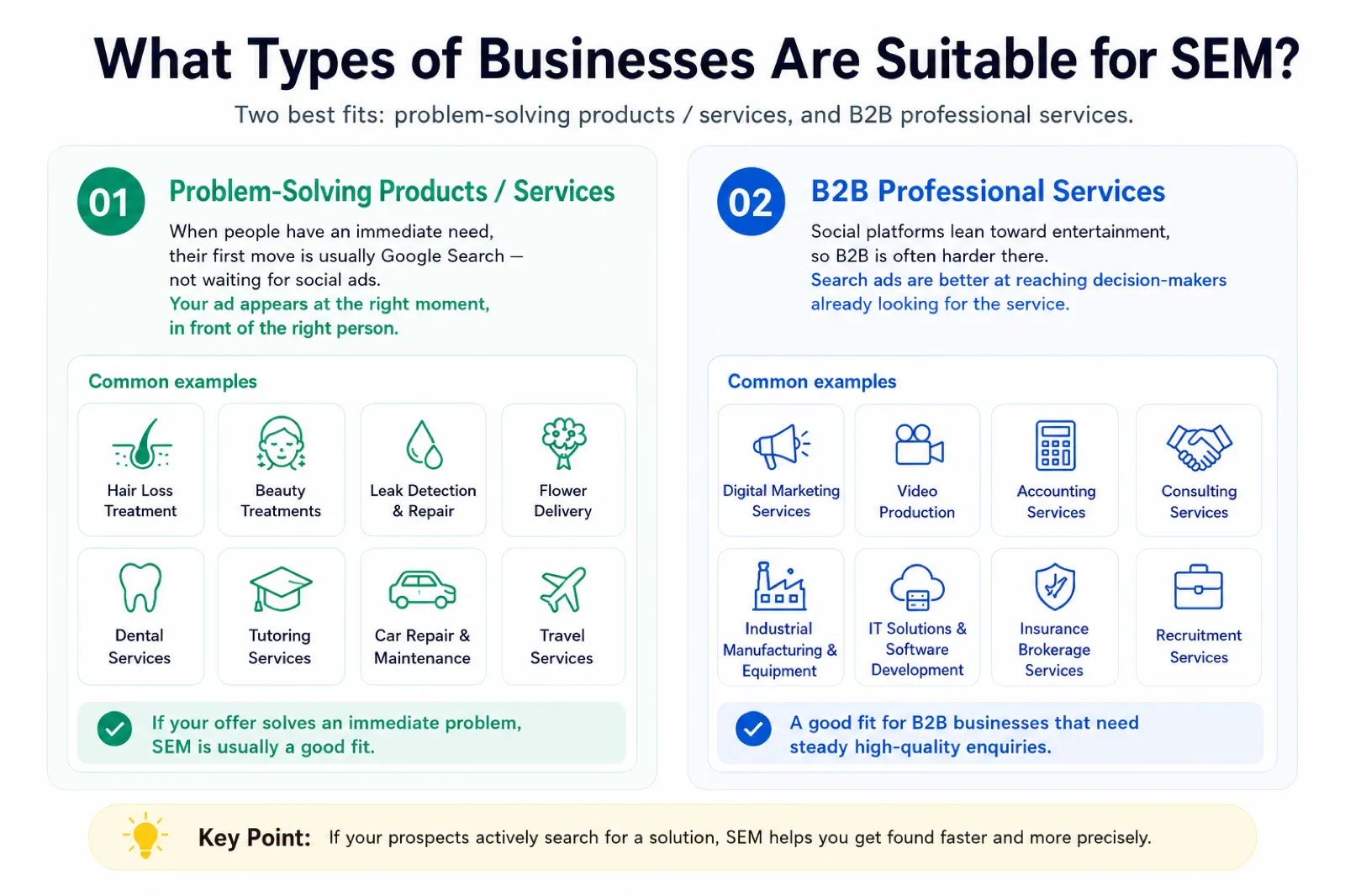
Quick answer: Two types fit best — problem-solving products and services, and B2B professional services. Both share the same trait: when a customer feels the need, their instinct is to search for the answer, and that's exactly where a search ad meets them.
1. Problem-solving products and services. When someone has an immediate need — hair loss, a beauty treatment, a leak to fix, flowers to send — their first move is to search Google, not to wait for a Facebook ad. That's the moment your ad can appear. If your product or service solves a problem, SEM usually fits.
2. B2B professional services. Digital marketing, video production, accounting, industrial manufacturing, and the like. Social platforms lean toward entertainment, which makes B2B a harder sell there; search ads, by contrast, reach decision-makers at the exact moment they're looking for that service. We have broken this down further into six industries, and what changes in each.
Is SEM worth it, and what budget do you need?
Quick answer: It comes down to two numbers — your conversion rate and the cost per customer you can accept (Target CPA). The maths is simple: cost per click ÷ conversion rate = cost per enquiry or order. If that figure sits below what a customer is worth to you, SEM is worth doing.
If you know your site's conversion rate — say a HK$10 CPC at a 5% conversion rate, that's one enquiry every 20 clicks, or about HK$200 per enquiry. Weigh that against the profit in each deal and you have your answer.
If you don't know it yet — start small (around HK$5,000/month) for a month or two, then calculate your real CPA and optimise from there. Whatever you do, don't spend big without tracking in place.
In practice, we usually suggest Hong Kong businesses start at around HK$10,000/month. That may not be enough to judge final ROAS right away, but it's usually enough to see your main keywords' CPCs, how much traffic they bring, your site's conversion rate, and which search terms actually produce enquiries or orders. With that data, you know where to add keywords, which campaigns are worth scaling, and whether to fix the landing page or tracking first. Higher-CPC verticals — medical, beauty, law, B2B services — generally need a higher starting budget.
What decides your ad rank and CPC?
Quick answer: Rank and your actual CPC aren't simply "highest bid wins" — they're driven by your bid and your ad's quality. A strong Quality Score typically lets you rank higher while paying less per click, which is why relevance often beats raw spend.
The main factors:
- Bid — how much you're willing to pay per click.
- Quality Score — a 1–10 diagnostic that reflects three real-time signals: expected click-through rate, ad relevance and landing-page experience. Those signals feed Ad Rank in the auction and are what actually lower your CPC — Quality Score itself isn't a value plugged into the auction. On-topic ads paired with a relevant landing page pull your CPC down.
- Assets / Extensions — sitelinks, call, location and more (9 ad assets worth adding), which make your ad bigger and lift its click-through rate.
Google's own Ad Rank documentation lists six inputs, and only the first is money:
- Your bid amount
- The quality of your ads and landing page
- The Ad Rank thresholds
- How competitive the auction is
- The context of the search: location, device, time, the wording of the query, and the other ads and results on the page
- The expected impact of your assets and other ad formats
Quality Score is the diagnostic that tells you how you are doing on the second one. It runs 1 to 10 at the keyword level and breaks into three parts:
| Quality Score component | What Google is measuring | Where you fix it |
|---|---|---|
| Expected click-through rate | How likely your ad is to be clicked when it shows | Ad copy that answers the keyword, and an offer worth clicking |
| Ad relevance | How closely the ad matches the intent behind the search | Tighter ad groups, one theme each, so the copy can be specific |
| Landing page experience | How relevant and useful the page is to people who click | Send the keyword to a page about that keyword, loading fast, with an obvious next step |
One thing worth being precise about, because a lot of SEM advice gets it wrong: Google states plainly that "Quality Score is not an input in the ad auction. It's a diagnostic tool to identify how ads that show for certain keywords affect the user experience." Chasing the number itself is not the job. The three underlying signals are real and they do lower your CPC. For the full breakdown, see our Quality Score guide.
Keyword match types (2026)
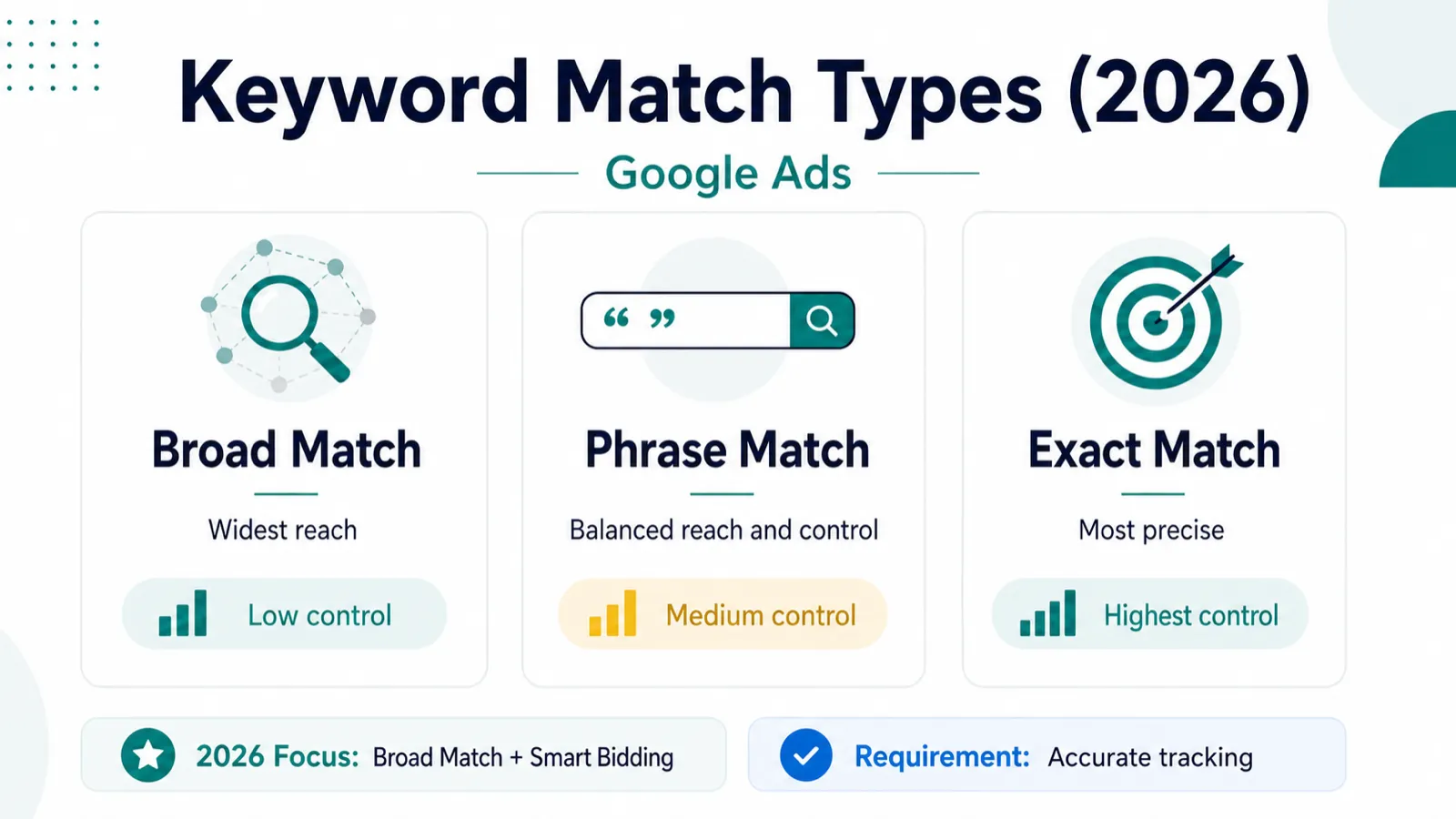
Match types decide which searches trigger your ad. There are three (further reading: the complete guide to keyword match types):
| Match type | Reach | Control |
|---|---|---|
| Broad Match | Widest — includes related intent | Lowest; in 2026, only safe when paired with Smart Bidding |
| Phrase Match | Searches carrying the keyword's meaning | Medium |
| Exact Match | The keyword and very close variants | Highest |
A 2026 note: Google pushes the "Broad Match + Smart Bidding" combination hard. Broad match is no longer the spray-and-pray of old — paired with smart bidding and solid conversion data, it can surface high-value searches you'd never list by hand. This only works if the conversion tracking is accurate first.
Negative keywords: how to cut waste without cutting sales
Quick answer: Negative keywords stop your ad showing on searches you do not want. Before you add one, check what it would have blocked over the last 12 months. A term that looks like waste but converts at or below your account's average CPA is not waste, and negativing it costs you sales you will never see in the report.
Match types decide which searches can trigger your ad. Negatives decide which ones cannot, and they have their own three match types:
| Negative match type | Blocks the search when |
|---|---|
| Negative broad (the default) | It contains all your negative terms, in any order |
| Negative phrase | It contains your exact terms, in that order |
| Negative exact | It is your exact terms, in that order, with nothing added |
Note that negative broad is the default, and it is the one that quietly blocks the most. "free course" as a negative broad blocks "free trial course booking" and also "course free consultation".
The method we use, and the mistake it exists to prevent. Run any proposed negative list against the account's own 12-month search terms export before it goes live, and compare the CPA of the terms it would block against the CPA of the terms it would keep. If the blocked set converts at or below account average, it is producing sales and it stays.
What that check found on one account. On a Hong Kong lead-generation account we rebuilt in July 2026, we ran a proposed list of 263 negative keywords against the account's own 12-month search terms export before anything went live. It would have blocked 42% of all converting search terms (156.5 conversions out of 372.1), at HK$538 per conversion against HK$524 for the terms it kept. The traffic that list read as waste was buying at the same price as everything else, and the only signal against it was the wording of the queries. That is one account and one 12-month window, so read it as an example of what the check catches, not as a benchmark for your own account.
We check this on every account audit we run, and the result is consistently uncomfortable: a chunk of the traffic that reads as off-topic in a spreadsheet is booking appointments and placing orders in real life. Hong Kong searchers use adjacent vocabulary constantly and still buy. Query wording is not a service boundary.
So:
- Never blanket-negative a broad root. Whole categories of words that look tangential to your service will be carrying conversions.
- Keep negatives at campaign level, exact or phrase, individually reviewed. An account-level blanket list is where the damage happens.
- Never negative a term your landing page actually sells against. If your page's argument is "why our method beats X", you want the searches about X.
- A big, relevant term with zero conversions is a routing problem, not a waste problem. Fix which page it lands on before you block it.
- Bilingual accounts need bilingual negatives. A Hong Kong account running Chinese and English keywords needs 免費, 教學, 招聘, 自學 and their English counterparts, checked separately, because the search-term report will not group them for you.
Review the Search Terms Report on a schedule rather than when a month looks bad. Google also caps Display and Video at 1,000 account-level negative keywords, which is worth knowing before you paste in a list.
SEM vs Meta (Facebook / Instagram) — not rivals
Quick answer: Search ads capture demand that already exists and is clearly intended; Meta ads create demand and handle remarketing. They complement each other, and running the full funnel together usually works best. On the video side, pair this with our complete YouTube Ads guide.
| SEM (Google Search) | Meta ads | |
|---|---|---|
| Demand | Captures existing demand (active search) | Creates demand (interest-triggered) |
| Intent | High | Lower, but broad reach |
| Best for | Immediate enquiries and conversions | Awareness, remarketing, community |
| What to watch | Enquiries, CPA, ROAS, brand-search performance | Reach, creative performance, site traffic, remarketing |
In our experience, Meta can widen brand awareness first — showing more people who you are, what you sell and what your offer is. When those people later have a need, some go straight to Google and search your brand, your product, or the service itself. So look beyond Meta's own clicks and conversions and watch brand search too: whether brand-keyword impressions, clicks, enquiries and conversions rise as Meta spend rises. A word of caution — a lift in brand search isn't necessarily all Meta's doing. Seasonality, promotions, PR, KOLs, other media, even a change to your brand campaign's budget or bids all move the number. The cleaner read is to hold brand-search settings steady, then watch the trend before and after you scale Meta.
What's changed in SEM for 2026? (Smart Bidding, RSA, AI Max)
Quick answer: SEM in 2026 is heavily automated. Text ads are now Responsive Search Ads (RSA) only, bidding leans on Smart Bidding (Target CPA / Target ROAS / Maximise Conversions), and Google has added AI Max for Search to expand keywords and creative with AI. There's less to fine-tune by hand — but feeding the system the right data and creative matters more than ever.
- RSA (Responsive Search Ads) — the old Expanded Text Ads are gone; RSA is all that remains. You supply many headlines and descriptions, and Google assembles them. Write plenty of relevant headlines, and use pinning to lock down your key messaging.
- Smart Bidding — Target CPA, Target ROAS or Maximise Conversions bid for you, as long as your conversion tracking is accurate; feed it bad data and it learns the wrong thing. (Deep dive: the complete guide to Google Ads bidding strategies.)
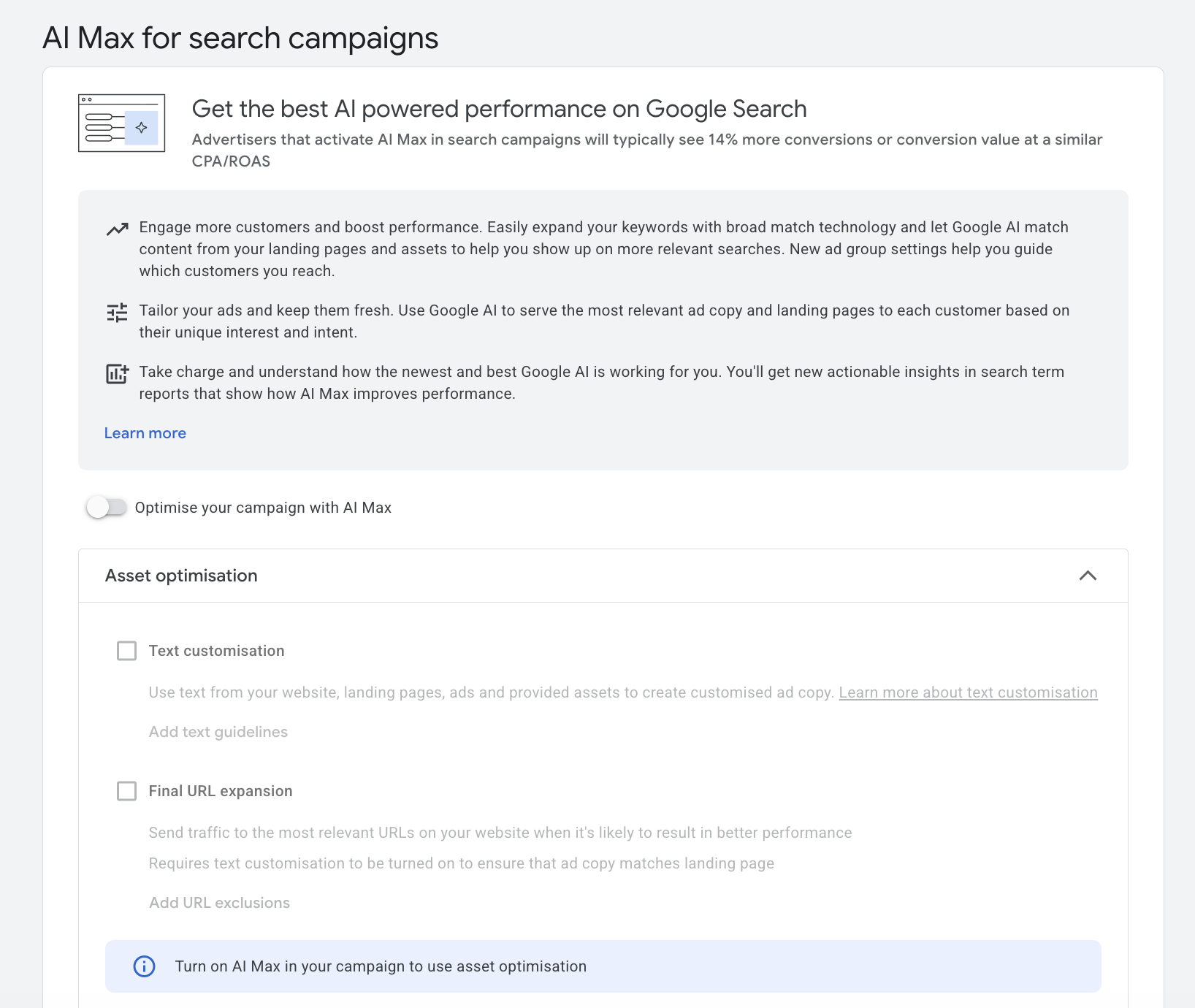
- AI Max for Search — Google's AI expands your keywords, landing pages and creative combinations to catch searches you wouldn't have listed. It's best for accounts with good conversion data; new accounts should lay down tracking and a clean structure first.
How Kick Ads does it
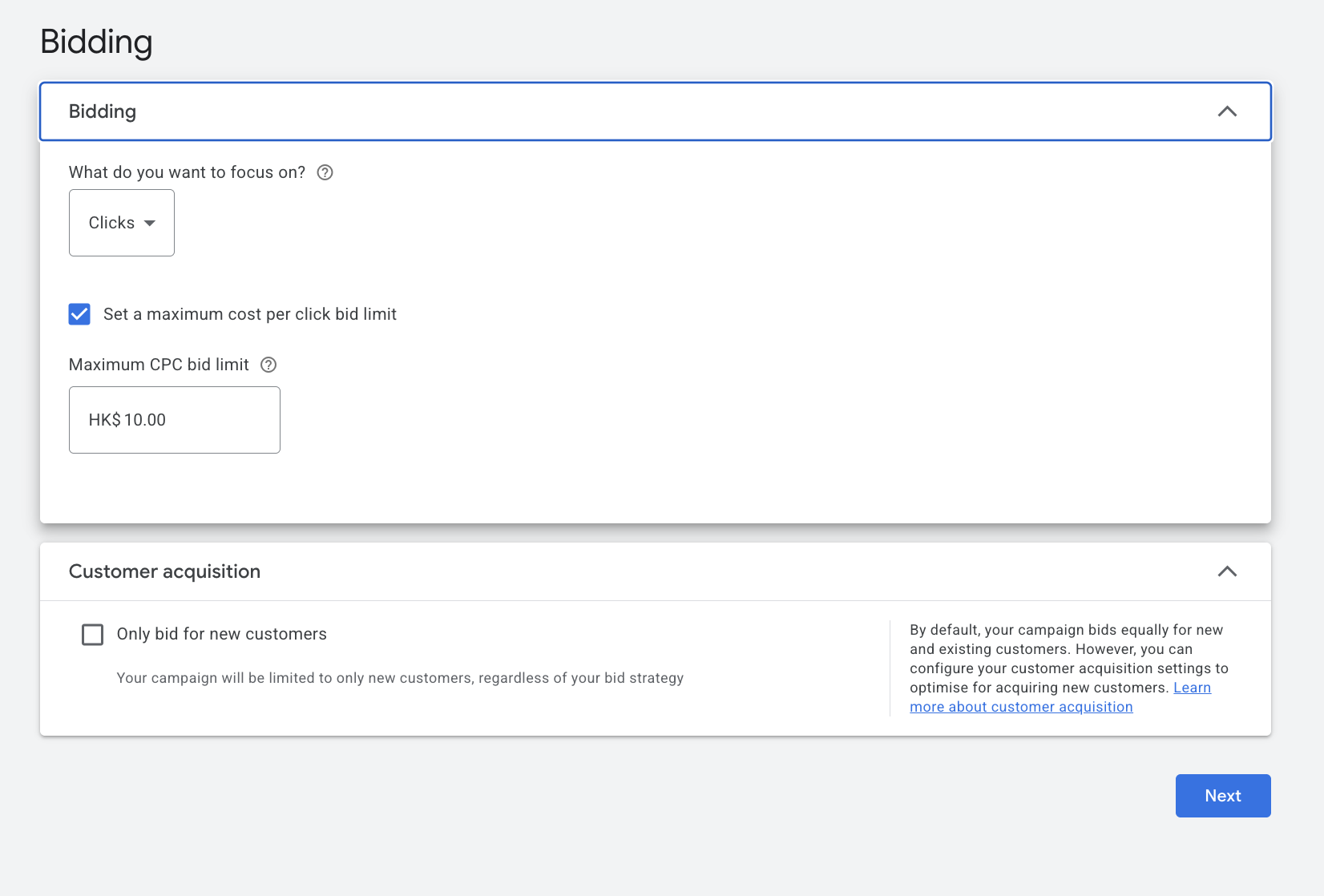
1. Bid slow, then fast. When a new Search campaign launches, we usually open with Maximise Clicks and a CPC bid limit for about two weeks — to keep CPC controlled at low risk, read the raw search terms, and confirm conversion tracking is firing, before the algorithm narrows traffic on thin data. Once conversion data settles, we move to Maximise Conversions (value), Target CPA or Target ROAS. Low-conversion accounts often shouldn't set a target too early.
2. We don't flip AI Max fully on. AI Max can match beyond your existing keywords and may pull traffic from your landing-page content. But turning it fully on over a generic Search campaign tends to invite low-intent search terms and push CPA up. So we sort out the conversion goal, negative keywords, brand exclusions and URL exclusions first, then run a Google Ads Experiment against the original campaign — watching new search terms, landing-page matching, and the quality of the enquiries and sales, not just CPA.
⚠️ Important August 2026 update (Target CPA / ROAS): Google is changing how target-based bidding behaves. From 17 August, campaigns flagged Limited by budget that use Target CPA or Target ROAS will optimise more closely to the target you set. For example, a Target CPA set at HK$10 but recently delivering HK$5 may drift back toward HK$10 — and Target ROAS is affected the same way. From 6 July, Google Ads offers a Bid Target Adjustment Tool to review and adjust these settings. It mainly affects Search, Shopping, Performance Max and Demand Gen; App, Video Reach and Video View campaigns are unaffected.
How Kick Ads responds: we review every affected campaign, comparing recent actual CPA/ROAS against the current target. For efficiency-first accounts, we lower the tCPA or raise the tROAS to sit closer to recent stable performance; for clients chasing more volume, we reset targets to an acceptable efficiency and reallocate budget. Then we watch over one to two conversion cycles rather than making one big sweeping edit.
How do AI Overviews affect SEM?
Quick answer: AI Overviews push organic results and ads further down and eat clicks on informational searches. But commercial and transactional searches — SEM's home turf — are far less affected, because people ready to buy or enquire still click ads. Google is also placing ads inside and around AI Overviews, so SEM inventory is changing shape, not shrinking away.
- Informational queries (e.g. "what is SEM", "how does Google Ads work", "what is CPC") get answered on the spot, so organic clicks fall sharply — but these were never SEM's focus.
- Commercial and transactional queries (e.g. "Google Ads agency", "aesthetic treatment price", "best tutoring centre") still carry strong click and conversion intent, so SEM holds up — and can even stand out more as organic gets pushed down.
- Google is folding ads into AI Overviews, including sponsored links within the Overview itself. The format is shifting, not disappearing.
- In practice: in 2026, concentrate budget on high-intent commercial keywords and strong landing pages, and do less pure-informational. In the AI era, SEM is actually steadier and more controllable than pure SEO.
From running Hong Kong accounts, we see purely informational (how-to, definition) searches delivering less convertible traffic, so we concentrate Search budget on commercial and transactional keywords and strong landing pages — where conversion performance stays stable. One caution: don't read too much into ad impressions alone. Impressions move with budget; the more reliable signal is the quality of the enquiries and orders you get, watched under a relatively steady budget.
How to set up Google Ads search ads, step by step (2026 interface)
Create an account at ads.google.com and enter the standard Google Ads interface to begin.
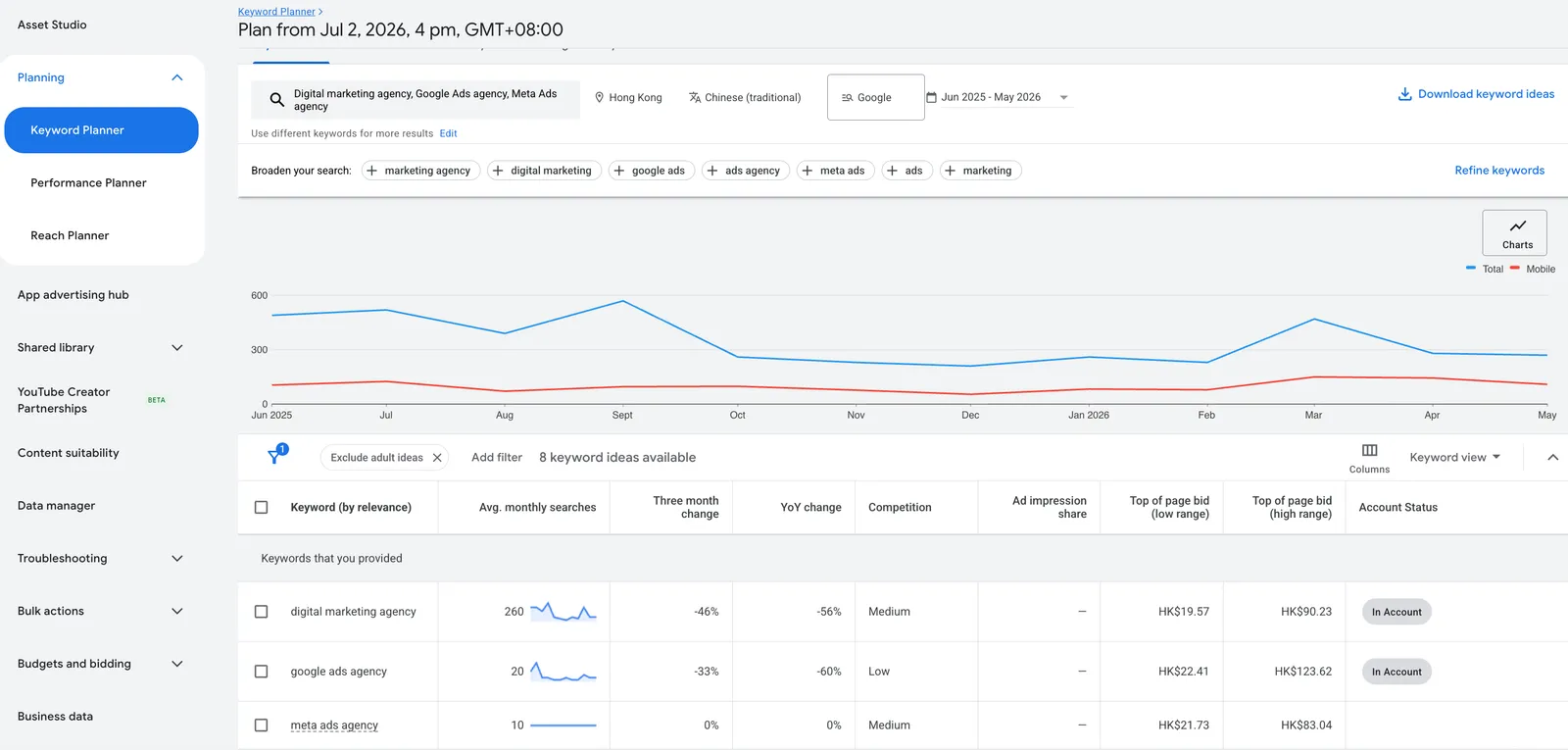
Step 1 — Keyword research (Keyword Planner). Use Keyword Planner to gauge search volume and competition, then group keywords by intent (brand, product, competitor, generic).
Step 2 — Campaign settings. Choose the "Sales / Leads / Website traffic" objective and the "Search" campaign type. How should you structure campaigns? Split them by intent, product line or market for cleaner budgeting and analysis (for example: Brand, Product-A, Generic, Competitor).
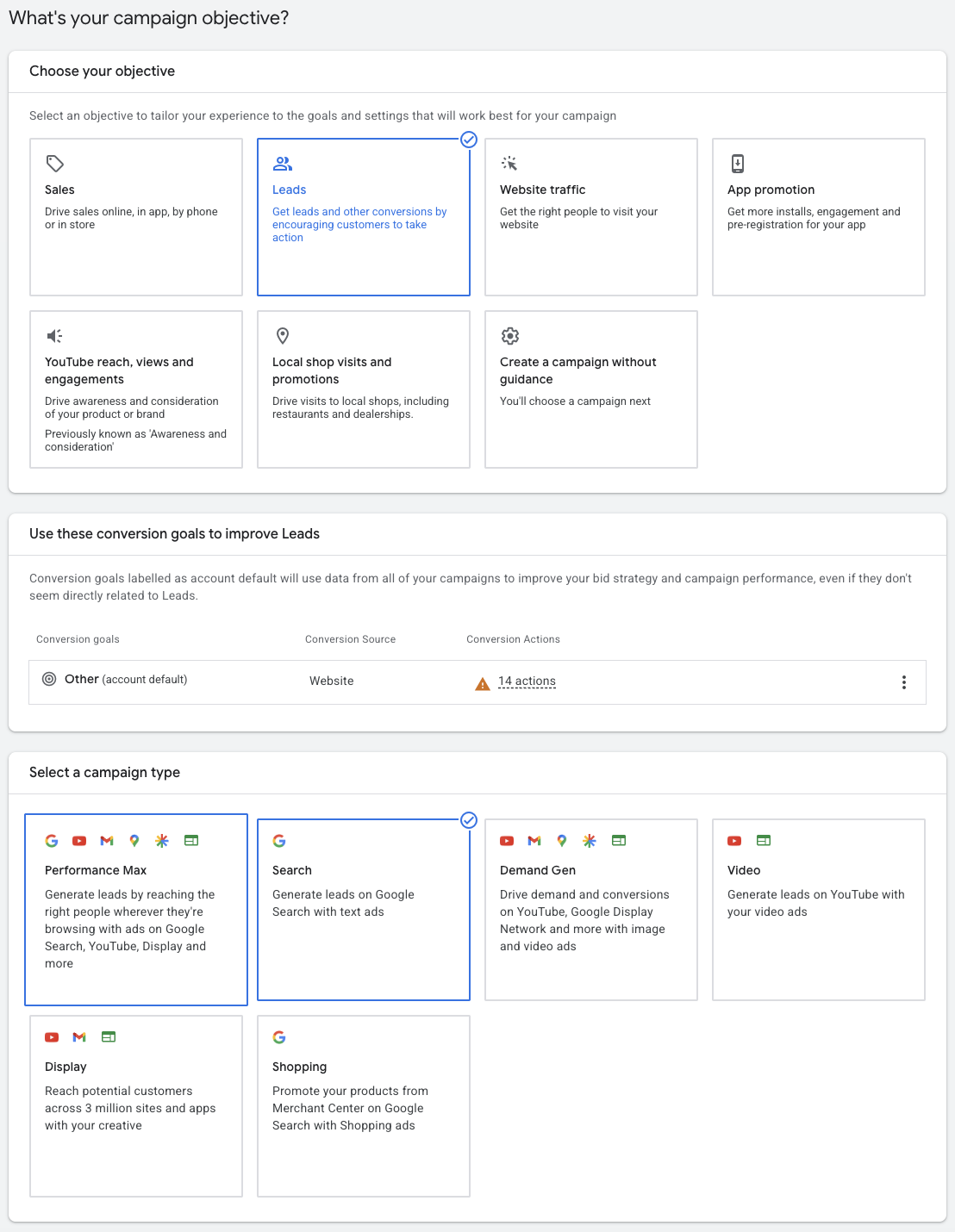
For bidding, start with Maximise Clicks (with a maximum cost-per-click bid limit) or Maximise Conversions — see "How Kick Ads does it" above — then move to Target CPA or ROAS once you have enough conversion data.
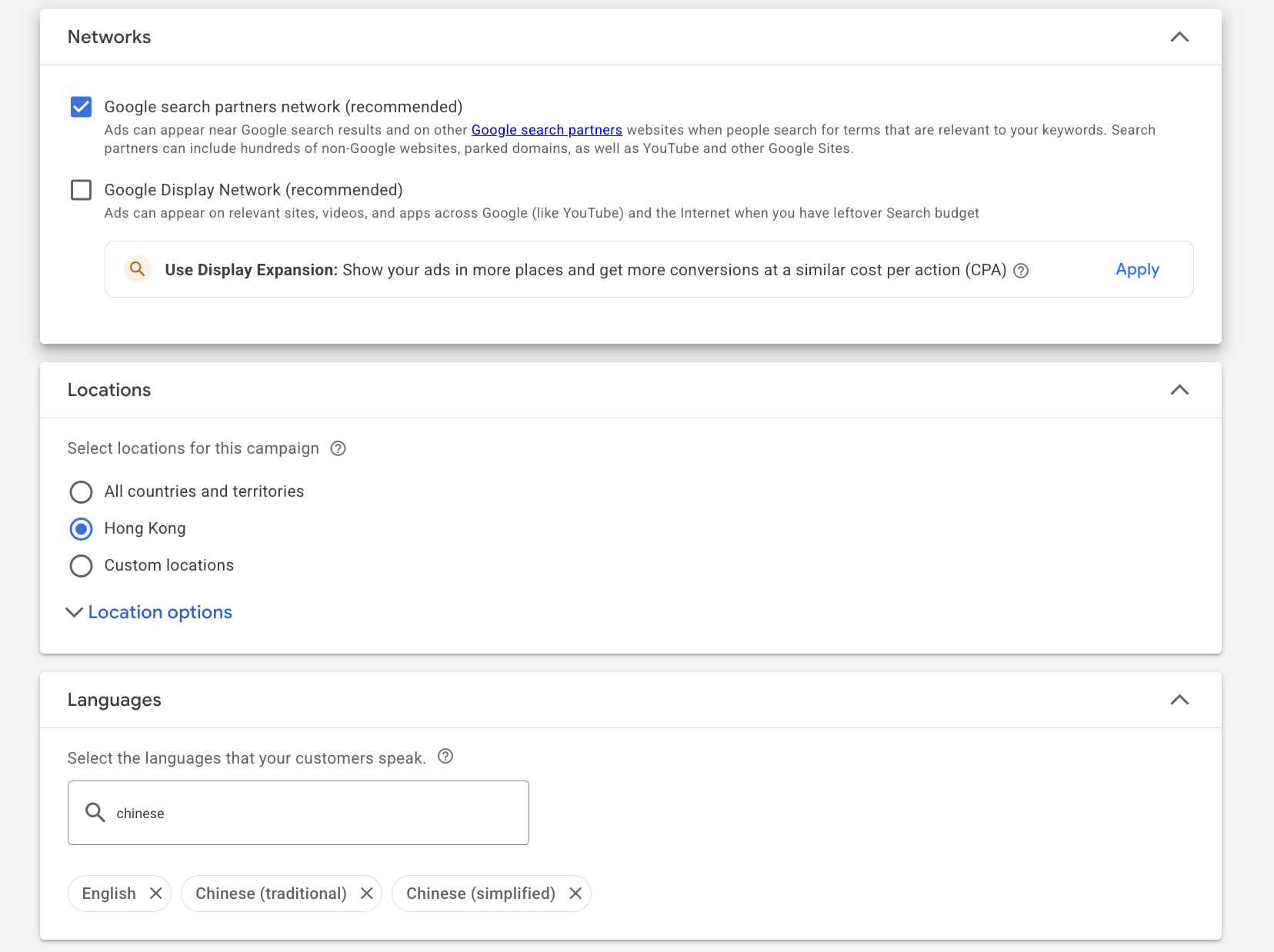
Set your budget, location and language (for Hong Kong, choose Chinese and English).
AI Max: on a brand-new account, leave it off to begin with — it needs accurate conversion tracking and negative keywords. Once the campaign has run for a while and the data is stable, then consider switching it on.
Step 3 — Ad group settings. Build ad groups, each focused on one tightly related theme or intent, so they map cleanly to ad copy and landing pages.
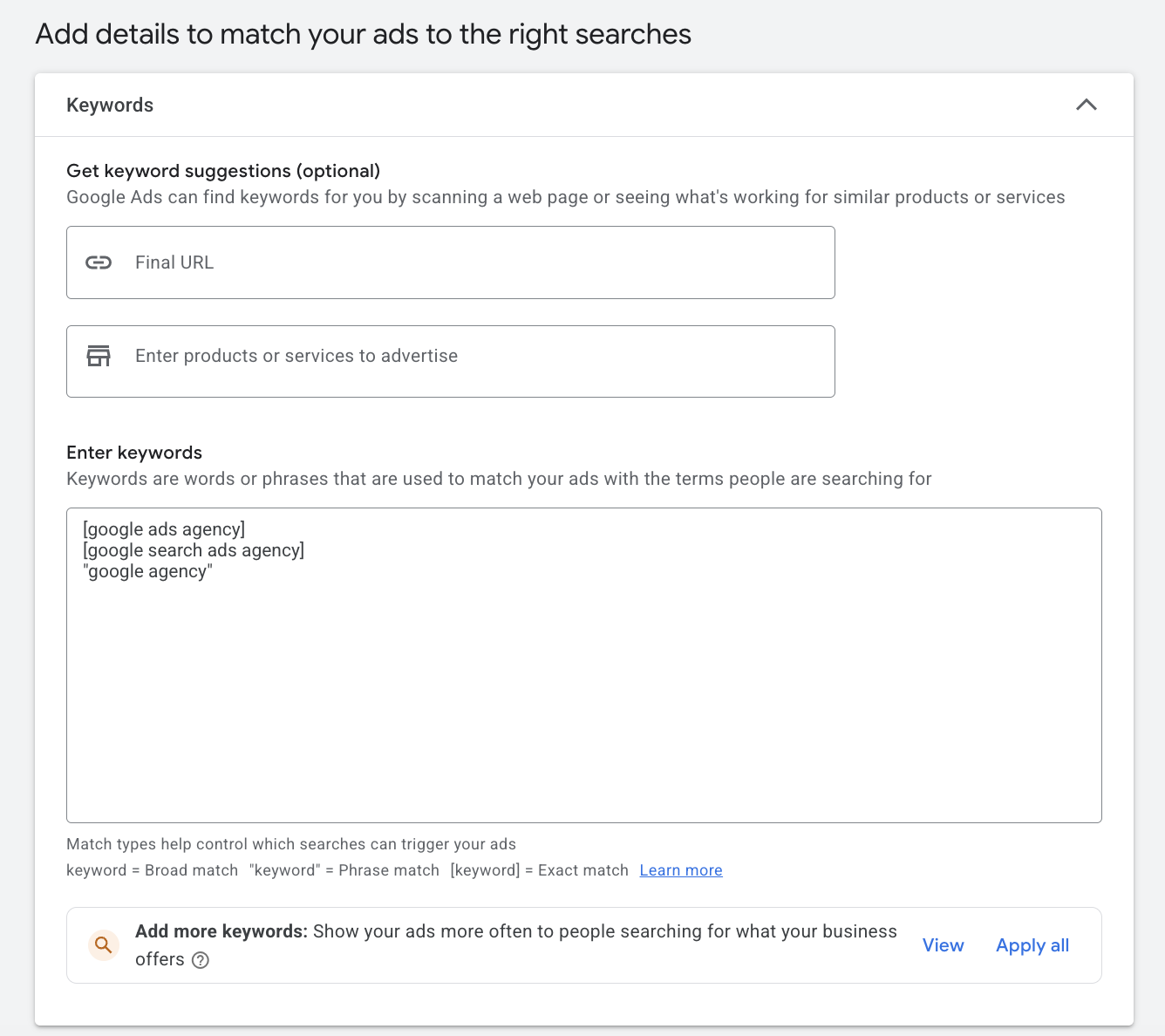
Step 4 — Keywords. Add tightly related keywords to the ad group and pick your match types.
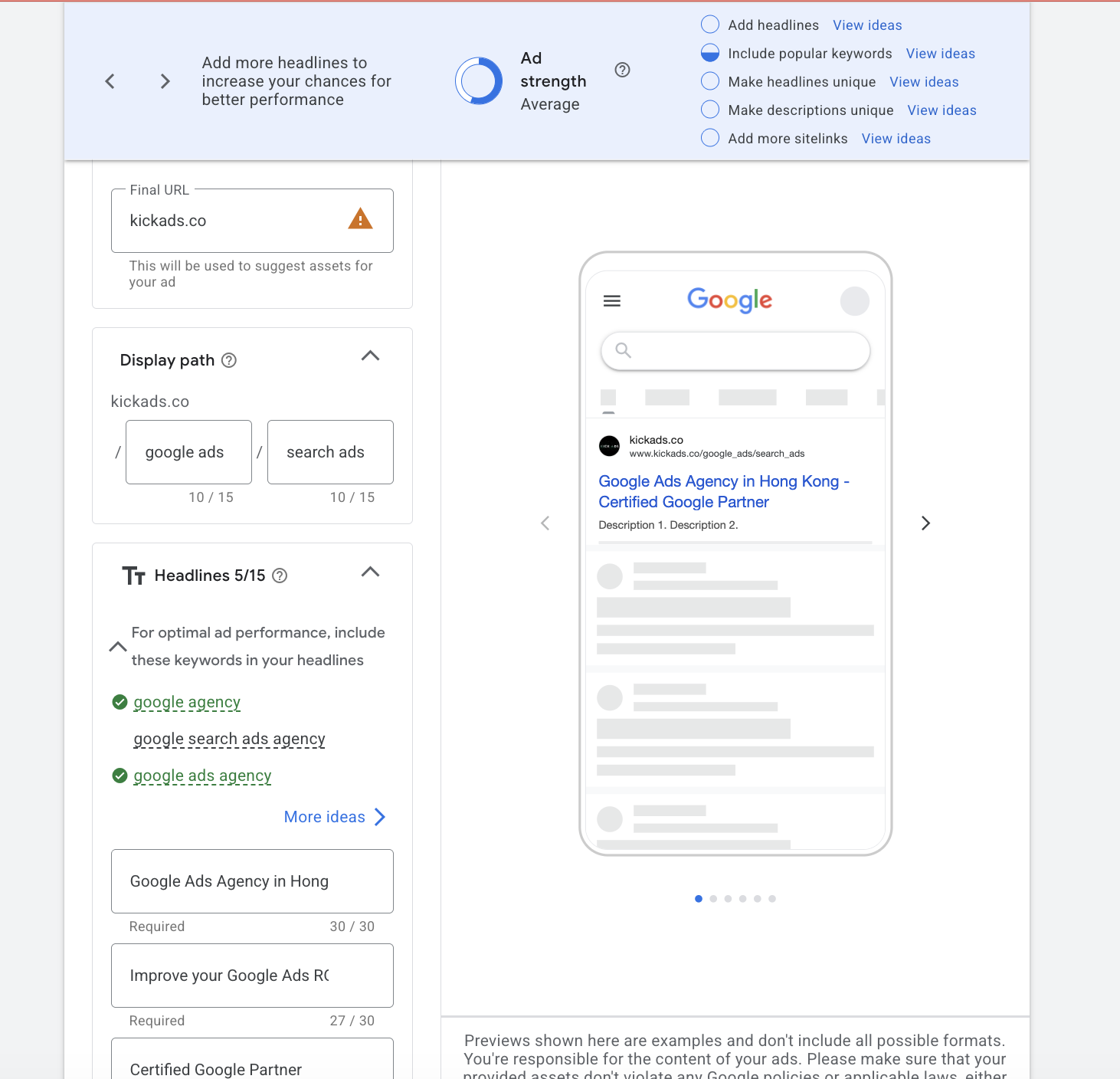
Step 5 — Write the RSA (Responsive Search Ad). Supply plenty of headlines and descriptions — on-topic, keyword-rich, with a clear CTA — and use pinning to control key messaging. The more relevant headlines you give it, the more room Google has to assemble a high-performing ad.
Here is what the format actually allows, from Google's responsive search ad documentation:
| Field | Character limit | Minimum | Maximum |
|---|---|---|---|
| Headline | 30 | 3 | 15 |
| Description | 90 | 2 | 4 |
Google shows a minimum of one headline and one description at a time, assembled from whatever you supplied, and it says pinning "isn't recommended for most advertisers and can affect ad strength" because it cuts the number of combinations available. Our own position is narrower than Google's: pin the one message you cannot afford to lose, such as a fee model or a licence, and leave everything else unpinned. For headline writing specifically, see our guide to writing Google text ad headlines.
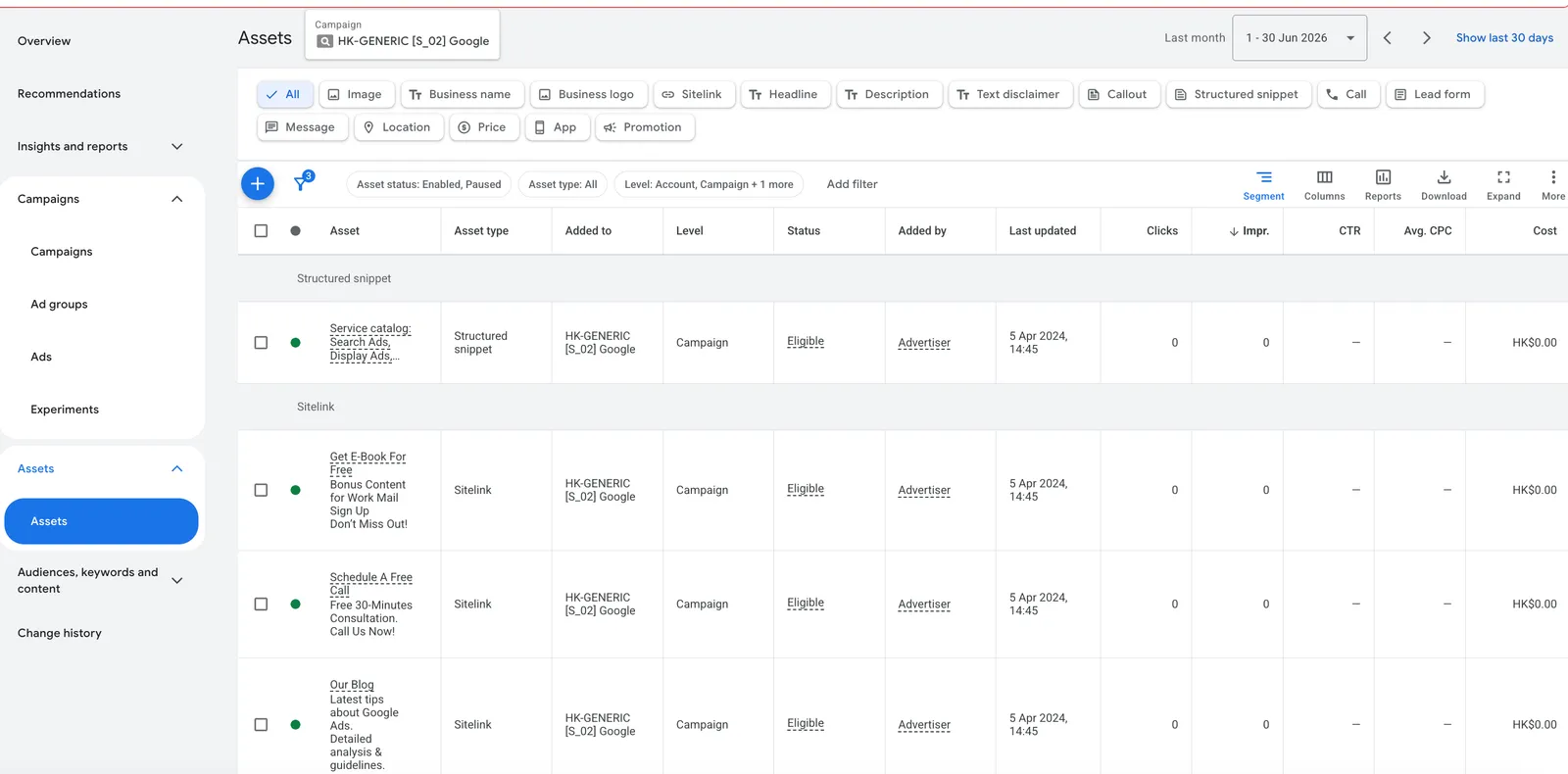
Step 6 — Add assets and negative keywords. Add sitelinks, callouts, call, location, price and other assets to enlarge your ad, lift its CTR and reinforce your message.
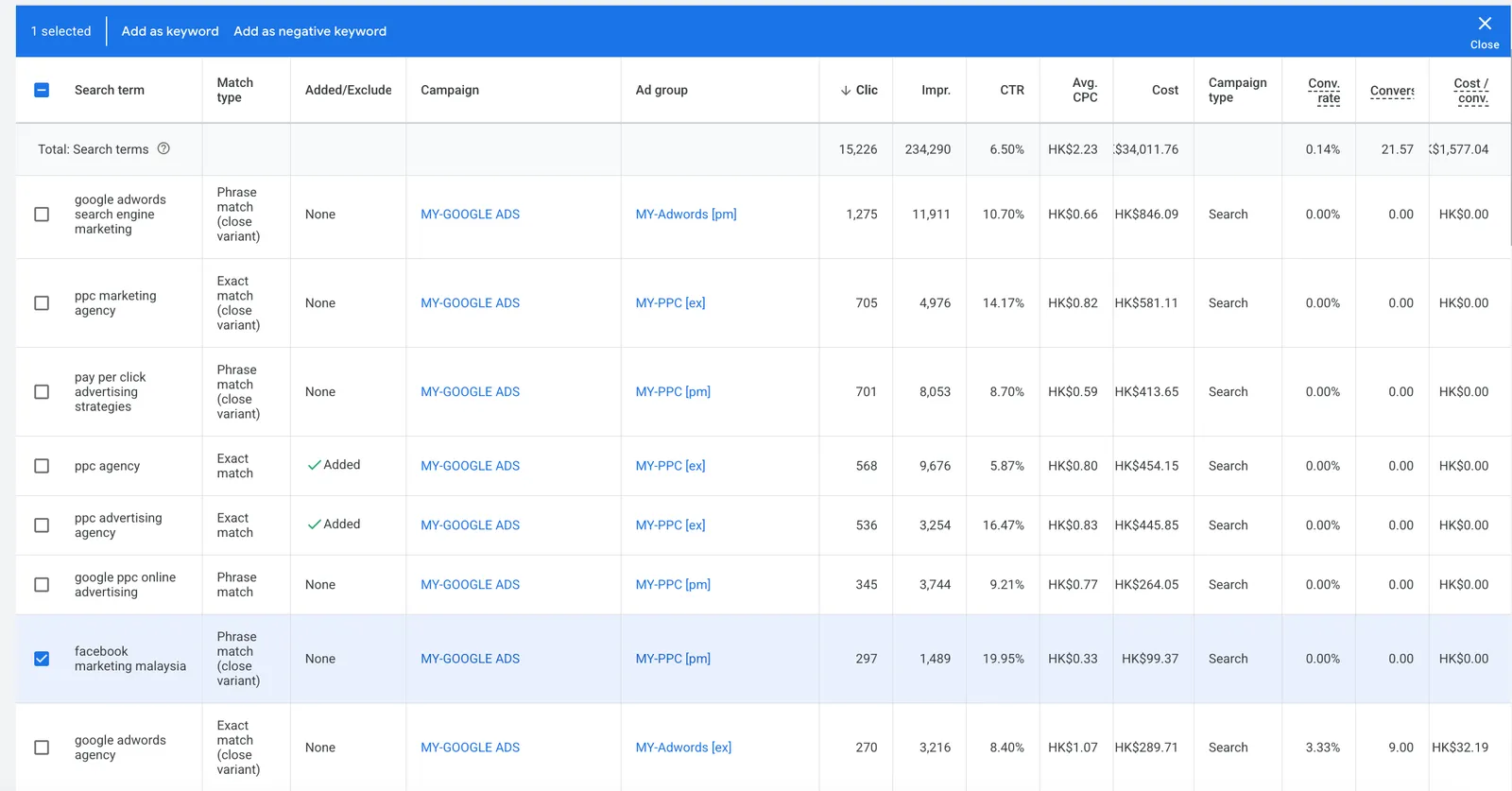
Then add negative keywords (for instance "free", "jobs" or "tutorial", if those aren't your target), and review the Search Terms Report regularly to keep adding them — that's how you stop wasted spend.
DIY, or hire an agency? How to choose a Google Ads / SEM agency in Hong Kong
Quick answer: With a small budget, time to learn and a simple product, running Google Ads yourself is entirely doable. But once spend reaches real scale, the vertical is competitive, or you'd rather spend your hours on the business itself, a specialist Google Ads agency in Hong Kong usually pays for itself — provided it's transparent with data, genuinely hands-on, and run by senior people.
When is an agency worth it?
- Monthly spend reaches a level where 10–20% wasted already exceeds the agency fee
- High-CPC, competitive verticals that need constant optimisation
- You need the full stack — landing pages, tracking, reporting — not just ads switched on
What to look for in a Hong Kong SEM agency?
- Is it a certified Google Partner?
- Do the reports explain what changed, why, and what's next — rather than a wall of impressions and clicks?
- Do senior people stay hands-on, or does the account get handed to juniors after onboarding?
- Is the pricing transparent?
If you would rather hand it over, our SEM management service for Hong Kong sets out what the weekly work covers and how the fee is structured.
Wondering whether your Search account has room to improve? Kick Ads is a Hong Kong certified Google Partner, founded by two ex-Googlers — senior people stay hands-on, and the reports get straight to the point and the next step. Get a free Paid Media Health Check — no sales pitch, just honest findings.
Real SEM results
Quick answer: SEM delivers for both problem-solving products and B2B/professional services. Here are real results from Kick Ads' Hong Kong accounts.
Ecommerce / retail. After we optimised the Search account for a sports retail/ecommerce client (H1 2026 vs H1 2025), ROAS rose about 96%, cost per conversion (CPA) fell about 48%, and orders climbed about 40%.
Professional services. For a medical/professional-services client, Search optimisation (H1 2026 vs H1 2025) lifted enquiries about 20% while cutting cost per enquiry (CPL) about 16%.
SEM glossary: the terms you will meet in the interface
Most SEM guides define two or three of these and leave the rest for you to work out from context. Here they all are.
| Term | What it means | The bit that catches people out |
|---|---|---|
| SEM | Search Engine Marketing. Paying to appear on a search engine's results page | It is a category, not a product. Google Ads is the product |
| PPC | Pay-per-click. The pricing model where you are charged per click, not per view | PPC and SEM are used interchangeably in Hong Kong, but PPC is only the billing model |
| CPC | Cost per click. What one click actually cost you | Your average CPC is usually below your max CPC bid |
| CPM | Cost per thousand impressions | Search ads are bought on CPC. CPM shows up on Display, YouTube and Demand Gen |
| CPA | Cost per acquisition. Ad spend divided by conversions | Only as trustworthy as your conversion tracking |
| CTR | Click-through rate. Clicks divided by impressions | A high CTR on the wrong query is a warning, not a win |
| Conversion rate | Conversions divided by clicks | Usually a landing page number, not an ads number |
| ROAS | Return on ad spend. Revenue divided by ad spend | Needs a value passed on the conversion, or it reports nothing |
| Quality Score | A 1 to 10 keyword-level diagnostic of expected CTR, ad relevance and landing page experience | Google says it is not an input to the auction. The three signals behind it are |
| Ad Rank | What decides whether your ad shows and in what position | Bid is one of six inputs, not the whole calculation |
| Impression share | The share of available impressions you actually received | Split it into lost-to-budget and lost-to-rank before acting on it |
| Match type | How closely a search must resemble your keyword to trigger the ad | Broad match in 2026 is a different feature from broad match in 2018 |
| Negative keyword | A term that stops your ad showing | The default is negative broad, which blocks more than people expect |
| RSA | Responsive Search Ad. Up to 15 headlines and 4 descriptions that Google assembles | The only text ad format left on Search |
| Smart Bidding | Target CPA, Target ROAS and Maximise Conversions, where Google sets bids per auction | It optimises to whatever your conversion tracking tells it, including the wrong thing |
| Search Terms Report | The actual queries people typed, as opposed to the keywords you bought | This is where negatives and new keywords come from |
People searching your company name see more than the ad: the Google Business Profile card sits alongside it. That card is free, and on a brand search it is one of the first things anyone reads, so it is worth getting right.
FAQ
What's the difference between SEM and SEO? SEM is pay-per-click keyword advertising — instant and controllable. SEO earns free organic rankings — slower, but it compounds. They complement each other.
How is SEM charged, and what's the CPC in Hong Kong? It's charged per click (PPC), with no flat rate. Hong Kong CPCs vary by industry, from roughly HK$1 in retail to HK$15–30 in beauty/aesthetics and overseas-study education.
How much budget does SEM need? There's no platform minimum, but to gather enough data to optimise, Hong Kong SMEs are generally advised to start around HK$10,000/month.
Can I run Google Ads myself? Yes — especially with a small budget and a simple product. But with a large budget, a competitive vertical, or limited time, a specialist agency usually pays off.
How long until SEM works? Ads can get impressions and clicks immediately, but gathering conversion data and letting Smart Bidding learn and stabilise usually takes a few weeks.
Will AI Overviews replace SEM? No. AI Overviews mainly eat organic clicks on informational searches; commercial and transactional searches still carry strong buying intent, so SEM holds up — and Google is folding ads into AI Overviews. The key is to concentrate on high-intent commercial keywords.
What is Google Ads? Google Ads (formerly Google AdWords) is Google's online advertising platform; its most common use is search keyword advertising — charged per click, bidding on the keywords your customers are searching on Google. It's one of the highest-intent paid channels there is.
How much do Google Ads cost in Hong Kong? They're charged per click (PPC) with no flat rate; the actual CPC depends on how competitive your industry is — from roughly HK$1 in retail to HK$15–30 in beauty/aesthetics and overseas-study education. For monthly budget, Hong Kong SMEs are generally advised to start around HK$10,000 so Smart Bidding has enough data to optimise.
Is Google Ads the same as SEM? Not quite. SEM is the category, meaning paid advertising on any search engine. Google Ads is the platform almost everyone means when they say SEM, and PPC is how you are charged. In Hong Kong the distinction is largely academic, because Google held 91.33% of search in June 2026.
What search engines matter for SEM in Hong Kong? Google, at 91.33% of Hong Kong search in June 2026 per StatCounter. Yahoo was 3.05%, Bing 2.94% and Baidu 0.34%, so Microsoft Advertising is a small test on high-value keywords rather than a second channel.
How is Ad Rank calculated? Google lists six inputs: your bid, the quality of your ads and landing page, the Ad Rank thresholds, how competitive the auction is, the context of the search, and the expected impact of your assets and ad formats. Bid is one of six, which is why relevance often beats spending more.
Is Quality Score used in the ad auction? No. Google states that Quality Score is not an input in the auction and is a diagnostic tool. The three signals behind it, expected click-through rate, ad relevance and landing page experience, do affect the auction and do lower your CPC.
How many negative keywords should I add? As few as will do the job, and none until you have checked what they block. Run the list against your own 12-month search terms export first: if the terms it would block convert at or below your account average CPA, they are producing sales and should stay.
How many headlines does a responsive search ad need? At least 3 and up to 15 headlines of 30 characters, plus at least 2 and up to 4 descriptions of 90 characters. Google advises against heavy pinning because it reduces the combinations it can test.
Want to know if your Search campaigns are structured to win the right clicks? We can review your keywords, match types and account structure to cut the wasted spend. Message us on WhatsApp or book a free strategy call →.

About the author
Frankie Chan · Co-Founder, Kick Ads
Frankie is an ex-Googler and paid media strategist. He has managed Google Ads and Meta Ads for ecommerce and lead generation businesses across Hong Kong and Malaysia since 2017, working closely on strategy, reporting and client growth planning.