
Google Ads Bidding Strategies: The 2026 Guide
By Terrence Chung, Co-Founder · Updated 30 July 2026 · 15 min read
Jump to section
- How many bidding strategies does Google Ads have?
- Bidding strategies at a glance
- Manual or automated? How to choose in 2026
- Strategies built around conversions
- Strategies built around conversion value / ROAS
- Strategies built around traffic / visibility
- Manual and transitional strategies
- The 2026 direction: Smart Bidding × broad match × AI Max
- August 2026: a major Target CPA / ROAS update
- Reading the gap between actual ROAS and your target
- How much conversion data do you need before you set a target?
- Switching a campaign to Target CPA: what actually happens
- How to choose the right bidding strategy
- Conclusion
- FAQ
Your bidding strategy decides how Google bids for you in every auction — and it directly shapes your cost per click, your conversion volume and your return. In 2026, the choice is no longer "manual or automated"; it's "which automated strategy, matched to which goal." This guide breaks down each bidding strategy, where it fits, and gives you a simple framework for choosing.
Quick answer: A Search campaign in Google Ads gives you seven bid strategies to choose from: Target CPA, Target ROAS, Maximise conversions, Maximise conversion value, Maximise clicks, Target impression share and Manual CPC. Google split Target CPA and Target ROAS back out as standalone options in June 2026, having previously presented them as optional targets tucked inside Maximise conversions and Maximise conversion value. Enhanced CPC has been switched off since March 2025.
How many bidding strategies does Google Ads have?
Seven, if you mean the options a Search campaign actually lets you select. Guides promising "11 bidding strategies" or "12 bidding strategies" pad the count with Enhanced CPC, which Google retired, and with the CPM, viewable CPM, target CPM and CPV strategies that only appear on Display, video and reservation buys. The Search list, in full:
| Bid strategy | What you set | What Google optimises for | Status |
|---|---|---|---|
| Target CPA (tCPA) | The cost per conversion you are willing to pay | As many conversions as it can buy at that cost | Standalone option again since June 2026 |
| Target ROAS (tROAS) | The return on ad spend you want | As much conversion value as it can buy at that ratio | Standalone option again since June 2026 |
| Maximise conversions | A budget, no target | Conversion count within the budget | Live |
| Maximise conversion value | A budget, no target | Total conversion value within the budget | Live |
| Maximise clicks | A budget, optionally a max CPC cap | Click volume | Live |
| Target impression share | A position, and the share of impressions you want to hold there | Holding that position | Live |
| Manual CPC | Every keyword bid, by hand | Nothing. You do the bidding | Live |
| Enhanced CPC (eCPC) | n/a | n/a | Retired March 2025 |
The June 2026 rename was cosmetic. Google says campaigns bid exactly as they did before and nobody had to touch an account. It does change how an account reads at a glance, though: a campaign labelled "Target CPA" is running to a target, and you can now see that from the campaign list without opening the bid settings. (Source: Google Ads Help on the Smart Bidding reorganisation)
Bidding strategies at a glance
Which Google Ads bidding strategy should I use? For a brand-new campaign, start with Maximise Conversions to build data. If you have a target cost per acquisition, use Target CPA (tCPA). For ecommerce where conversions carry different values, use Target ROAS (tROAS). If the goal is brand defence or traffic rather than an immediate conversion, use Maximise Clicks.
| Strategy | Goal | When to use | Control level |
|---|---|---|---|
| Maximise Conversions | Most conversions within budget | New campaigns building conversion data fast; sets no cost ceiling, so watch your cost per conversion | Automated |
| Target CPA (tCPA) | Most conversions at a set cost per acquisition | Stable conversion data of similar value, typically lead generation | Automated, cost-controlled |
| Maximise Conversion Value | Highest total conversion value within budget | Ecommerce and revenue-focused accounts | Automated |
| Target ROAS (tROAS) | Most conversion value at a set return on ad spend | Ecommerce with plenty of conversion-value data | Automated, return-controlled |
| Maximise Clicks | Most clicks within budget | New sites gathering traffic, or before you have enough conversion data | Automated, traffic-only |
| Manual CPC | You set the bid for every keyword (Enhanced CPC retired March 2025) | Tiny budgets or accounts without conversion tracking yet | Manual |
Manual or automated? How to choose in 2026
Quick answer: In 2026, most accounts should lead with Smart Bidding. As long as you have accurate conversion tracking and enough conversion volume, automated bidding almost always beats manual — it adjusts each bid to the likelihood of a conversion in real time, which no human can do. Manual bidding is now mainly for thin-data or high-control edge cases.
Smart Bidding uses Google's machine learning, weighing a huge range of live signals — device, time of day, location, audience — to set each bid. There's one prerequisite: accurate conversion tracking. Without it, automated bidding is flying blind.
Strategies built around conversions
Quick answer: If you want more conversions (enquiries, sign-ups, sales), use Maximise Conversions or Target CPA (tCPA).
Maximise Conversions: gets you as many conversions as possible within your budget. Good for newer campaigns building up conversion data fast; the trade-off is that it sets no cost ceiling, so watch your cost per conversion.
Target CPA (tCPA): gets as many conversions as it can at the target cost-per-acquisition you set. Since June 2026 it appears as its own bid strategy again, after several years of living as an optional target inside Maximise Conversions. The bidding behaviour is unchanged either way. Best for campaigns with stable conversion data where each conversion is worth roughly the same — typical of lead generation. Start from a slightly looser target and tighten it once performance stabilises.
Strategies built around conversion value / ROAS
Quick answer: If your conversions are worth different amounts (say, ecommerce orders of varying size), use Maximise Conversion Value or Target ROAS (tROAS).
Maximise Conversion Value: aims for the highest total conversion value within budget, rather than raw conversion count. Suited to ecommerce and any account that cares about revenue, not just volume.
Target ROAS (tROAS): chases the most conversion value at the return-on-ad-spend target you set. Like tCPA, it is a standalone option again as of June 2026, having spent several years as an optional target inside Maximise Conversion Value. Best for ecommerce with plenty of conversion-value data. A caveat: set the target too high, or apply tROAS before you have enough data, and it will throttle your reach and hurt overall performance — move gradually.
Strategies built around traffic / visibility
Quick answer: If the goal isn't an immediate conversion but traffic or placement, use Maximise Clicks or Target Impression Share.
Maximise Clicks: brings the most clicks within budget. A reasonable stopgap for a new site building traffic, or before you have enough conversion data to support conversion-based bidding; the downside is it only counts clicks, not quality.
Target Impression Share: keeps your ad showing at a set share of impressions in a chosen position (for example, the very top of the results). Best for brand defence — making sure your own brand searches aren't overshadowed by competitors.
Manual and transitional strategies
Quick answer: Manual and semi-automated strategies are mostly transitional or special-purpose in 2026; unless you have a specific reason, a typical account doesn't need them.
Manual CPC: you set the bid for every keyword. Maximum control, but you can't respond to each auction in real time and it's very labour-intensive. These days it's mainly for tiny budgets or accounts where conversion tracking isn't built yet.
Enhanced CPC (eCPC) — retired: the old halfway house that nudged manual bids up or down by conversion likelihood was switched off completely in March 2025. If a guide or an old account note still recommends it, that advice is out of date — go straight to full Smart Bidding.
CPM / tCPM: charged per thousand impressions rather than per click, for awareness-focused Display or video campaigns (such as YouTube ads) — not performance-focused search.
The 2026 direction: Smart Bidding × broad match × AI Max
Quick answer: The combination Google pushes hardest in 2026 is broad match to widen reach, Smart Bidding to filter for value using conversion data, and AI Max to automate search ads further.
Two supporting tools are worth knowing as accounts scale: portfolio bid strategies let several campaigns share one tCPA or tROAS target (useful when no single campaign has enough conversion data on its own), and seasonality adjustments tell Smart Bidding in advance about short, sharp conversion-rate spikes — a flash sale, a holiday promo — so the algorithm doesn't misread them.
This combination is powerful, but it hands more control to the machine. The prerequisite for using it well is still accurate conversion tracking and a clear goal — otherwise the system will faithfully optimise toward the wrong one. Kick Ads recommendation: don't mistake the “direction” for a guarantee. Broad match plus AI Max will match your ads to a huge volume of loosely related — sometimes completely irrelevant — search terms. Smart Bidding is supposed to steer spend toward the valuable ones, but in practice the search terms report is often frightening: plenty of junk queries still eat budget. The test that matters most: did your actual ROAS / CPA genuinely improve at the same or higher volume? Compare real before-and-after results, not Google's automated recommendations or how much was spent. Pull the search terms report regularly, add negative keywords aggressively, and feed Smart Bidding clean conversion signals. Broad match + AI Max only pays off when your conversion data is clean and you actively prune the search terms.
For the latest on AI Max and search ads, see our SEM / Google Ads complete guide.
August 2026: a major Target CPA / ROAS update
From 17 August 2026, Google changed how target-based bid strategies (Target CPA, Target ROAS) behave when a campaign is budget-limited. Previously, budget-limited campaigns often significantly outperformed the target you set — for example, a $10 Target CPA campaign actually delivering a $5 CPA. After the change, they will perform more consistently toward the target you set.
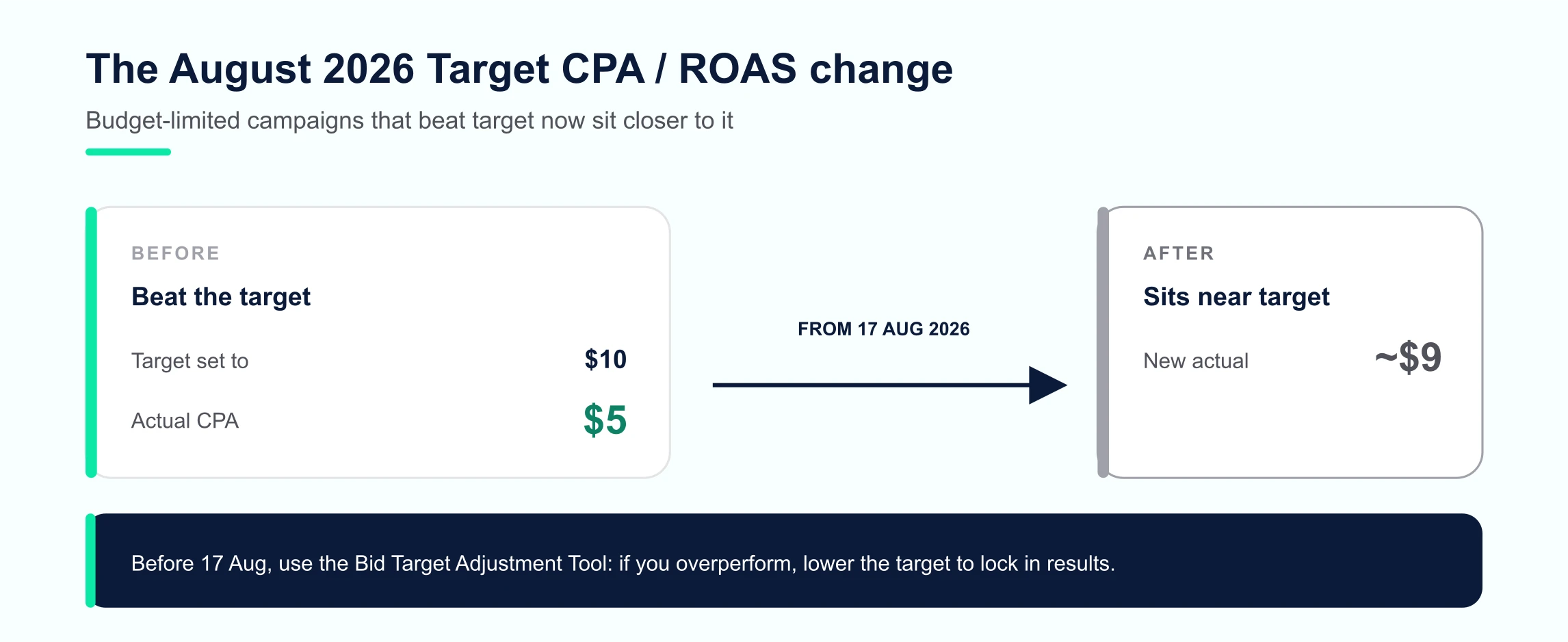
In plain terms: if your campaign has been "coming in cheap" (well below target), its cost will now drift back up toward the target unless you act.
Scope: Search, Shopping, Performance Max, Demand Gen, Display, Hotel and Travel (App and Video campaigns are unaffected; Display and Hotel already used the new behaviour).
What you should do: Google launched the Bid Target Adjustment Tool on 6 July 2026 so you can review historical performance and update targets before 17 August. If you've been overperforming, the cleanest move is to lower the target to match your recent actual CPA / ROAS and lock in current results; otherwise you can keep the target (accepting higher cost for more volume), switch strategies, or raise the budget to scale at the stated target. (Source: Google Ads Help)
Reading the gap between actual ROAS and your target
Once you accept that a budget-limited target campaign will now track the target you set, the more useful habit is to read the distance between your actual ROAS and that target. The size and direction of the gap tell you which way the target is mis-set.
When actual runs far above target, say you set 3x and the account reports 15x, the target isn't binding at all. Google is free to chase volume, and in a strong period it hands you a high ROAS "for free" without the target ever getting in the way. When actual instead sits right on the target, the target has become the ceiling. On Search and Shopping you can usually read it off the shape of the numbers: impression share lost to rank starts climbing and volume flattens, because the strategy is quietly lowering bids to protect the ratio. So "actual ≈ target" is not automatically the good outcome people assume; more often it means the headroom is gone.
This pattern shows up clearly in live accounts. Across three retail accounts we manage, most campaigns in May ran on very low targets (low single-digit x) or none at all, yet actual ROAS came in at mid-teens to thirty-something in peak season. By July the targets had been raised to roughly 10–15x; against a softer period, actual ROAS promptly compressed back toward target, total conversion value fell by 30–50% on essentially flat spend, and Search/Shopping campaigns began losing impression share to rank. The drop was concentrated in exactly the campaigns whose targets had been raised.
The 17 August change matters here for a specific reason. Before it, setting a deliberately low target on a budget-limited campaign was a way of saying "spend freely and keep whatever ROAS the auction gives me." After it, a low target will actually pull your ROAS down toward it, with more volume as the trade. You can no longer set a low target and expect a high ROAS to survive. Roughly speaking, from now on the target you set is close to the ROAS you will get, so set it at the return you are genuinely willing to run at, not as a loose floor you never expected to touch.
That reshapes the cleanest setup for a budget-limited account whose reported ROAS sits well above breakeven, common in retail and ecommerce where the account reports 10x or more against a breakeven nearer 3x. In accounts like these it is often worth running the strongest campaigns on Maximise Conversion Value with no target, and using the daily budget as your control lever instead of a ratio. A no-target strategy is not a target-based strategy, and the 17 August change applies only to target-based strategies, so it sits outside its scope; it simply keeps maximising value within the budget you allow. Keep a target only where you have a real efficiency floor to defend, and when you do, set that target at the floor rather than above what the account already delivers on its own.
Two honest caveats, so none of this reads as a free lunch:
- Going no-target does not remove the risk of a lower ROAS. It moves your control from the target to the budget, so you have to set budgets deliberately and keep checking that ROAS stays above your profit floor.
- A large share of very high reported ROAS, especially on brand and PMax, is existing-demand capture rather than incremental sales. When you open up volume, judge the result on incremental or blended numbers, not the headline ROAS the platform shows you.
How much conversion data do you need before you set a target?
Enough that the target is grounded in something. Google publishes a minimum for Target ROAS, and it is not the same number for every campaign type:
| Campaign type | Google's stated minimum for Target ROAS |
|---|---|
| Search and Shopping | 15 conversions in the past 30 days |
| Display | 15 conversions carrying values in the past 30 days, counted across all your campaigns together |
| Demand Gen | 50 conversions in the past 35 days, at least 10 of them in the past 7 days |
| App | roughly 10 conversions a day, or 300 in 30 days |
Target CPA has no equivalent hard gate, but Google's guidance on judging it is to measure the last 30 days with at least 30 conversions in that window. Under those volumes, a target is a number the algorithm has to obey without enough evidence behind it, which is how campaigns end up throttled.
Then leave it alone for a while. The bid strategy status can sit in "Learning" for up to three weeks, or one to two conversion cycles, and each target change restarts that clock. Three tweaks in a fortnight and the strategy never finishes learning. (Sources: Target ROAS bidding, Target CPA bidding, learning period duration)
Switching a campaign to Target CPA: what actually happens
Moving a campaign off manual bidding onto Target CPA (tCPA) isn't an overnight win. It usually plays out like this: first accumulate enough conversion data (ideally a steady flow over the last 30 days), start with a slightly loose target so the system has room to learn, then tighten it in a few steps. Done right, as the algorithm learns to bid up on high-probability auctions and pull back on weak ones, conversions tend to climb while the cost per action settles — and, just as usefully, you stop hand-adjusting bids keyword by keyword, freeing that time for strategy and creative.
Two conditions are non-negotiable, though: first, conversion tracking must be clean and accurate — tCPA follows your conversion data completely, so if the data is wrong it optimises toward the wrong thing. Second, remember the August 2026 change above: if your tCPA has been running below target, cost will drift back to target after the change, so proactively adjust the target to match recent actual performance.
How to choose the right bidding strategy
Quick answer: Ask three questions. One: what's your goal — conversions, value, or traffic? Two: do you have accurate conversion tracking? Three: how much conversion data have you built up? The answers point to your strategy.
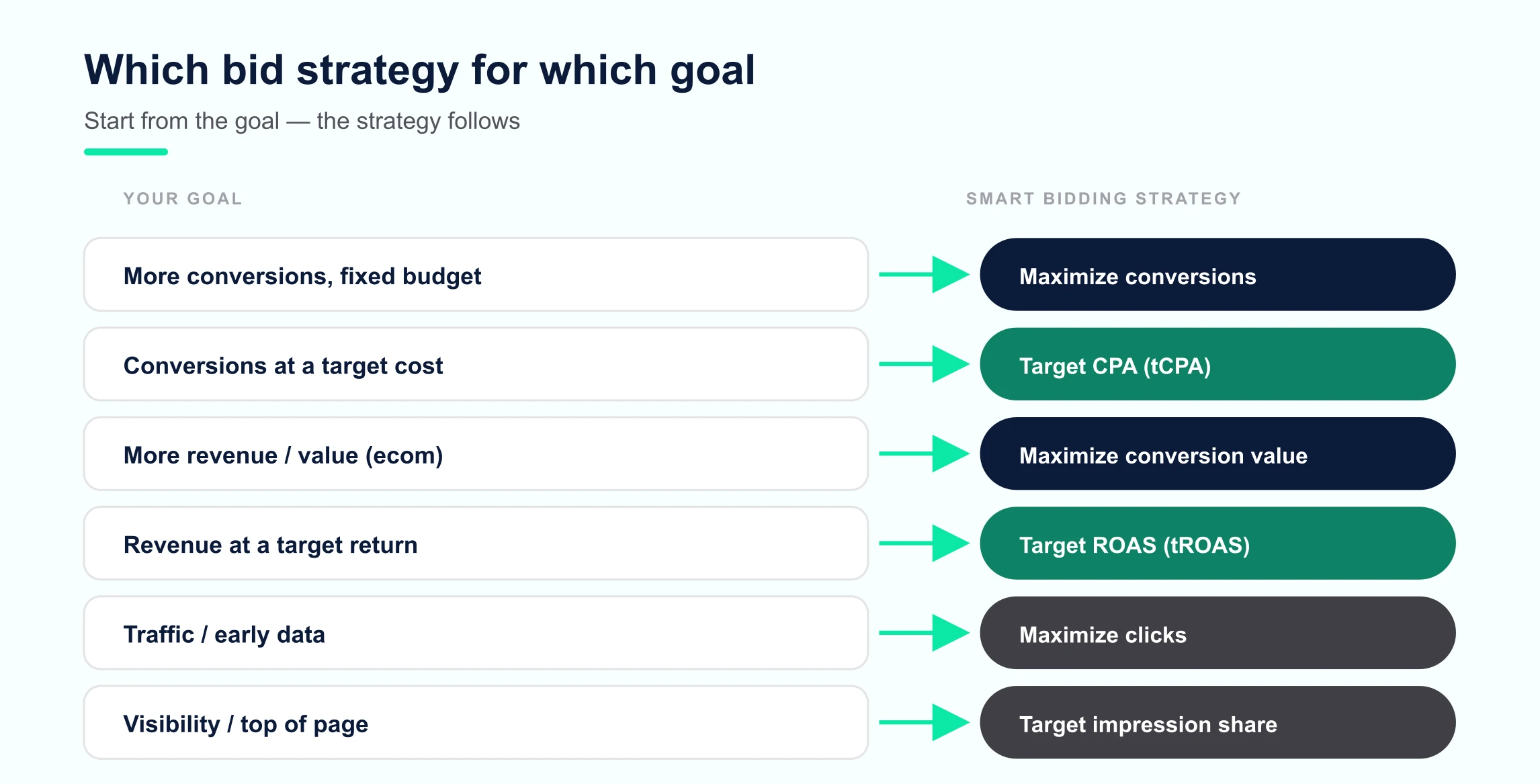
A practical decision order:
- No conversion tracking yet? Build it first; in the meantime use Maximise Clicks to drive traffic and gather data.
- Goal is conversion volume, with similar per-conversion value (usually lead-gen)? Start with Maximise Conversions, then move to Target CPA once data is stable.
- Goal is revenue, with varying conversion value (usually ecommerce)? Start with Maximise Conversion Value, then move to Target ROAS once you have enough data.
- Just holding your brand placement? Use Target Impression Share.
Give each strategy at least a week or two to learn, and avoid frequent changes that reset the learning phase.
Conclusion
In 2026, bidding is less about "manual vs automated" and more about pointing the right automated strategy at the right goal. Get clear on the goal, build accurate conversion tracking, gather enough data, then choose using the framework above, and give the system time to learn. Do that, and Smart Bidding will genuinely work every dollar of your budget for the best return.
FAQ
What bidding strategies does Google Ads offer? They fall into: conversion goals (Maximise Conversions, Target CPA), value goals (Maximise Conversion Value, Target ROAS), traffic/visibility goals (Maximise Clicks, Target Impression Share), and manual/special-purpose options (Manual CPC, CPM/tCPM). Enhanced CPC was retired in March 2025.
Is manual or automated bidding better? In 2026, as long as you have accurate conversion tracking and enough conversion data, Smart Bidding almost always beats manual, because it adjusts each bid to live auction signals. Manual bidding is mainly for thin-data or high-control situations.
What's the difference between Target CPA and Target ROAS? Target CPA controls the cost per conversion and suits conversions of similar value (like lead-gen); Target ROAS controls the revenue return per dollar spent and suits ecommerce with varying conversion values. One watches cost, the other watches return.
Which bidding strategy should a new campaign use? If conversion tracking isn't built, start with Maximise Clicks to gather data. Once it's built, lead-gen can start on Maximise Conversions and ecommerce on Maximise Conversion Value, moving to Target CPA or Target ROAS as data accumulates.
How many bidding strategies does Google Ads have? Seven that a Search campaign lets you select: Target CPA, Target ROAS, Maximise conversions, Maximise conversion value, Maximise clicks, Target impression share and Manual CPC. Display, video and reservation campaigns add CPM, target CPM, viewable CPM and CPV. Lists of 11 or 12 usually include Enhanced CPC, which Google retired in March 2025.
How many conversions do I need before switching to Target ROAS? For Search and Shopping campaigns, Google's stated minimum is 15 conversions in the past 30 days. Display needs 15 with conversion values across all campaigns combined, Demand Gen needs 50 in the past 35 days, and App campaigns need roughly 300 in 30 days.
What is the main benefit of automated bidding? Auction-time bidding. Smart Bidding sets a bid for each individual auction using live signals such as device, location, time of day and audience, which a person adjusting keyword bids by hand cannot do at that frequency or granularity.
Why is my Smart Bidding underperforming? The usual causes are inaccurate conversion tracking, too little conversion data for the machine to learn from, or a target (such as tROAS) set too aggressively. Make sure tracking is accurate, allow a proper learning period, and adjust targets gradually.
Not sure your tROAS or Maximise Conversions targets are set right? We can review your bidding setup and conversion data to make sure the machine has what it needs. Message us on WhatsApp or book a free strategy call →.

About the author
Terrence Chung · Co-Founder, Kick Ads
Terrence is an ex-Googler, paid media and SEM trainer. He has managed Google Ads for ecommerce and lead generation businesses across Hong Kong and Malaysia since 2017, working closely on account strategy and optimisation direction.