
Performance Max vs Standard Shopping: The Ecommerce Verdict (2026)
By Frankie Chan, Co-Founder · Updated 24 July 2026 · 7 min read
Updated July 2026 — this is an ecommerce-only comparison of Performance Max and Standard Shopping. It combines a clearly labelled 2022–2023 study from one of our ecommerce accounts with what we are currently seeing across the ecommerce accounts we manage. If you run a store and are choosing between the two, the short verdict is at the end.
For the full Performance Max guide, see our complete Performance Max guide. This post narrows in on one question: for ecommerce, does Performance Max beat Standard Shopping?
Performance Max campaigns and Google Shopping Ads (Standard Shopping) can both help retailers promote online products and local inventory — driving traffic and, for ecommerce, driving real sales.
From Shopping-led to Performance Max overtaking
When Performance Max first launched, Google Shopping Ads were often more effective — because Performance Max was a “black box”: you couldn’t see where ads showed, how assets were combined, and the data was very limited. The real turning point was Google gradually opening that black box.
In October 2023, Google introduced search themes to improve Performance Max — see “Optimize Performance Max with search themes for improved traffic”. Since then, Google has kept chipping away at the “black box” criticism: Performance Max now supports campaign-level negative keywords, brand exclusions and channel-level performance reporting, so you can finally see which surfaces your budget goes to.
How do Performance Max and Google Shopping Ads work?
The setup for Performance Max and Google Shopping Ads in ecommerce is quite similar. You share the product data through Merchant Center and set up a campaign within Google Ads. Google then uses the campaign and product data to create ads across Google platforms and various websites. Since they are so similar, why is there a gap in performance between the two?
Performance Max is an automated campaign built on audience signals that aims to win more conversions. Using machine learning and automation, it maximises performance across Google surfaces such as YouTube, Display, Search, Discover, Gmail and Maps. It analyses inputs like budget, product feed, audience data, creatives, images and videos to show ads to the most conversion-worthy audience at the most opportune time.
Google Shopping Ads is a campaign type designed specifically for retailers to promote products online, showing detailed product information before users click. Rather than relying on keywords, it is built from the product data supplied via Google Merchant Center. These ads showcase the title, price, store name, images and other attributes, so the quality of your feed directly determines how relevant the ads are to a user's search — and the visual listing gives shoppers a clearer sense of the product. For setup details, see our complete guide to Google Shopping Ads.
Why Performance Max tends to win for ecommerce
There is no guaranteed winner, but as Google Ads has grown smarter we have consistently seen Performance Max outperform Standard Shopping for ecommerce. The advantages fall into three areas.
- Broader audience and enhanced visibility
Performance Max spans every Google Ads placement. Beyond Search, it includes YouTube, Gmail, the Google Display Network (GDN) and the Discover feed, increasing exposure to potential customers and breaking the placement limits of Standard Shopping. It also offers a wider variety of formats — display, text and video ads.
- Maximise your conversions
Performance Max incorporates AI-driven features that Standard Shopping lacks, such as audience signals, final URL expansion and new customer acquisition goals. It automatically optimises bids, audience targeting, creative combinations and placements against your CPA/ROAS goals — the automated equivalent of picking a Search bidding strategy. In Standard Shopping you pay on a cost-per-click (CPC) basis, and a low CPC bid relative to competitors can throttle delivery. Performance Max uses Smart Bidding to adjust bids and budgets across placements and generally wins conversions at a lower CPA.
- Creative optimisation
Performance Max automatically generates ads from additional creative assets (headlines, descriptions, images, videos, extra information, URLs and more), organised into asset groups alongside the Merchant Center product data. This enables sharper predictions about which ads, audiences and creative combinations perform best. Standard Shopping is built only from the Merchant Center feed, with no additional creative, so the ads can look monotonous. Asset-group reporting also lets you review which groups drive the campaign, so you can see which assets engage the audience and drive conversions.
What our 2026 ecommerce portfolio shows
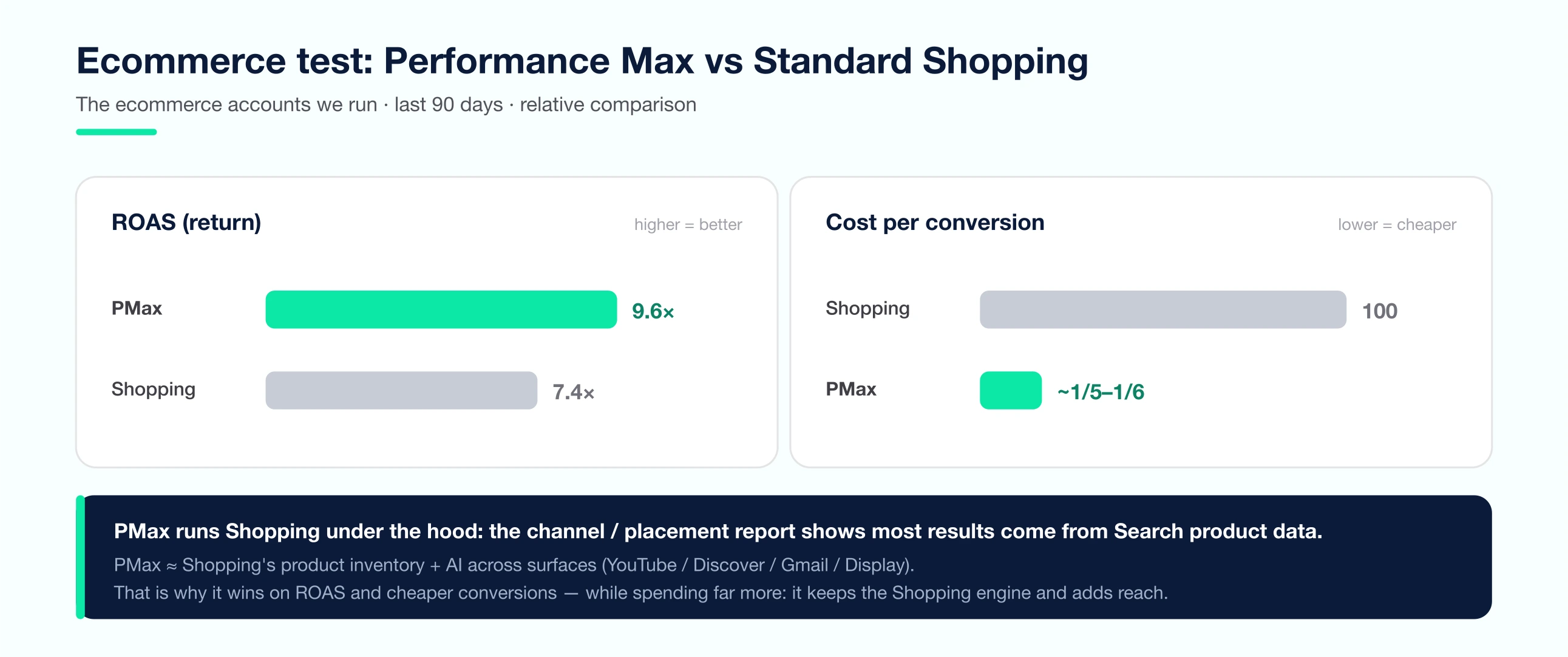
This “Performance Max overtakes Shopping” pattern has held and widened across our own book. Across the ecommerce accounts we run, over the last 90 days Performance Max returned roughly a 9.6× ROAS versus about 7.4× for Standard Shopping — and it did so at a much lower cost per conversion, roughly one-fifth to one-sixth of Standard Shopping's. In other words, PMax won on both efficiency measures at once: a higher return and cheaper conversions. Its cost per conversion also sits far below what the same campaign type produces in our lead-generation accounts.
Here is the part that matters most. When you open Performance Max's channel and placement report, the large majority of its results actually come from Search with product data — product listings on Google Search, which is Standard Shopping inventory. For ecommerce, Performance Max and Shopping are not rivals: Performance Max is largely Shopping's inventory plus AI across more surfaces (YouTube, Discover, Gmail, Display). That is why it tends to win on ROAS while also spending far more — it keeps the Shopping engine and adds reach on top.
When to lean Performance Max, and when to keep Standard Shopping
For most ecommerce advertisers, Performance Max should carry the main budget — it wins the conversions and, because it is Shopping-led, those conversions are real purchases. Keep or add a slice of Standard Shopping when you need one of these:
- Control and transparency — Standard Shopping gives cleaner search-term and product-level visibility plus full bid control. If you need to see exactly which queries and products spend, or you want hard control over bids, a dedicated Shopping campaign earns its place.
- Feed or promo edge cases — pushing a specific discounted SKU, a clearance line or a time-limited promotion, where you want a ring-fenced budget and priority rather than letting the AI decide.
- Brand exclusions — historically a low-priority Standard Shopping campaign was one way to steer brand versus non-brand traffic. Performance Max now supports brand exclusions and negative keywords, so you can also handle this inside PMax — but if you want fully separate brand economics, Shopping still gives you that control. That is worth measuring before you decide. At the median of the 13 ecommerce accounts we looked at, brand Search took 20% of spend and returned 36% of value.
A practical split for most stores: Performance Max on the main budget for the bulk of conversions, with a small Standard Shopping campaign reserved for the edge cases above.
One important caveat before applying this to your own account: this verdict is for ecommerce, where Performance Max largely serves Shopping inventory and conversions are real purchases. In lead-generation accounts we have repeatedly seen the opposite pattern — Performance Max fills the pipeline with enquiries, but the overwhelming majority are junk; for lead-gen we keep budgets on Search. If you need a refresher on the campaign type itself, see “Performance Max Campaign: Boost Your Google Ads with Ease”.
FAQ
Is Performance Max better than Standard Shopping for ecommerce? For ecommerce, yes, in most cases. In our labelled 2022–2023 study Standard Shopping led in November 2022 but Performance Max overtook it on conversions and ROAS by November 2023, and across our ecommerce portfolio Performance Max has stayed ahead since — over the last 90 days it returned roughly a 9.6× ROAS versus about 7.4× for Standard Shopping, at a cost per conversion around one-fifth to one-sixth of Standard Shopping's. The nuance: PMax's ecommerce wins come overwhelmingly from product data on Search, so it largely serves Shopping inventory with additional automation on top.
What is the difference between Performance Max and Google Shopping Ads? Both use product data from Merchant Center, but Performance Max runs across all Google placements — Search, YouTube, GDN, Gmail, Discover and Maps — with Smart Bidding and additional creative assets. Standard Shopping only shows product listing ads built from the feed and is paid on a CPC basis.
Should I stop running Google Shopping Ads completely? No. Keep a slice of Standard Shopping when you need tighter control and transparency, a ring-fenced budget for a specific promo or discounted SKU, or separate brand economics. Let Performance Max carry the bulk of conversions.
Why has Performance Max performance improved? Google added AI-driven features that Standard Shopping lacks — audience signals, final URL expansion, new customer acquisition goals and search themes (introduced October 2023) — plus campaign-level negative keywords, brand exclusions, channel-level reporting and asset-group reporting, which together closed much of the old “black box” gap.

About the author
Frankie Chan · Co-Founder, Kick Ads
Frankie is an ex-Googler and paid media strategist. He has managed Google Ads and Meta Ads for ecommerce and lead generation businesses across Hong Kong and Malaysia since 2017, working closely on strategy, reporting and client growth planning.