
Performance Max (PMax) 2026: Strengths, Traps & Best Practices
By Terrence Chung, Co-Founder · Updated 24 July 2026 · 9 min read
Jump to section
- What is Performance Max?
- What's new in Performance Max for 2026?
- The sweet-spot traps: three things to watch with PMax
- Ecommerce vs lead-gen: how should PMax and Search split the budget?
- When should you use PMax — and when shouldn't you?
- PMax best practices (2026)
- Conclusion: PMax is a tool, not autopilot
- FAQ
Performance Max (PMax) is the fully automated, AI-driven campaign type Google Ads has been pushing hardest in recent years — one campaign, running across Search, Shopping, YouTube, Display, Gmail, Discover and Maps. The pitch is simple: "hand it to Google's AI and maximise results." Used well, it's a powerful conversion engine. Used badly, it quietly cannibalises the credit your other campaigns earned — leaving you convinced you're winning when you've really just shuffled the numbers around. This is an honest 2026 overview: what PMax is, what changed this year, the three traps to watch, and how to use it properly — with first-hand observations from real accounts we manage.
What is Performance Max?
Quick answer: Performance Max is Google Ads' fully automated, cross-channel AI campaign. You supply the assets (headlines, images, video), the budget and the goal, and the system decides — across Search, Shopping, YouTube, Display, Gmail, Discover and Maps — who to show it to, what to bid, and which mix to serve.
The biggest difference from traditional campaigns is control. With Search ads you pick the keywords, write the copy and see the performance of every term. PMax hands those decisions to machine learning: you give it direction (goals, assets, audience signals), not line-by-line instructions. That makes it fast to launch and easy on your time — but it costs you transparency, because it's harder to know where results actually came from.
What's new in Performance Max for 2026?
Quick answer: The 2026 version of PMax is far more transparent and controllable than the early "black box" days — Google has steadily added Brand Exclusions, account-level negative keywords and channel-level reporting, handing advertisers back part of the steering wheel.
The changes that genuinely matter over the last couple of years:
- Brand Exclusions. You can exclude your own or competitors' brand terms, so PMax can't quietly claim cheap brand searches and inflate its numbers.
- Account-level negative keywords. You can block irrelevant or unwanted searches at the account level — PMax is no longer a campaign with zero negative-keyword control.
- Channel-level reporting. You can finally see whether results came from Search, Shopping or YouTube/Display — the single most important report for exposing the "PMax mirage."
- Search Themes. You can proactively tell PMax which search directions you want to compete for (search themes optimisation), supplementing its own guesses.
- Demand Gen split out. The old Discovery campaigns have been replaced by Demand Gen and now stand on their own — a better fit when your aim is to proactively create demand rather than harvest it (our full walkthrough) — letting PMax focus more squarely on conversion-intent performance goals.
- Display inventory folds in. With Google retiring the standalone Display campaign type in 2026 (migration tool from June 2026, with any remaining campaigns auto-migrated after that), the Google Display Network inventory now flows through Demand Gen and Performance Max instead.
- Its relationship with AI Max for Search. In 2026 Google also brought AI into pure Search campaigns (AI Max), so PMax is no longer the only "automation" option — you can choose the tool by how much control you need.
The sweet-spot traps: three things to watch with PMax
Quick answer: The biggest risk with PMax isn't that it fails — it's that it "looks effective." It prioritises claiming credit wherever conversions are easiest, making the report look great while delivering little genuine incremental business.
Trap 1: cannibalising your existing results. Without Brand Exclusions, PMax will happily take over the brand searches and existing customers you were always going to win, using those cheap conversions to make ROAS/CPA look beautiful — but that business was already yours. The numbers go up; the number of genuinely new customers may not.
Trap 2: the black box and the attribution mirage. PMax blends cross-channel results into one figure, so it's hard to know whether a conversion came from a high-intent search or a cheap Display click. This mirage is worst on lead-gen (enquiry-collection) accounts: across the accounts we manage, PMax often uses only around 30% of the ad spend yet claims close to 90% of the conversions on the report. But here's the truth — in our hands-on experience, roughly 95% of the contact-form and WhatsApp conversions PMax brings back on lead-gen accounts are junk or low-quality enquiries. That pretty CPA on the report is very often just a pile of those junk leads.
Trap 3: brand and incremental goals don't fit. PMax puts conversions first, so it will sacrifice click-through rate and impression share. If your goal is building brand awareness or opening up a brand-new audience, PMax may be the wrong tool — decide on the goal first, then decide whether to use it.
Ecommerce vs lead-gen: how should PMax and Search split the budget?
Quick answer: Across the accounts we manage, ecommerce allocates about 58% of spend to PMax, while lead-gen keeps about 55% on Search — not by accident, but by deliberate strategy.
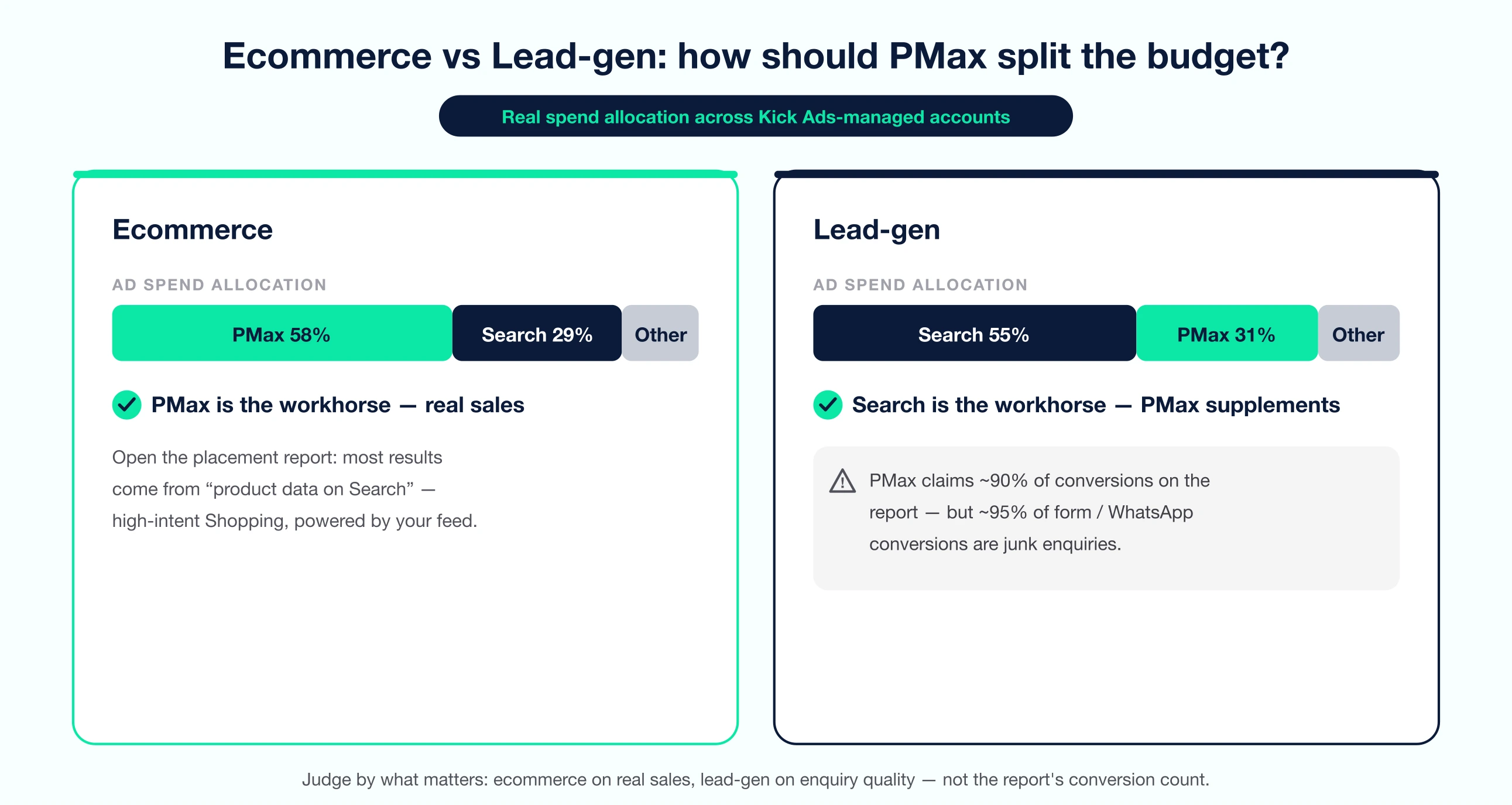
Ecommerce: PMax is the workhorse, and it genuinely drives sales. Unlike lead-gen, PMax delivers real, tangible sales on ecommerce accounts. In the ecom accounts we manage, PMax accounts for about 58% of spend and brings in roughly half the conversions, complementing Search and Shopping. The gap in the numbers is just as stark: over the last 90 days, PMax on our ecommerce accounts returned close to a 10× blended ROAS, at a cost per conversion roughly a third of what lead-gen accounts pay. Here's the key observation: when you open PMax's search term insights and placement / channel report — both far more transparent in 2026 than they used to be, no longer a black box — you'll find that the overwhelming majority of its results actually come from "product data on Search" — your products showing in Google's search results, which is essentially Shopping under the hood. In other words — as our own PMax vs Shopping test also showed — the reason PMax drives real ecommerce sales is largely that it's high-intent Shopping at heart, powered by your product feed — and that's exactly why lead-gen accounts (which have no product feed) can't replicate the same effect. That said, it isn't win-on-switch-on: across our accounts, PMax's cost per conversion ranges from about 40% cheaper than Search to 1.5–2× more expensive, depending on the account, products and setup — so you still have to measure account by account and set your guardrails.
Lead-gen: Search is the workhorse, and PMax's numbers need a discount. On lead-gen accounts, PMax claims close to 90% of conversions on the report at a CPA that looks absurdly low — but as noted above, roughly 95% of those form and WhatsApp conversions are junk. So we deliberately keep over half the budget on Search and let PMax supplement rather than dominate. The metric we judge by is real enquiry quality, not the conversion count on the report.
Put simply: PMax faithfully reflects the environment you give it. Ecommerce has a product feed and clear transactions, so the Shopping engine inside PMax fires and drives real sales; lead-gen has no feed and lives or dies on enquiry quality, so PMax easily becomes a junk-lead machine. Understand this, and you won't be led around by a pretty report.
When should you use PMax — and when shouldn't you?
Quick answer: PMax is worth using when you have accurate conversion tracking, enough conversion volume, and quality assets to feed the AI. If your tracking is off, your budget is too small, your enquiry quality is hard to police, or your goal is pure brand awareness — hold off.
Good fit: ecommerce and businesses with clear online transactions, rich product feeds, stable conversion data already in place, and a goal of scaling results you already have. Hold off: conversion tracking not yet built (PMax is flying blind), a monthly budget too small for the AI to learn, lead-gen businesses that rely mainly on manually vetting enquiry quality, goals of brand awareness or breaking into a brand-new market, and B2B that needs fine keyword-by-keyword control.
PMax best practices (2026)
Quick answer: The key to using PMax well is "give direction, set guardrails, read the real data" — not switching it on and walking away.
- Get conversion tracking and conversion values right first. Everything PMax does is built on your conversion data — this is the foundation. Lead-gen especially must filter out junk and count only "genuine enquiries" as conversions.
- Set Brand Exclusions and account-level negative keywords. Block cannibalisation and irrelevant traffic, forcing PMax to earn "new" business.
- Feed it quality assets and audience signals. Supply several sets of strong headlines, images and video; use audience signals to speed up the AI's learning (these are hints, not hard limits).
- Check the channel-level report regularly. See which channel results really come from, and catch the parts that are being over-credited.
- Pair it with Search, don't let it replace Search. Keep separate brand and high-intent Search campaigns so PMax supplements rather than takes over.
- Give it time, then tighten targets gradually. Start with a looser tCPA/tROAS and adjust once performance stabilises.
Conclusion: PMax is a tool, not autopilot
PMax is a powerful AI advertising tool, but it isn't a "switch it on and win" autopilot. It will faithfully optimise the goal you give it — including, without you noticing, claiming credit wherever it's easiest. Set your guardrails, read the real data and pair it with Search, and it becomes a genuine engine for scaling results; leave it unattended, and all it hands you is a good-looking report. That is exactly the value of a professional agency: not to replace the AI, but to set the direction for you, dismantle the mirage, and point PMax's potential at the incremental business that actually matters.
Wondering how much of your PMax "performance" is real? Kick Ads manages Google Ads across Hong Kong and Malaysia — we set the guardrails, read the channel-level data, and tell you where the genuine business is. Get a free Paid Media Health Check — no sales pitch, just honest findings. Or see how we approach Google Ads management.
FAQ
What is Performance Max? Performance Max (PMax) is Google Ads' fully automated, cross-channel AI campaign — one campaign covering Search, Shopping, YouTube, Display, Gmail, Discover and Maps. You supply the assets and goal, and the system decides where to serve and what to bid.
What's the difference between PMax and Search ads? With Search ads you pick the keywords and control the performance of every term; PMax hands those decisions to AI and serves automatically across many channels. Search gives you strong control, PMax saves time but offers less transparency — the two work best together.
Is PMax good for lead generation? Be careful. PMax often reports beautiful conversion numbers on lead-gen accounts, but in our experience most of those form and WhatsApp conversions are low-quality enquiries (junk). For lead-gen we recommend Search as the workhorse with PMax supplementing, and judging strictly on enquiry quality rather than the conversion count.
Where do PMax's results mostly come from? For ecommerce, open PMax's placement report and you'll usually find most results come from "product data on Search" — your products appearing in Google's search results, which is essentially Shopping. That's why ecommerce businesses with a product feed benefit most.
What are the downsides of PMax? Mainly low transparency (the black box), the risk of cannibalising existing brand and customers and thereby inflating results, and being unsuitable for pure brand-awareness goals. Setting Brand Exclusions and reading the channel-level report cuts the risk substantially.
Does PMax have to be paired with Search ads? Strongly recommended. Keeping separate brand and high-intent Search campaigns prevents PMax cannibalisation and keeps you in direct control of your high-value searches.

About the author
Terrence Chung · Co-Founder, Kick Ads
Terrence is an ex-Googler, paid media and SEM trainer. He has managed Google Ads for ecommerce and lead generation businesses across Hong Kong and Malaysia since 2017, working closely on account strategy and optimisation direction.