
Performance Max Search Themes: Best Practices
By Frankie Chan, Co-Founder · Updated 24 July 2026 · 3 min read
Performance Max is now a core campaign type in most Google Ads accounts (see our complete Performance Max guide for the fundamentals) — but left entirely to automation, it can miss pockets of demand you know exist. Search themes fix that. Introduced in late 2023 and now a standard Performance Max feature, they let you tell Google AI which topics matter to your business, actively guiding the campaign towards audiences it may have missed. Together with campaign-level negative keywords, brand exclusions and channel-level reporting, search themes give you far more steering power than Performance Max offered at launch.
When Can Search Themes Be Especially Beneficial?
Search themes earn their place in a few specific situations:
- Incomplete or slow-to-update landing pages — they bridge the information gap when your page doesn't yet spell out the products or services you want to promote.
- New markets or new products with no performance history — they supply the signal Google AI can't yet learn from past data.
- Seasonal promotions with limited historical data — they help you target the right audience before the campaign has data to lean on.
- Cross-channel coverage — they keep your key business themes represented across Google's channels, from Search to the Display Network.
Search Themes Setup: Best Practices
When you add relevant search themes, you’re telling Google AI that you want to reach specific traffic, so you have to leverage your expertise to let Google AI drive your campaign effectively. Here are some recommended strategies you should know:
- Ensure that your search themes are not duplicated or closely related variants.
- Utilize search term insights to gain valuable information about existing search queries and user behavior — the same intent logic that drives keyword match types in Search campaigns.
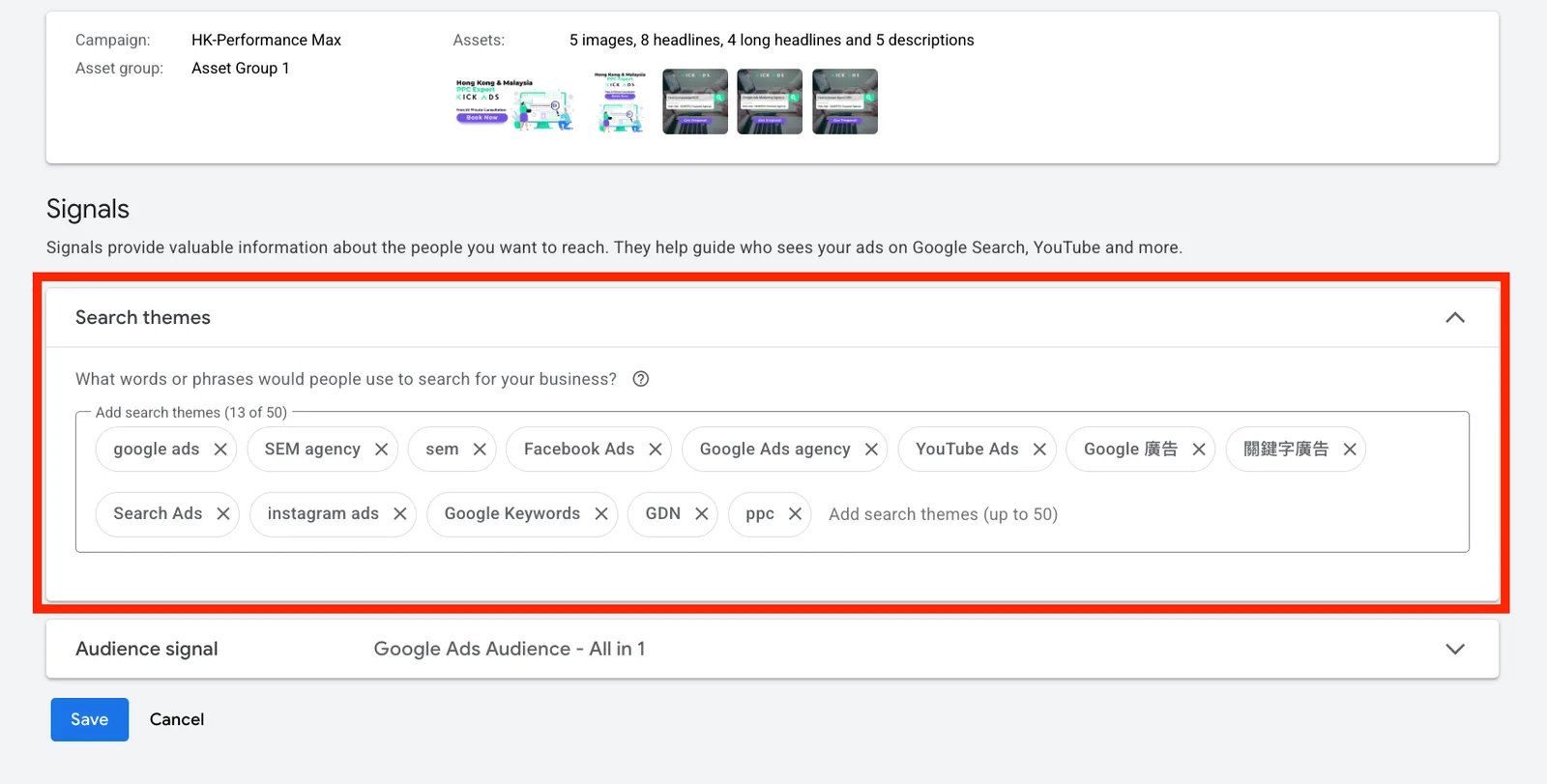
- Maximum of 50 search themes per asset group in Performance Max campaigns (the earlier limit of 25 has been raised to 50).
- Assign the same prioritization level to search themes as you would for phrase match and broad match keywords in Search campaigns.
- Pair search themes with campaign-level negative keywords and channel-level reporting, so the extra reach they unlock stays accountable.
You can add up to 50 search themes in your Performance Max campaign
Source: Google Ads & Commerce Blog
Search themes are one of the simplest ways to combine your industry knowledge with Google AI. Used well, they open up new, targeted traffic across Google's channels without giving up the efficiency that makes Performance Max worth running.
Whether you're filling a landing page gap, expanding into a new market, or tightening up an existing campaign, search themes belong in your Performance Max setup. If they're not in your asset groups yet, that's the first thing to fix.
FAQ
What are search themes in Performance Max? Search themes are a feature that lets you actively guide Performance Max towards audiences it may have missed, by telling Google AI which topics matter to your business so your ads can reach a broader audience across Google's channels.
How many search themes can I add to a Performance Max campaign? You can add a maximum of 50 search themes per asset group in a Performance Max campaign.
When are search themes most useful? They shine when your landing page is incomplete, when you are entering a new market or launching a product with little performance history, and during seasonal promotions with limited historical data.
How are search themes prioritized against keywords? Google assigns search themes the same prioritization level as phrase match and broad match keywords in Search campaigns, so avoid duplicated or closely related variants and use search term insights to refine them.

About the author
Frankie Chan · Co-Founder, Kick Ads
Frankie is an ex-Googler and paid media strategist. He has managed Google Ads and Meta Ads for ecommerce and lead generation businesses across Hong Kong and Malaysia since 2017, working closely on strategy, reporting and client growth planning.