Google Ads vs Meta Ads: Which Should a Hong Kong SMB Choose?
By Frankie Chan, Co-Founder · Updated 16 July 2026 · 11 min read
Jump to section
- The core difference: demand capture vs demand generation
- Where each one is strongest
- Google Ads vs Meta Ads at a glance
- Ecommerce: which to choose (with the first-party evidence)
- Lead generation / services: which to choose (the PMax mirage warning)
- What campaigns and formats each actually uses
- How to split the budget
- Common mistakes
- FAQ
For most Hong Kong SMBs, "should I run Google Ads or Meta Ads?" is the wrong question. The two aren't rival platforms competing for the same job. They do two completely different jobs. The real decision isn't either/or; it's which one leads, which goal each one owns, and how to split the budget. This guide answers that using the first-party data we've built managing Hong Kong and Malaysia accounts since 2017, anonymised, ratios only.
Quick answer: For most Hong Kong SMBs the answer isn't either/or. Google Ads does demand capture: it reaches people already searching for what you sell. Meta Ads does demand generation: it creates demand among people who aren't searching yet. Ecommerce needs both pulling weight; lead-gen and service businesses should run Google Search as the reliable engine and use Meta for top-funnel reach and retargeting.
The core difference: demand capture vs demand generation
In one line: Google Ads is demand capture. Meta Ads is demand generation.
- Google Ads captures existing intent. When someone searches "aircon repair Hong Kong" or "English tutor secondary school," the demand already exists and they're looking to buy right now. You're simply putting yourself in front of them. This traffic is high-intent and close to the sale, but it's capped by how many people are actually searching.
- Meta Ads manufactures demand. Nobody types "I want to buy an aircon" into Facebook or Instagram. You interrupt them mid-scroll, before the thought even forms, and use creative to spark interest. This traffic is lower-intent and further from the sale, but the reachable audience is vastly larger, and it can create demand for a product nobody is searching for yet.
That's why the two behave differently: Search spends on people who already want the thing (fast, stable conversion), while Meta spends on people who don't want it yet (creative and a funnel have to warm them from stranger to buyer). Once this clicks, every decision below follows naturally. For the Meta side in depth, see our Facebook & Instagram ads guide; for the Search side, our SEM ultimate guide.
Where each one is strongest
Google Ads wins when:
- Your market already actively searches for what you sell (repairs, professional services, B2B, products with a clear category name).
- You want enquiries, quotes, bookings — immediate, measurable actions.
- You need to defend brand demand: when people search your company name, you have to own that.
- The sales cycle is short and driven by need.
Meta Ads wins when:
- You sell something visual, impulse-driven, or genuinely new (fashion, beauty, homeware, DTC brands).
- The market doesn't yet realise it needs you, so demand has to be manufactured with content.
- You want to build brand awareness and reach at scale.
- You already have a warm audience (site visitors, customer lists, engagers) to retarget.
Note that Google itself has been blurring this line. Google's Demand Gen campaigns go straight after Meta's visual, demand-creation turf across YouTube, Discover and Gmail. So "Google = search only" is no longer accurate, but Google's core edge is still demand capture.
Google Ads vs Meta Ads at a glance
| Dimension | Google Ads | Meta Ads |
|---|---|---|
| Nature | Demand capture: harvest existing intent | Demand generation: reach people not searching |
| User mindset | Actively searching, ready to buy | Passively scrolling, not yet interested |
| Lead quality | High (high intent) | More variable (pushed) |
| Cost per click | Higher | Lower |
| Creative burden | Lower | High: constant refresh needed |
| Ecommerce return | PMax ROAS ≈ 1.3× Standard Shopping; lower the bar for own brands | ASC workhorse + retargeting; needs Reach to warm the audience |
| Lead-gen role | Reliable primary engine | Top-funnel / retargeting |
| Best for | Products/services people search for, lead generation | Visual / new-brand / impulse buys, ecommerce demand creation |
Ecommerce: which to choose (with the first-party evidence)
Ecommerce is the one category where both sides deliver real, cash-positive returns. But first, one distinction most people miss.
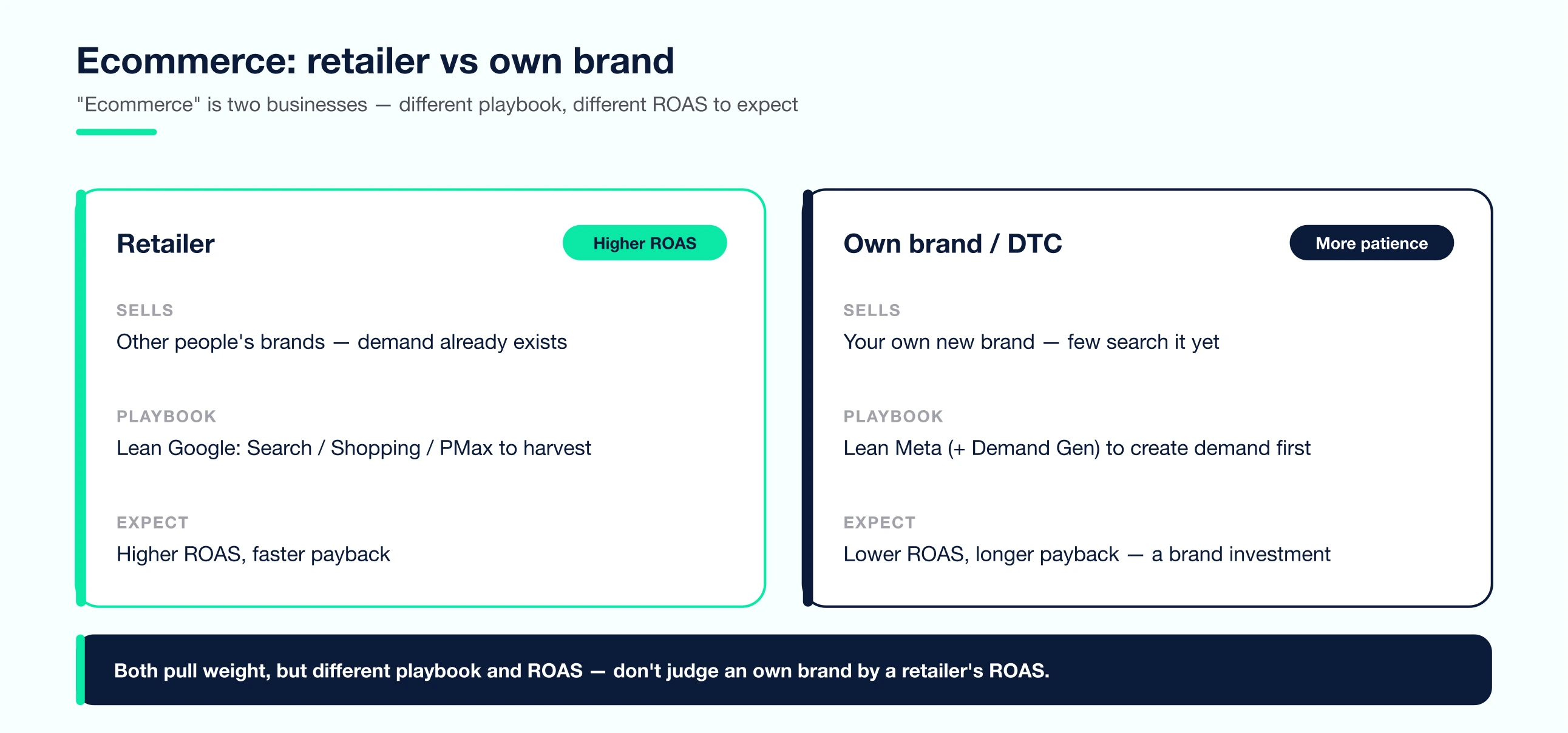
Own brand vs retailer changes the approach and the ROAS you should expect. "Ecommerce" is really two different businesses:
- Retailer (reselling other people's brands): the brands you carry already have search demand: people look for them by name. Search, Shopping and PMax capture that existing intent, so ROAS tends to be higher and you can lean harder on Google.
- Own brand / DTC: nobody is searching for your new brand name yet, so you have to create demand first. These businesses need a heavier Meta (plus Demand Gen) weighting, and you must set a lower ROAS expectation with a longer payback: it is an investment in building the brand, not something to judge against a retailer's ROAS, or you will wrongly call it a failure and pull out too early.
Once you know which one you are, here is how each platform plays. Our anonymised MCC data is clear:
Google side: PMax is real sales for ecommerce. Performance Max serves Shopping inventory, pushing your catalogue across Google, YouTube, Discover and more. Across the ecommerce accounts we manage, PMax delivers roughly 1.3× the ROAS of Standard Shopping (about 9.6× vs about 7.4×), at a CPA around one-fifth to one-sixth of Standard Shopping. For a catalogue business, PMax is a genuine revenue engine, not hype.
Meta side: ASC is the workhorse. Advantage+ Shopping (ASC) is essentially a warm-audience conversion engine: it does its best work re-converting people that reach and content have already warmed, plus retargeting cart and product viewers. But it needs upper-funnel Reach and video to warm the audience first; the bottom can't run on its own.
Demand Gen holds up for ecommerce too. In visual ecommerce accounts, Google Demand Gen hits low double-digit CPAs, same logic as Meta's discovery play, using strong creative to manufacture demand on low-intent surfaces.
Ecommerce verdict: both platforms pull weight. Search + Shopping/PMax capture intent; Meta (ASC + Reach) and Demand Gen manufacture demand and retarget. If the budget genuinely only stretches to one to start, check whether people already search for your product: if yes, capture on Google first; if no, create demand on Meta first.
Lead generation / services: which to choose (the PMax mirage warning)
For lead generation and service businesses the story completely flips, and this is where most advertisers get burned.
First, the core trade-off between Google and Meta for lead-gen:
- Google Search: you reach people actively searching for a solution: high intent, better lead quality, genuinely solving the searcher's problem, but the cost per click (CPC) is higher, especially in competitive service categories.
- Meta: leads are far cheaper, but the demand is pushed, so quality is usually more variable; and you have to rotate creative constantly: the moment it fatigues, performance drops. It is ongoing operational work, not set-and-forget.
PMax is a mirage for lead-gen. The same PMax that ships product for ecommerce, dropped into a lead-gen account, hands you enquiries where the overwhelming majority are low-quality junk: forms filled, numbers left, zero real intent to buy. Because PMax optimises to "complete a conversion action," and a lead form is far too easy to complete, the system floods toward the cheapest, easiest-to-trigger, least valuable traffic. The CPA looks great while your sales team chases tyre-kickers. Lead-gen should keep budget on Google Search, using high-intent keywords to capture people genuinely looking for the service.
Demand Gen burns budget on services too. Our data shows Demand Gen is polarised: visual ecommerce wins, but service/lead-gen accounts post absurdly high CPAs. Same reason: low-intent surfaces don't work for services that need convincing before anyone buys.
Meta's role in lead-gen is top-funnel, not the main engine. Meta can build brand awareness for service businesses, warm an audience, and retarget site visitors, but asking it to be the primary intent-capture engine usually can't hold its cost. Treat it as the top of the funnel, not the harvester.
Lead-gen / services verdict: Google Search is the reliable main engine, Meta handles top-funnel reach and retargeting, and PMax and Demand Gen need real caution on pure lead-gen. For real-world Hong Kong search costs, see our Google Ads cost in Hong Kong guide.
What campaigns and formats each actually uses
Once the strategy is set, here is what to actually run:
Google side — the campaign mix. No single campaign does it all; it is a combination:
- Ecommerce: Search (defend brand terms + high-intent product terms) plus Shopping / PMax as the main engine to harvest product demand. PMax serves Shopping inventory and drives scale; if you want hard control over search terms and bids, keep a separate Standard Shopping campaign too.
- Lead generation / services: Search at the core, using high-intent keywords to capture real prospects; only try Demand Gen if you have strong visual creative; avoid using PMax to chase volume for pure lead-gen.
- Whatever the category, always defend your brand search terms first.
Meta side: which format. Formats include single image, video, carousel, collection and dynamic catalog ads. For ecommerce, dynamic catalog ads (formerly DPA, now Advantage+ Catalog Ads) usually win: they automatically show each person the exact products they browsed, and ROAS is especially strong when retargeting warm audiences. We have first-party evidence for this: in one Hong Kong ecommerce ASC campaign we run, dynamic catalog (DPA) ads carry roughly 70% of the spend at about 4× ROAS, the format that actually scales, while static hero creative can post a higher ROAS but never at volume. These are typically delivered through an ASC (Advantage+ Shopping) campaign; once an account has enough weekly purchases (roughly 50+), ASC merges prospecting and retargeting into one and usually beats the old manually-segmented setup. Either way, you still need Reach / video at the top to warm the audience first, so ASC and catalog ads have a warm pool to convert.
How to split the budget
There's no one-size-fits-all ratio, but you can work it backwards from which category you're in:
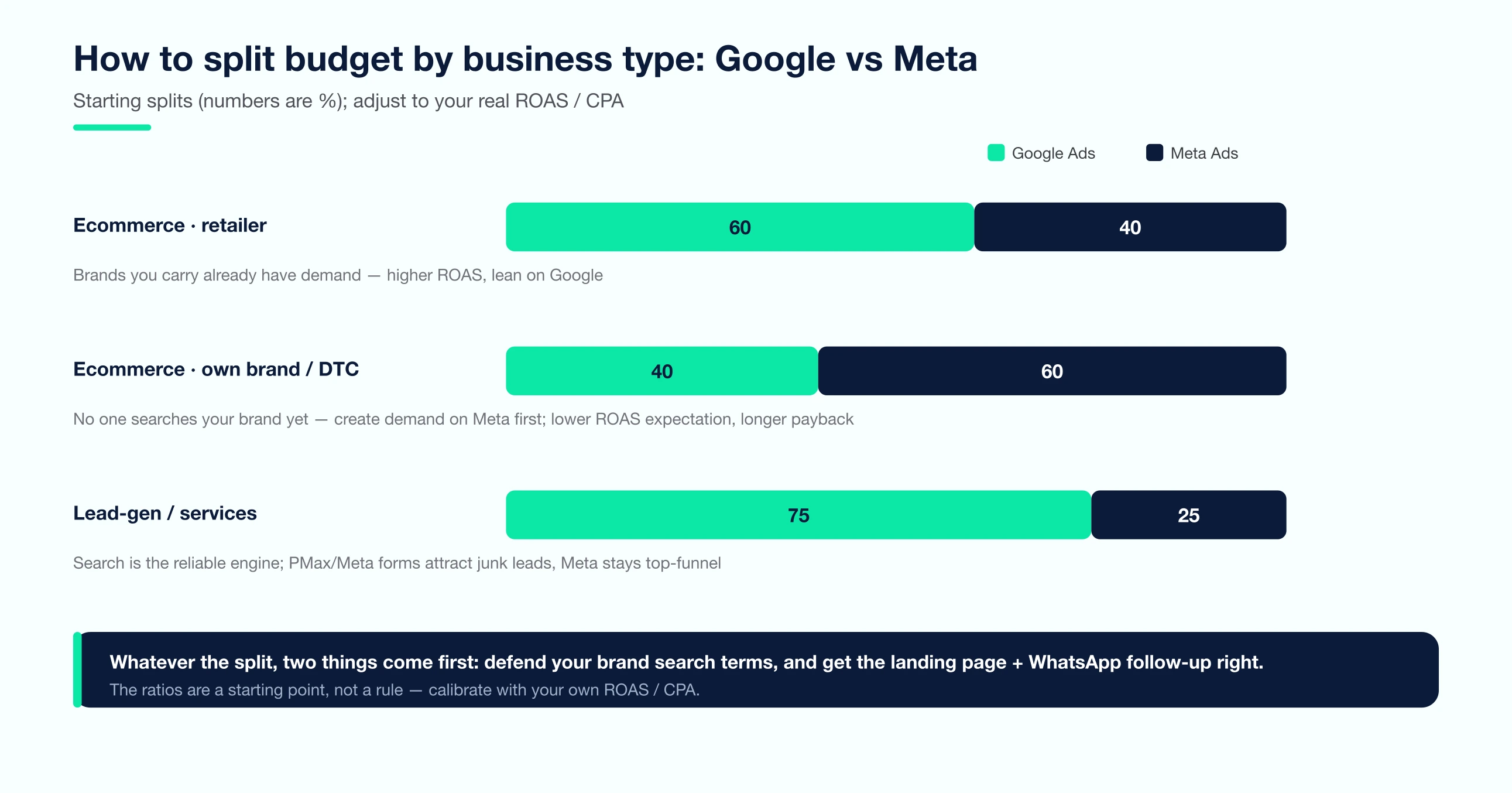
- Ecommerce (products people search for): start around Google 60 / Meta 40. Google captures via Search + Shopping/PMax; Meta manufactures demand and retargets via ASC + Reach. Then adjust to each side's actual ROAS.
- Ecommerce (new / visual, nobody searching yet): flip it to Meta 60 / Google 40: lead with Meta to create demand, keep Google on brand terms and light Shopping as a floor.
- Lead generation / services: Google 70–80 / Meta 20–30. Put the weight on Search to capture intent; use Meta only for top-funnel awareness and retargeting. Never anchor lead-gen on PMax or Meta forms.
- Budget genuinely tight: run only one side. Market already searches for what you sell → Google Search first. Market doesn't realise it needs you → Meta first.
Whatever the split, two things always come first: defend brand search terms (cheapest, highest intent), and make sure the landing page and WhatsApp follow-up are solid, otherwise every click leaks out the bottom of the funnel.
Common mistakes
- Treating it as an either/or holy war. They do different jobs; most of the time it's division of labour, not opposition.
- Using PMax to pump lead-gen volume. The pretty CPA is an illusion: most of what floods in is junk with no intent to buy.
- Judging by platform-reported ROAS alone. Google and Meta both claim credit and double-count; always reconcile against your CRM and actual sales.
- Running only bottom-funnel Meta retargeting without feeding the top. No upper-funnel warming means no warm audience to convert, and costs only climb.
- Forcing Meta to be the main harvester for services. Low-intent surfaces don't pay off for services that need convincing.
- Ignoring the landing page and follow-up. The ad is only half the system: a slow page or an unmanned WhatsApp wastes money on both platforms.
FAQ
Google Ads or Facebook Ads: which is better? Neither is universally better; they do different jobs. Google Ads captures people already searching for your product (demand capture); Meta Ads creates demand among people who aren't searching (demand generation). If your market already searches for what you sell, start with Google; if you sell something visual or brand-new that nobody searches for yet, start with Meta. Established businesses usually run both.
Which should an SMB run first? It depends on whether your market actively searches for your product or service right now. If yes (repairs, professional services, products with a clear category name), start with Google Search to capture existing intent. If no (new concept, visual impulse buys), start with Meta to manufacture demand. On a tight budget, doing one side well beats doing both halfway.
How should I split the budget? Ecommerce: start around Google 60 / Meta 40 and adjust to actual ROAS. Lead generation and services: Google 70–80 / Meta 20–30, with the weight on Search and Meta on top-funnel reach and retargeting. Whatever the split, defend brand search terms first and make sure the landing page and follow-up are solid.
How does the strategy differ for ecommerce vs lead generation? Ecommerce returns real value on both sides: Google's PMax/Shopping and Meta's ASC both ship product. Lead generation is the opposite: PMax and Meta forms tend to flood in with low-quality junk leads, so keep the weight on Google Search with high-intent keywords, and use Meta only for brand and retargeting.
Is PMax a silver bullet? No. PMax is a genuine sales engine for catalogue ecommerce (it largely serves Shopping inventory), but a mirage for lead-gen: the overwhelming majority of enquiries are junk with no intent to buy. Fine for ecommerce, but treat it with real caution on pure lead-gen and lean back on Search.
Want to work out which side your business should back, and how to split the spend? Kick Ads has run Google Ads (as a certified Google Partner) and Meta ads side by side since 2017, deciding with first-party data rather than benchmarks. See our Google Ads service and Meta ads service, or talk to us.

About the author
Frankie Chan · Co-Founder, Kick Ads
Frankie is an ex-Googler and paid media strategist. He has managed Google Ads and Meta Ads for ecommerce and lead generation businesses across Hong Kong and Malaysia since 2017, working closely on strategy, reporting and client growth planning.