Facebook Ads in Hong Kong 2026: Costs, Targeting & Setup
By Frankie Chan, Co-Founder · Updated 16 July 2026 · 10 min read
Jump to section
- What Meta ads cover in 2026
- Account structure: Business Manager and Ads Manager
- Campaign objectives in 2026
- Audience targeting after iOS 14.5
- Creative: the real targeting lever
- What Facebook ads cost in Hong Kong
- Measurement: Pixel, Conversions API, Events Manager
- The WhatsApp-first setup for Hong Kong and Malaysia
- Common mistakes we keep seeing
- Should you run Facebook ads or Google Ads?
- Ready to make Meta ads accountable?
- FAQ
Most Hong Kong businesses have tried Facebook ads at some point, usually by pressing "Boost Post" and hoping. Some got enquiries. Most got likes, a bill, and no idea what worked. This guide is the version we wish every client had read before spending their first dollar: how Meta ads actually work in 2026, what they cost in Hong Kong, and the mistakes that commonly waste spend.
We manage Meta ads alongside Google Ads for businesses across Hong Kong and Malaysia, so this is written from the practitioner's seat, what we set up, what we test, and what we tell clients when they ask "why is my cost going up?" Everything here reflects how Facebook advertising in Hong Kong actually plays out in live accounts, not textbook theory.
What Meta ads cover in 2026
"Facebook ads" is shorthand. One campaign in Meta Ads Manager can serve across:
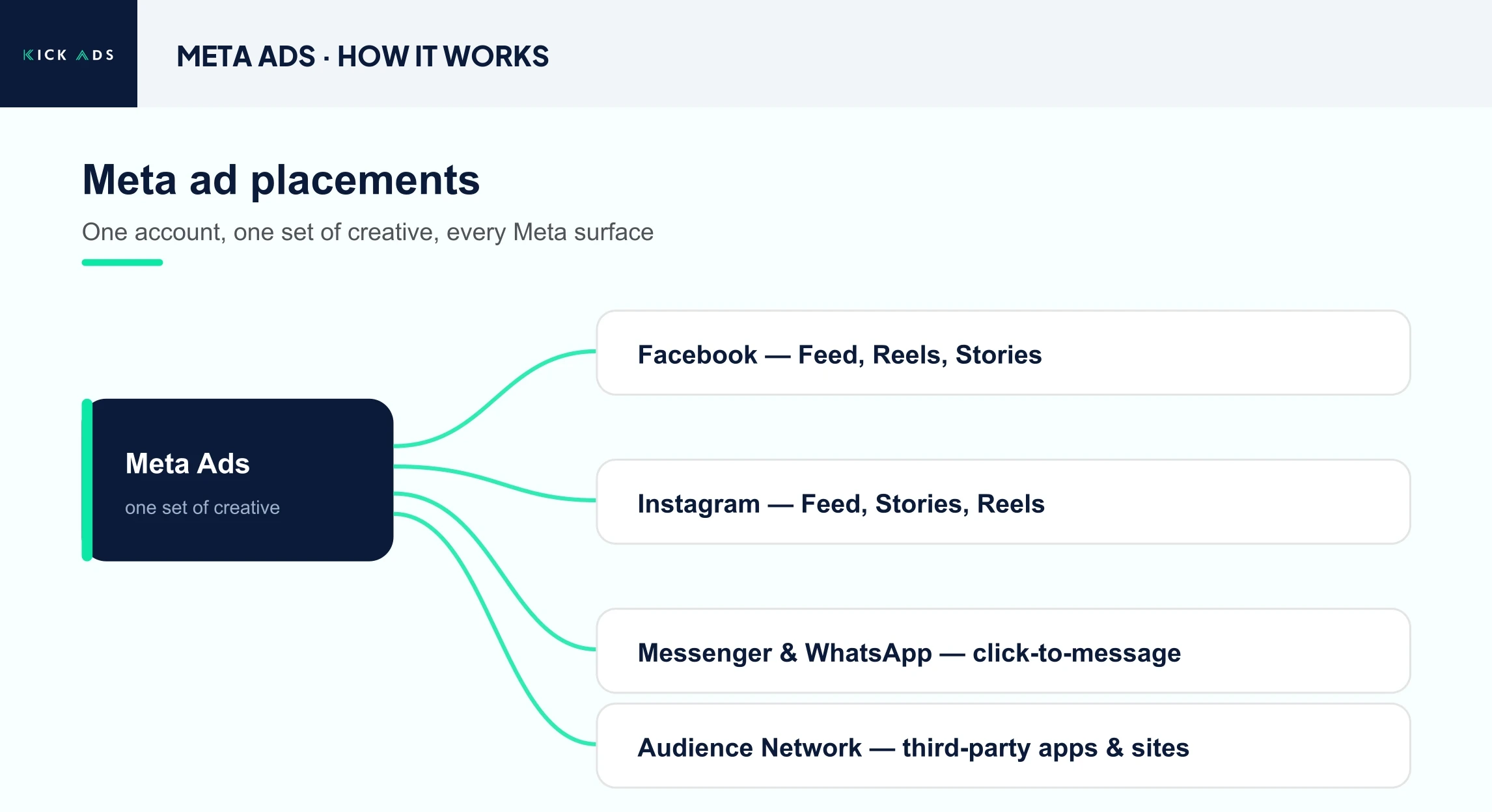
- Facebook, feed, Stories, Reels, Marketplace, in-stream video
- Instagram, feed, Stories, Reels, Explore
- Messenger, inbox ad placements
- Audience Network, third-party apps and sites
- WhatsApp, via click-to-WhatsApp ads (the ad runs on Facebook or Instagram, the conversation lands in WhatsApp)
For most Hong Kong advertisers, Facebook and Instagram placements do the heavy lifting, and WhatsApp is where sales conversations actually happen. More on that later, it is the most under-used combination in this market.
Account structure: Business Manager and Ads Manager
Before running anything, get the structure right:
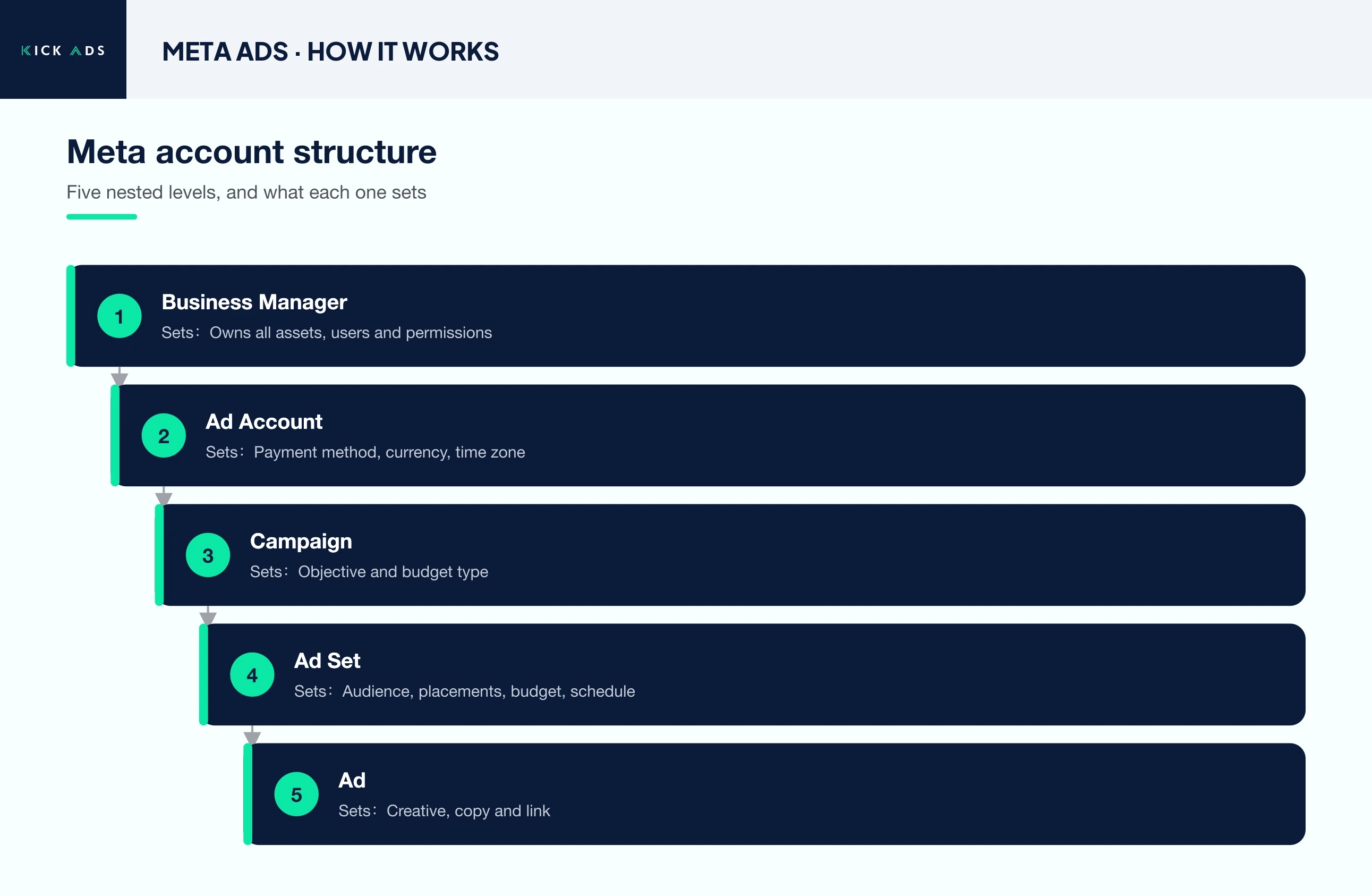
- Meta Business Suite / Business Manager is the container: it holds your Facebook Page, Instagram account, ad account, Pixel/dataset, and the people who can access them. Set this up under company ownership, not an employee's personal account. We still meet businesses locked out of their own ad account because an ex-staff member owned it.
- Ads Manager is where campaigns are built and reported.
Inside Ads Manager, everything follows a three-level hierarchy:
- Campaign, sets the objective (what you want)
- Ad set, sets the audience, placements, budget and schedule (who sees it, where, for how much)
- Ad, the creative itself (what they see)
Understanding which setting lives at which level saves hours of confusion. Budget usually sits at ad set level unless you use Advantage campaign budget, which lets Meta shift spend between ad sets.
Campaign objectives in 2026
Meta consolidated its objectives into six:
- Awareness, reach and brand lift; pay to be remembered
- Traffic, clicks to a destination (website, WhatsApp, call)
- Engagement, likes, comments, video views, messages
- Leads, instant forms, calls, or messaging conversations
- App promotion, installs and in-app events
- Sales, purchases and conversions, including catalog sales
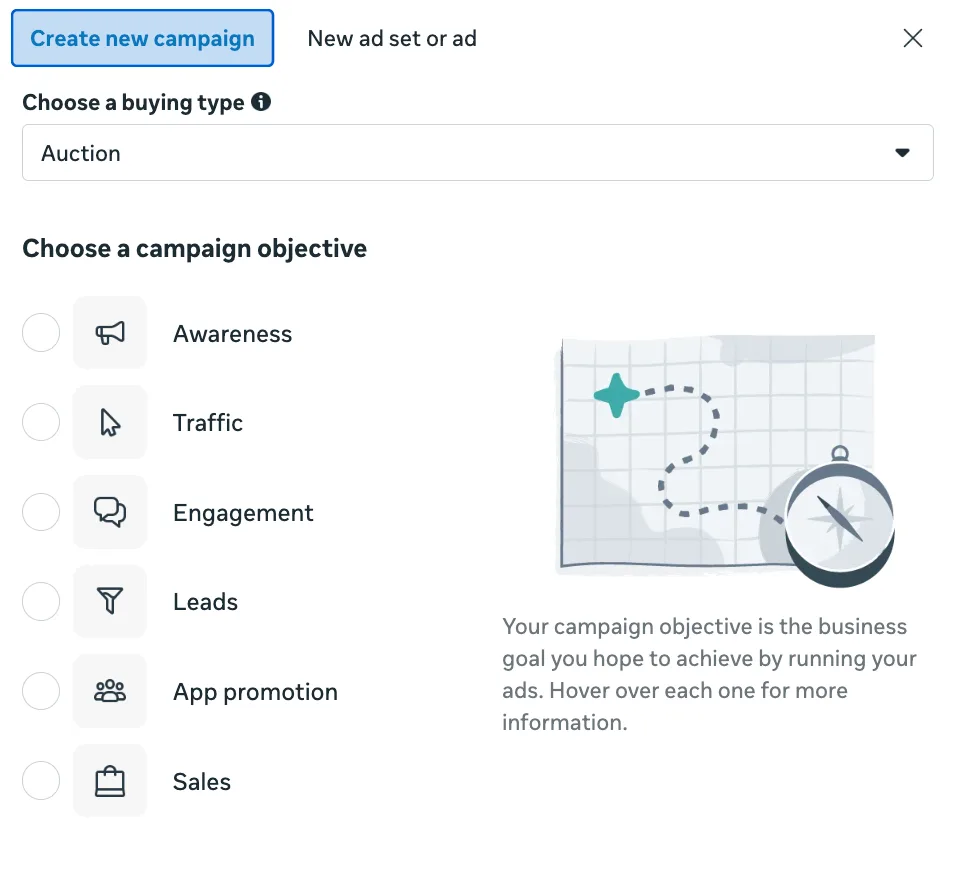
The objective is not a label, it tells Meta's delivery system what outcome to optimise towards, and the system takes it literally. Choose Engagement and Meta will find people who like and comment but rarely buy. If the goal is enquiries or sales, run Leads or Sales even when the cost per result looks higher, you are paying for outcomes, not activity. This single setting explains a large share of "Facebook ads don't work for us" stories we hear.
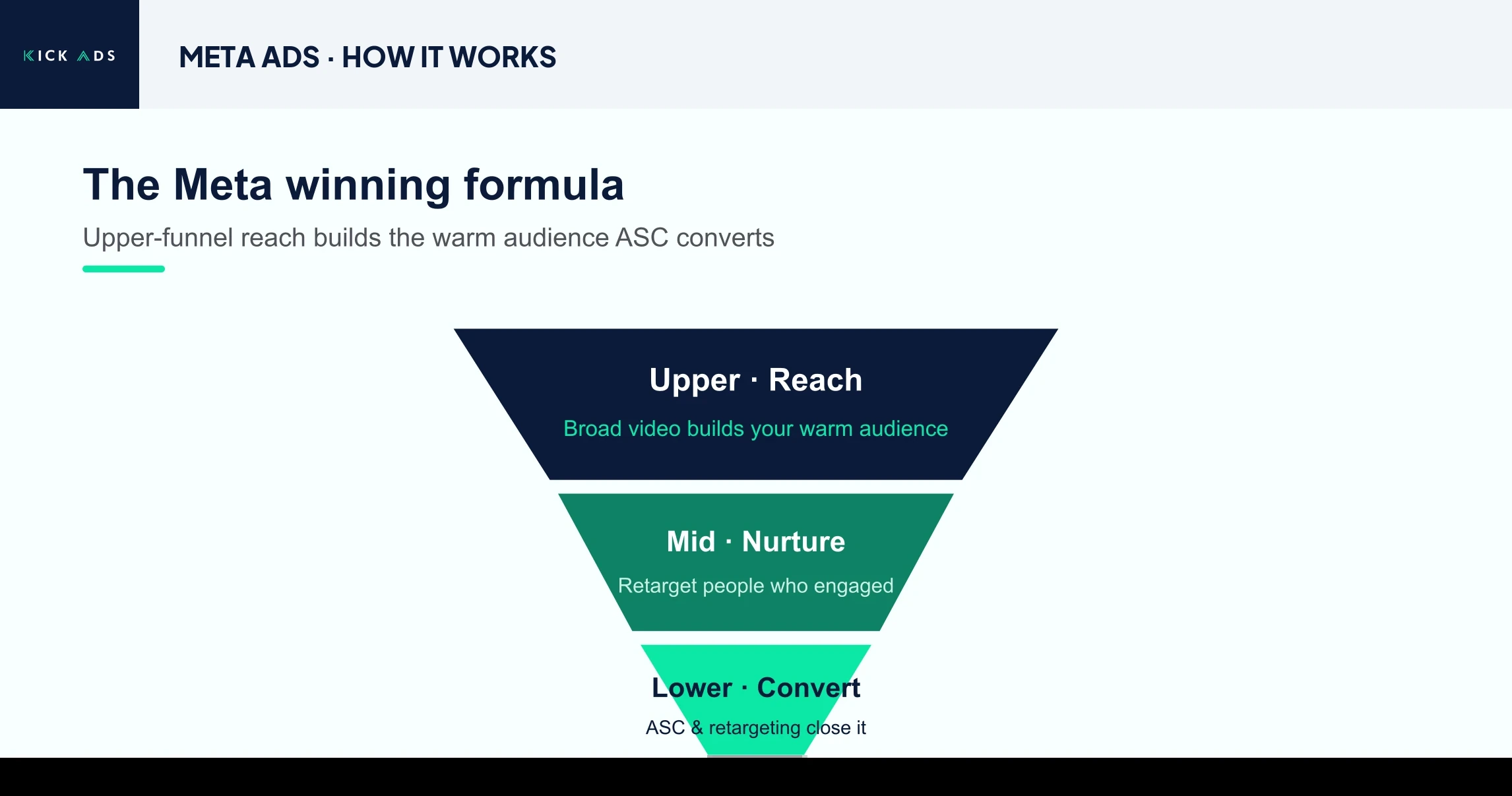
But picking the right objective is only half of it, the real win is a funnel mindset: stringing several objectives into one connected funnel instead of running them in isolation. This is the single most important shift we push for on Meta.
Top: Reach (and video does it best): start with Awareness / Reach for broad, cheap exposure. Video works best at this layer, it's cheap, memorable, and the strongest way to build a warm audience (viewers, engagers, site visitors). Without this layer, there's simply no one warm for the bottom to convert.
Bottom: ASC for retargeting: then use Advantage+ Shopping (ASC) and retargeting to convert the warm audience the top built. ASC is essentially a warm-audience conversion engine, it does its best work re-converting the people reach already warmed up, but it needs the top to warm them first.
Running only the bottom without feeding the top asks the engine to convert a warm audience that doesn't exist: costs climb, volume stalls. It's the single most common Meta mistake we see.
Audience targeting after iOS 14.5
Apple's App Tracking Transparency (iOS 14.5, 2021) permanently changed Meta targeting: fewer users are individually trackable, so the system leans on modelled signals. Practical consequences in 2026:
- Broader targeting usually wins. The old game of stacking narrow interest audiences is mostly over. Give the system room and let the creative do the targeting.
- Advantage+ audience is the default: you provide suggestions (interests, ages, custom audiences) and Meta treats them as a starting point rather than a hard boundary. For most accounts it outperforms rigid targeting.
- Custom audiences still matter: website visitors (via Pixel), customer lists, video viewers, page/IG engagers, and past WhatsApp conversations. These power retargeting.
- Lookalike audiences, modelled from your customer list or purchasers, remain useful for prospecting, though Advantage+ increasingly absorbs this job.
The reality: your first-party data (customer lists, Pixel events, CRM) is now the targeting edge. Interest picking is not.
Creative: the real targeting lever
With targeting broader, creative decides who stops scrolling. Two things separate accounts that scale from accounts that stall:
A testing rhythm. We plan angles (the hook or promise), formats (image, video, carousel, Reels), and messages in advance, launch several at once, scale what works and replace what does not. Waiting until performance drops to look for new creative is not testing, it is firefighting. Fresh variants no longer have to cost a shoot: see our Seedance 2.5 AI video test. For the build steps, see how to make AI video ads.
Watching for creative fatigue. The same ad cannot carry an account for months. When frequency climbs, CPM rises and CTR slides, the audience has seen it too many times. Fatigue is the number-one performance killer we see in Hong Kong accounts, not targeting, not budget.
Formats worth prioritising in 2026: short vertical video (Reels placements are where the reach is), carousels for products, and simple statement images for offers. Native-feeling content consistently beats polished ads.
What Facebook ads cost in Hong Kong
The honest answer: there is no rate card. Meta ads are sold by auction, you bid for attention against everyone targeting the same people at the same moment. What actually drives your cost:
- Audience and industry, finance, property, beauty and education in Hong Kong are crowded and pricier; niche B2B can be cheap to reach but expensive per lead
- Season, Q4 and major sale periods (11.11, 12.12, Christmas, CNY) push CPMs up market-wide
- Placement mix, Reels and Audience Network are usually cheaper per impression than top-of-feed
- Creative quality, ads people engage with earn cheaper delivery; tired creative pays a fatigue tax
- Objective, being charged per purchase-optimised impression costs more than per click
As very general guidance (these vary widely by industry and season): Hong Kong CPMs commonly land in the tens of Hong Kong dollars, and meaningful testing is hard below about HK$200–300 per day per campaign. Most SMB accounts we see run somewhere between HK$10,000 and HK$50,000 per month in media spend; what matters is not the number but whether cost per enquiry or per sale beats what the business can afford. Work backwards from your economics: if a customer is worth HK$2,000 and you close one in five enquiries, a HK$100 cost per enquiry works. That arithmetic (not a benchmark) should set your budget.
One more honesty check: agencies (ours included) charge management fees on top of media spend. If a quote bundles everything into one "package price" with no media-spend transparency, ask questions.
Measurement: Pixel, Conversions API, Events Manager
If conversions are not measured properly, Meta optimises blind and so do you.
- Meta Pixel, the browser-side tag on your site tracking standard events (ViewContent, AddToCart, Purchase, Lead...)
- Conversions API (CAPI), server-side events sent directly from your site or platform to Meta. Post-iOS 14.5 this is not optional: browser-only tracking misses a meaningful share of conversions. Run Pixel + CAPI together with event deduplication.
- Events Manager, where you verify events are firing, check match quality, and prioritise events.
Also expect platform-reported results to disagree with GA4, different attribution rules, different counting. Treat Meta's numbers as the platform's view, your CRM or sales record as the truth, and judge trends rather than absolute numbers. We wrote more about this in our conversion tracking guide.
The WhatsApp-first setup for Hong Kong and Malaysia
In Hong Kong and Malaysia, the fastest route from ad to sale is often a WhatsApp conversation, not a form. Click-to-WhatsApp ads open a chat directly from the ad; the business replies inside a 24-hour messaging window (after which templated messages apply). A related tactic on the same theme is turning post comments into an automatic Messenger conversation, engagement becomes a chat you can actually sell in.
Why we often lead with this:
- Response is immediate and personal, no form, no waiting
- Enquiry quality is visible instantly: you can read intent in the first message
- The chat history itself becomes a mini-CRM
Message mismatch is the common failure here. If the ad promises one thing and the first WhatsApp reply reads like a script for something else, or nobody replies for six hours, the click was wasted. Ad, landing page and WhatsApp flow have to say the same thing. If your follow-up process is weak, fix that before scaling spend; we cover the same principle for websites in our landing page optimisation service.
Common mistakes we keep seeing
- Boost-only advertising. Boosting optimises for engagement. It is fine for visibility on a post; it is not a growth system.
- Retargeting-only accounts. Warm audiences convert well until they run out. Without prospecting, the ceiling arrives fast.
- Constant fiddling. Every significant edit can reset the learning phase. Change things on a schedule, not on anxiety.
- No creative pipeline. One good ad, ridden until it dies, with nothing behind it.
- Judging by platform ROAS alone. Cross-check against sales records; attribution flatters.
- Ignoring frequency. If the same people see your ad ten times, you are paying to annoy them.
- Sending paid traffic to a weak destination. A slow page or an unmanned WhatsApp number wastes every click, the ad is only half the system. Our 4 always-on ecommerce campaigns piece shows how retargeting fits into a fuller structure.
Should you run Facebook ads or Google Ads?
Different jobs. Google Search captures people already looking for you; Meta creates demand from people who were not searching, though Google now competes for that same visual, demand-creation job through its Demand Gen campaigns. Ecommerce brands usually need both (product discovery on Meta, capture on Search and Shopping). Lead-gen businesses in HK often start with Search for intent, then add Meta for volume and retargeting. If the budget only stretches to one, decide based on whether your market already searches for what you sell. One sector usually needs both roles at once: Meta and Search working together for beauty and aesthetics.
Ready to make Meta ads accountable?
Kick Ads has managed paid media for Hong Kong and Malaysia businesses since 2017, Google Ads as a certified Google Partner, and Meta ads with the same discipline: planned creative testing, honest reporting, and WhatsApp-first flows built for how this market actually buys. If your Facebook ads feel like a black box, talk to us or start with our Meta ads service page.
FAQ
How much do Facebook ads cost in Hong Kong? There is no fixed price, Meta ads are auction-based. Costs depend on industry, season, audience, and creative quality. As rough guidance, meaningful testing is difficult below about HK$200–300 per day, and most SMB accounts we see spend HK$10,000–50,000 per month. Judge budget by cost per enquiry or sale against your margins, not by benchmarks.
What is the minimum budget to start? Technically a few dollars a day, but practically you need enough conversions for the system to learn, commonly cited as around 50 conversion events per ad set per week. If that is unrealistic for your budget, optimise for a lighter event (like WhatsApp conversations) instead of purchases.
Should I use Boost Post or Ads Manager? Ads Manager. Boosting optimises for engagement and hides most targeting, placement and objective controls. It has a place for occasional visibility, but growth budgets belong in Ads Manager.
Facebook ads or Google Ads, which should I run first? If people already search for your product or service, start with Google Search to capture that intent. If you sell something visual or new that nobody searches for yet, Meta is usually the better first channel. Most established businesses end up running both.
How long before I see results? Allow roughly one to two weeks for the learning phase to stabilise, and judge creative tests over full weeks rather than days. Structural improvements (new audiences, new creative systems) typically show their effect over one to three months.
Not sure your Meta ads are set up to actually convert? We can review your ASC setup, audiences and creative to find what's holding results back. Message us on WhatsApp or book a free strategy call →.

About the author
Frankie Chan · Co-Founder, Kick Ads
Frankie is an ex-Googler and paid media strategist. He has managed Google Ads and Meta Ads for ecommerce and lead generation businesses across Hong Kong and Malaysia since 2017, working closely on strategy, reporting and client growth planning.