
Instagram Ads in Hong Kong: Costs, Formats & Placements (2026)
By Terrence Chung, Co-Founder · Updated 23 July 2026 · 11 min read
Jump to section
- Which businesses suit Instagram ads?
- Instagram ad formats and placements
- Instagram formats worth running
- An Instagram funnel play that works
- What Instagram ads cost in Hong Kong
- Measuring Instagram ads: likes are not revenue
- Facebook or Instagram: which to prioritise?
- Common Instagram mistakes
- When is an agency worth it?
- FAQ
Plenty of Hong Kong businesses run their first ad by tapping "Boost" on an Instagram post. Some get enquiries; most get a handful of likes and a bill. This guide is the Instagram-specific version: which businesses IG actually suits, the ad formats and placements that set it apart from Facebook, the native plays worth running, what it costs in Hong Kong, and how to measure it against real business results rather than likes.
We have managed Meta ads for Hong Kong and Malaysia businesses since 2017, and everything below comes from hands-on account work. Instagram and Facebook run inside the same Meta system, so two things are worth reading alongside this article rather than repeating here: for objectives, audiences and measurement, see our Facebook & Instagram Ads guide; for building and reporting on a campaign in the tool, see our Meta Ads Manager tutorial. This article stays on what is genuinely Instagram.
Which businesses suit Instagram ads?
Instagram is a visual, lifestyle-led platform with a younger, more mobile Hong Kong audience than Facebook. Results lean heavily on the look and feel of the creative, so the businesses that do well share one trait: they are naturally photogenic or aspirational. These usually perform:
- Products that sell on looks such as fashion, beauty, F&B, homeware and gifts; a strong photo is half the ad
- Direct-to-consumer and ecommerce brands with a clear product story and a shop to send people to
- Local services and experiences such as fitness, nails, photography, cafés and workshops, where Stories and Reels immersion works in your favour
- Brands building familiarity with a younger audience before the sale, mixing organic content and ads
If your customers only appear when they have an urgent need, such as plumbing repairs or emergency services, Google Search usually comes first.
Instagram ad formats and placements
This is where Instagram differs most from Facebook. Instagram has four core ad placements, and the same campaign can serve across all of them, each rewarding a different kind of creative. Match the format to the surface and your costs drop; force a square Feed image into a full-screen Reel and you waste the placement.
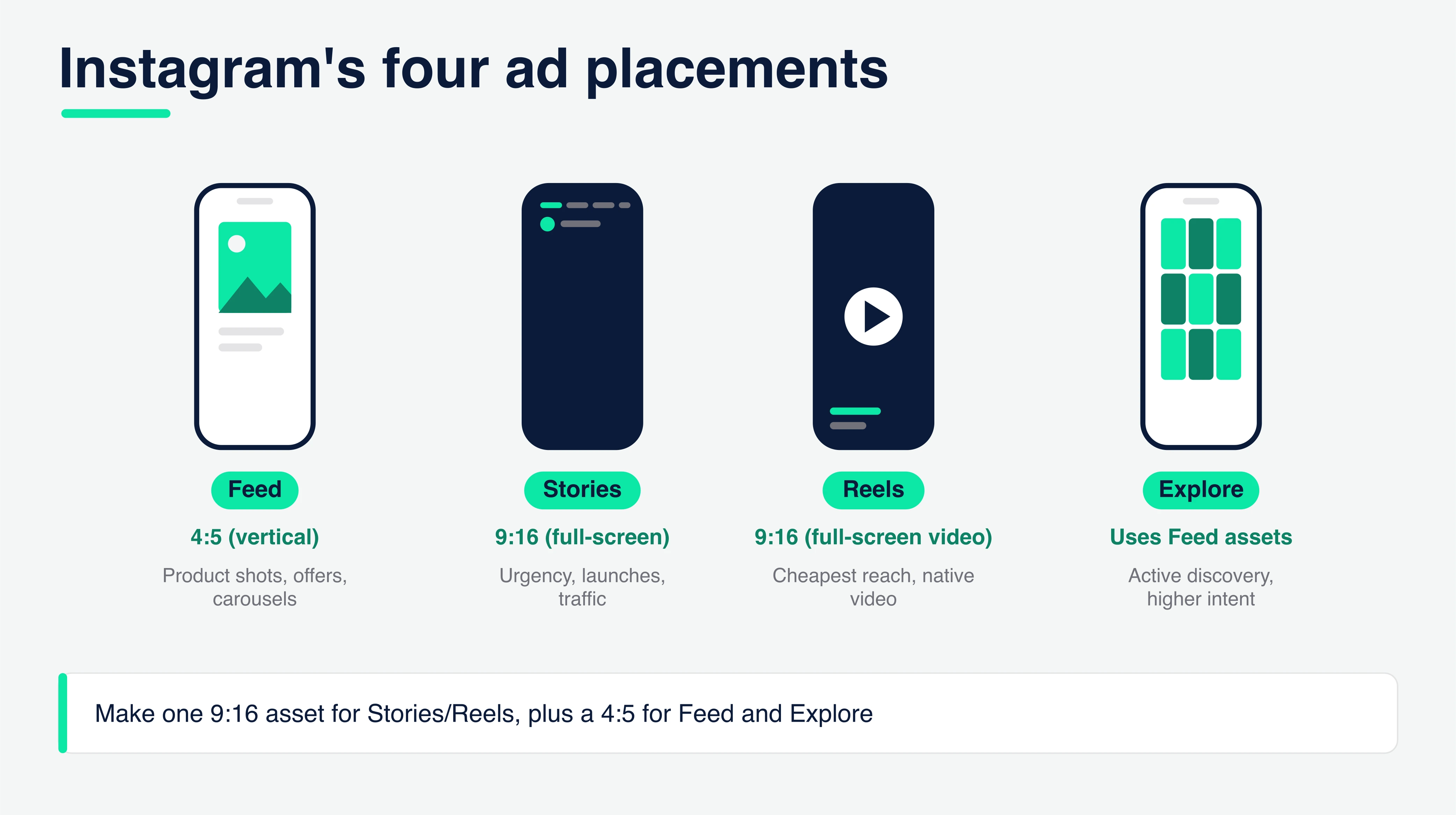
- Feed is the classic in-stream ad. Best for clear product shots, offers and carousels. Portrait 4:5 (1080x1350) is the strongest default because it takes up more vertical screen space than a square; 1:1 and 1.91:1 also run.
- Stories are full-screen, vertical, and gone in seconds. Best for urgency, launches and link-sticker taps. Use 9:16 (1080x1920) and keep text and logos out of the top and bottom margins, where the interface chrome sits.
- Reels are full-screen vertical video served between organic Reels, and they usually deliver cheaper reach (varies by market, season, creative). Best for hook-led video that feels native. Use 9:16 vertical; phone-shot energy beats an over-produced "ad-looking" cut.
- Explore shows your ad in the Explore feed, the scrolling stream someone lands in after tapping a tile from the discovery grid (not in the grid tiles themselves), a discovery-heavy environment where intent varies. It runs off your Feed creative, so there is nothing extra to make.
Product tagging is a format rather than a fifth placement. Ecommerce brands can tag catalogue products inside their Feed, Stories and Reels ads so a tap goes straight from the creative to the product page. The workhorse for running this at scale is catalogue-driven Advantage+ Catalog ads and the Advantage+ Shopping Campaign (ASC), which deliver across these same placements; the funnel section below covers how to put them to work.
A practical rule: build the 9:16 vertical asset first (it covers Stories and Reels), then a 4:5 version for Feed and Explore. Two aspect ratios cover almost every Instagram placement.
Instagram formats worth running
Beyond picking placements, a handful of plays are specific to how Instagram is actually used. These are the formats that tend to perform on Instagram:
- Reels-first creative. Reels is one of the fastest-growing placements on the platform and usually delivers cheaper reach (varies by market, season, creative). Shoot vertical, lead with a hook in the first second, and let it feel filmed on a phone. Native-feeling video often outperforms over-polished ads here, though there are exceptions (for example luxury or regulated categories). If production budget is the blocker, AI generation now delivers phone-feel vertical video at HK$18 a clip. For the build steps, see AI video generation, step by step.
- Stories with stickers and polls. Interactive stickers such as polls and the emoji slider turn a passive view into a tap. Even on paid Stories, giving people something to react to lifts engagement and warms the audience for retargeting.
- Partnership (branded-content) ads. When you work with a creator or KOL, their post can run as an ad under both names once they authorise it through Instagram's branded-content tool. Compared with a one-off sponsored post, you control the budget, audience and flight dates, and you can scale the content that works. In Hong Kong, in many categories a trusted local creator's face often outperforms brand-shot creative.
- Shopping and product tags. For ecommerce, tagging catalogue products inside the ad shortens the path from scroll to product, and a catalogue-driven setup (Advantage+ Catalog ads and ASC) runs this across Feed, Stories and Reels; in Hong Kong the checkout itself usually happens on your own website.
- Click-to-DM ads. Instead of sending people to a form, the ad opens a direct message or WhatsApp chat. In this market, a conversation converts faster than a form, and the chat history doubles as a lightweight CRM. The mechanics of setting the destination live in the Meta Ads Manager tutorial.
An Instagram funnel play that works
The individual plays above are more powerful strung together, and the most advanced version is not a one-way funnel at all. Do not run everything on one objective and hope; run it as a loop, where the connective tissue is a custom audience of people who engaged with your Instagram, an "IG engagers" audience.
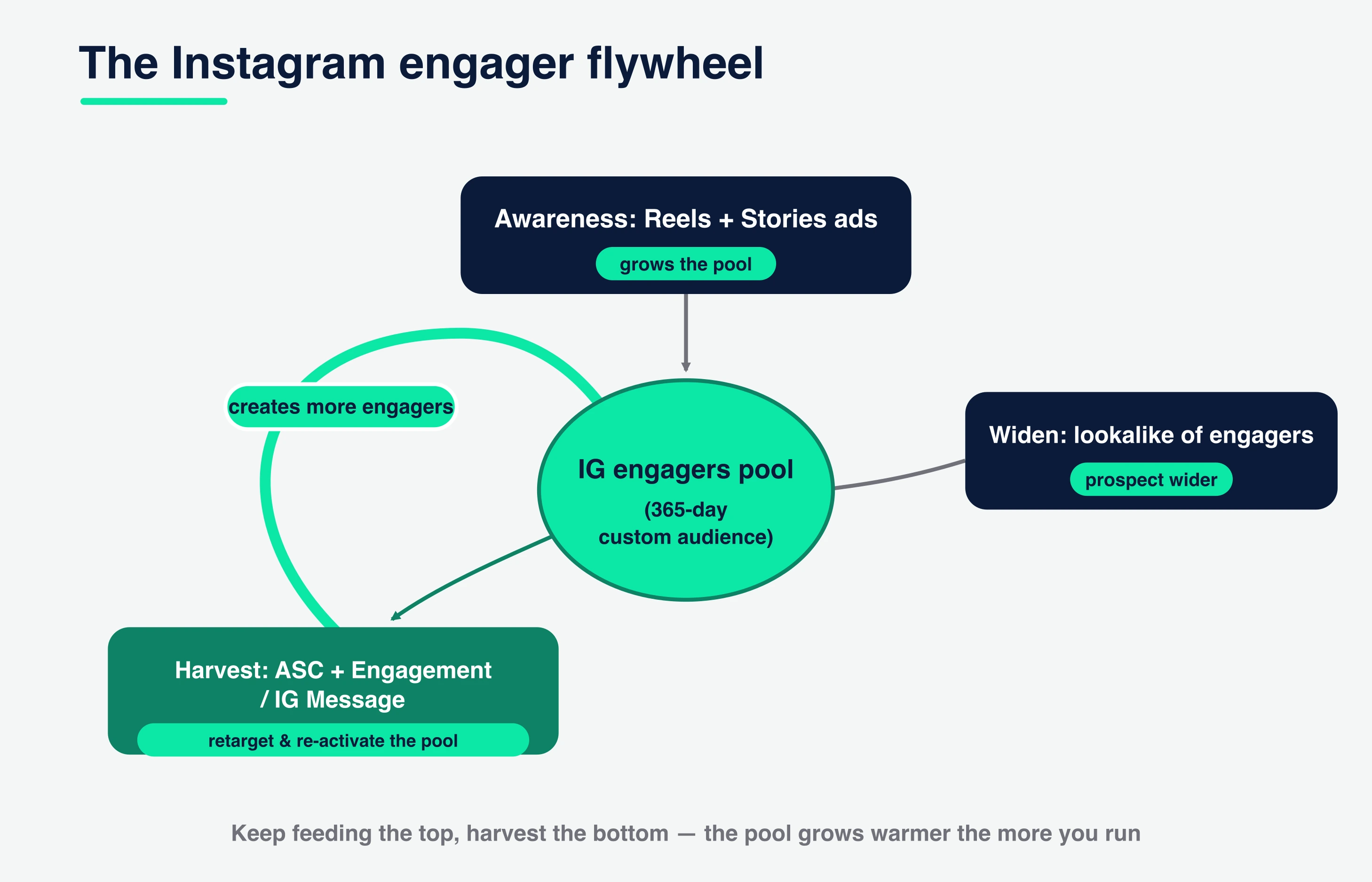
- Build and widen the engager pool (top). Run Awareness and Engagement ads with Reels and Stories. Their job is not the immediate sale; it is to grow a custom audience of everyone who engaged with your Instagram, an "IG engagers, 365-day" audience. To widen the top further, build a lookalike of those IG engagers and prospect against it. A lookalike of your own engagers often outperforms interests in our experience, though it varies by vertical and creative.
- Harvest and re-activate the engagers (bottom). Let your ASC (Advantage+ Shopping Campaign) do the broad sales harvesting, feeding it the IG-engager audience as a signal rather than a hard boundary, since the system expands beyond whatever you hand it. For strict remarketing to the IG-engager pool, use a Sales campaign with Advantage+ Catalog ads plus the engager custom audience, and/or an Engagement objective optimised for messages (IG Message, or click-to-DM), which can hard-target that audience to re-open conversations with people who already know you. Both convert far better than cold traffic because the audience is already warm.
- Close the loop. The ASC and the engagement ads themselves create more IG engagers, who flow straight back into the 365-day pool. So the more you run, the larger and warmer the retargetable audience becomes. It is a flywheel, not a funnel that empties.
This is not theory: one Hong Kong ecommerce account we run is built exactly this way. Reels and video engagement campaigns feed a 365-day IG-engagers custom audience, a lookalike of it widens prospecting, and ASC plus engagement remarketing harvest and re-activate that pool.
The mechanism that makes it a flywheel rather than a funnel is the engager custom audience: keep it fed at the top and harvest it at the bottom. For how to build the custom audience and set these objectives in the tool, see the Meta Ads Manager tutorial.
What Instagram ads cost in Hong Kong
The most common question we hear is "what do IG ads cost?" The honest answer: there is no price list. Instagram ads run on the same Meta auction as Facebook; billing is by that auction and you are usually charged per impression (CPM, per thousand impressions), while CPC (per click) is mostly a performance metric rather than the billing model. Your cost is set in real time by industry competition, how narrow your audience is, the season (11.11, Christmas and Chinese New Year push everyone up), your creative quality, and what you ask the system to optimise for.
That said, figures help. Across the Hong Kong accounts we manage, Instagram CPM commonly lands around HK$30 to 60 per 1,000 impressions, and CPC is typically about HK$1 to 3 when creative and audience are well matched. Treat these as a market range, not a promise: they swing wide with competition, audience breadth, season and creative. A broad, cheap-reach setup can run near HK$10 CPM, while a narrow, premium or peak-season audience can push past HK$100; a poor creative-audience match sends CPC well above that HK$1 to 3 band.
One Instagram-specific note on cost: Reels and Explore placements are usually cheaper per impression than the Feed, so a Reels-heavy mix often buys more reach for the same budget, provided your video is built for it.
As very rough guidance (industries vary widely): a few dozen Hong Kong dollars a day will technically deliver ads; HK$100 to 300 per day per campaign is a common floor for meaningful testing; and businesses optimising steadily for enquiries or purchases commonly invest four to five figures a month. Judge the budget by cost per enquiry or per sale, not by the total. For the full cost breakdown and how to work backwards from your own margins, see the cost section of our Facebook & Instagram ads guide.
Measuring Instagram ads: likes are not revenue
The biggest Instagram trap is grading ads on likes, reach and saves. Those are comfortable numbers, but they are not business results. Decide the real outcome first, whether that is a DM conversation, a form enquiry or a shop purchase, and judge the ads on cost per that outcome.
Instagram-flavoured metrics worth watching once the outcome is set: profile visits and follows as a sign the brand landed, saves and shares as an early read on whether creative resonates, and on Shopping ads, product-page views and checkouts as the real money signal. Treat the vanity numbers as a diagnostic, never as the scoreboard. For setting up tracking properly (Pixel, Conversions API and reading the reporting columns), follow our Facebook & Instagram ads guide and the Meta Ads Manager tutorial.
Facebook or Instagram: which to prioritise?
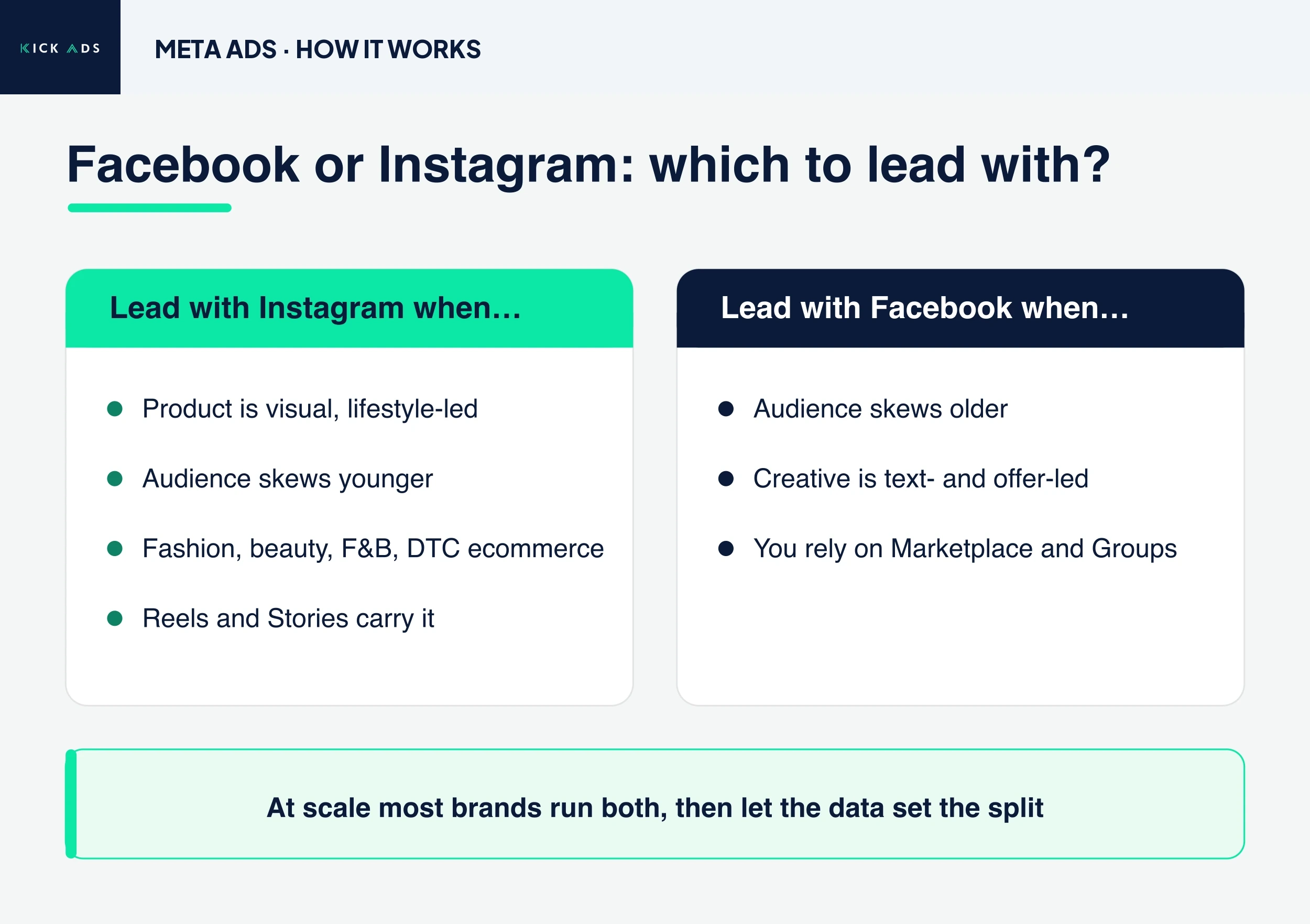
They run in one Ads Manager and automatic placements will split spend between them, so this is rarely all-or-nothing. Lead with Instagram when your product is visual or lifestyle-led and your audience skews younger, such as fashion, beauty, F&B and DTC ecommerce. Lean toward Facebook when your audience is older, your creative is text and offer-led, or you rely on Marketplace and Groups. Most established businesses end up running both and letting the data set the mix. For the deeper strategy behind that choice, see our Facebook & Instagram Ads guide.
Common Instagram mistakes
- Judging ads on likes and reach. Tie reports to enquiries and sales, or you are buying numbers.
- One aspect ratio for every placement. A square Feed image looks broken in a full-screen Reel. Build vertical first.
- Over-produced Reels. "Ad-looking" video underperforms phone-shot style on this placement.
- Running one creative forever. Instagram audiences fatigue fast; keep fresh angles coming.
- Ignoring Shopping and product tags. For ecommerce, they shorten the path to purchase and are often left switched off.
When is an agency worth it?
With a small budget and a simple goal, running your own Instagram ads is entirely doable, and the two guides linked above cover the setup. Professional management starts paying for itself when monthly budgets pass five figures and costs drift, when creator partnerships and Shopping feeds need managing at scale, or when your own time is the biggest cost.
Kick Ads is a Google Partner agency in Hong Kong managing Google and Meta ads together since 2017. If you want a second pair of eyes on your account, start with a free Paid Media Health Check, no pitch, just findings.
FAQ
How much do Instagram ads cost per month in Hong Kong? There is no fixed price; costs come from the Meta auction. As a market range, Instagram CPM in Hong Kong commonly runs around HK$30 to 60 per 1,000 impressions and CPC about HK$1 to 3, both swinging wide with competition, season and creative. On budget, a few dozen dollars a day will technically deliver; HK$100 to 300 per day is a common testing floor; businesses optimising for enquiries or purchases commonly invest four to five figures monthly. Judge by cost per enquiry or sale.
Which businesses suit Instagram ads best? Visual and lifestyle-led ones: fashion, beauty, F&B, homeware, gifts, DTC ecommerce, and local services or experiences, especially where the audience skews younger. Urgent-need services are usually better served by Google Search first.
What is the best Instagram ad format? It depends on the surface: full-screen 9:16 for Stories and Reels, and portrait 4:5 for Feed and Explore. For ecommerce, add product tagging via catalogue-driven ads (Advantage+ Catalog / ASC) inside those placements rather than treating it as a separate surface. As a rule, build the 9:16 vertical asset first (Stories and Reels), then a 4:5 for Feed and Explore.
Do I need a Facebook Page to run Instagram ads? When running through Ads Manager, yes, a linked Facebook Page is required; in-app boosting is a slightly different path. A professional Instagram account is also strongly recommended.
Should Instagram and Facebook ads be run separately? Not necessarily. Both are managed in the same Ads Manager and automatic placements will allocate between them; split them only when creative or audience strategy genuinely differs, such as Reels-specific video.

About the author
Terrence Chung · Co-Founder, Kick Ads
Terrence is an ex-Googler, paid media and SEM trainer. He has managed Google Ads for ecommerce and lead generation businesses across Hong Kong and Malaysia since 2017, working closely on account strategy and optimisation direction.