
Google Ads Broad Match + Smart Bidding: Does It Work? First-Party Data (2026)
By Frankie Chan, Co-Founder · Updated 28 July 2026 · 10 min read
Jump to section
Broad match plus Smart Bidding is one of the most heavily pushed recommendations in Google Ads today. The pitch is that the bidding algorithm reads auction-time signals and prices each query on the fly, so you get broad match's reach without paying for its old sloppiness. Our first-party data says that story is optimistic. Across the Search accounts in our book, when we segmented keyword performance by match type over 90 days, broad match had the lowest ROAS by a wide margin, and in our ecommerce accounts (where ROAS is real revenue, not an assigned lead value) broad match returned only about a third of what exact match did.
Quick answer: Broad match plus Smart Bidding is not free upside. In our ecommerce accounts with real revenue tracking, broad-match ROAS ran at roughly a third of exact-match ROAS, at a higher CPC and a lower conversion rate, and it lost to exact in nearly all of them. Use it only with tight guardrails, and judge it per account on real value, never on Google's recommendation or a blended number.
What does Google actually claim about broad match plus Smart Bidding?
Before the data, the claim, verified against Google's own Grow your business with broad match and Smart Bidding documentation rather than memory, because the pitch has hardened into a Recommendations-tab nudge that most advertisers now accept on reflex.
Google's argument is mechanical and, on paper, reasonable. Broad match used to run loose because it matched widely and every match cost the same bid. Smart Bidding is supposed to fix that: it "uses Google's AI to optimize for conversions or conversion value in each and every auction," so a low-value query gets a low bid and a high-value query gets a high one. Because the bid is set per auction, Google says there is no need to keep duplicate keywords across match types: pair broad with Smart Bidding and let the algorithm sort the traffic.
The headline numbers are specific. Google states that advertisers who switch phrase and broad-match-modifier keywords to broad match "can see ~25% more conversions (in Target CPA campaigns) and ~12% more conversion value (in Target ROAS campaigns) while meeting targets." That is the promise: more volume, same efficiency, no manual match-type work. It is a clean story. Our data does not match it.
What our first-party data shows
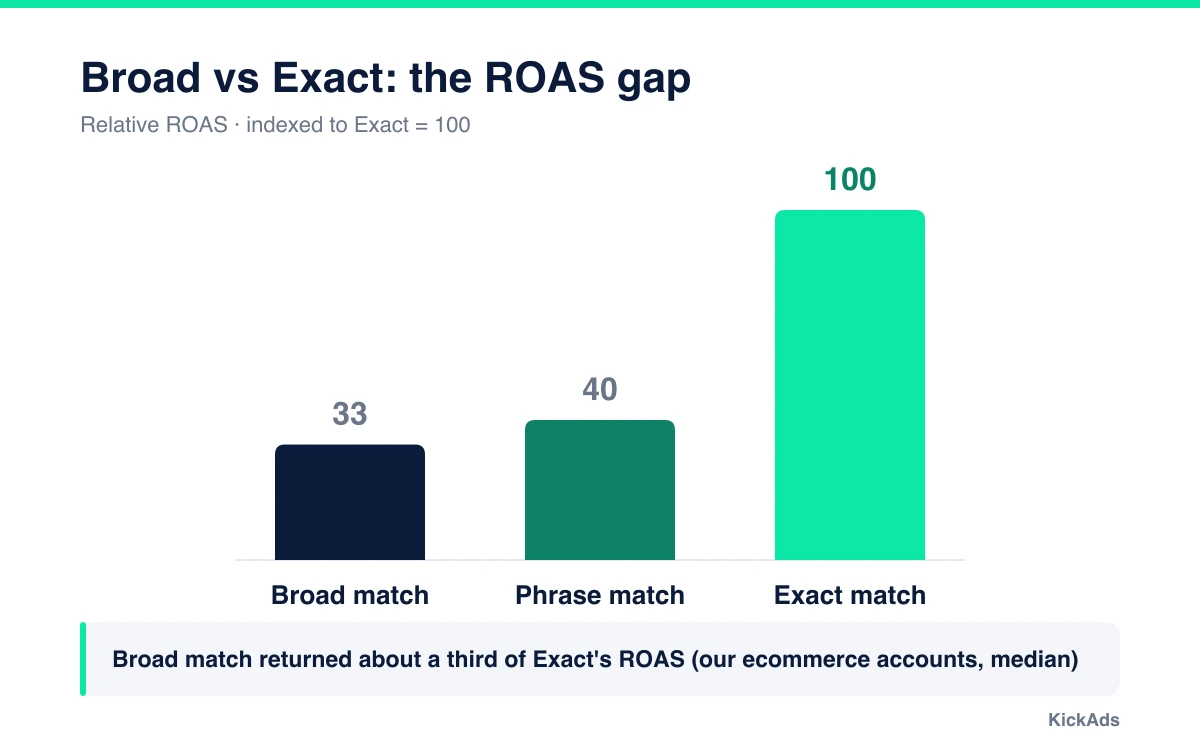
Here is what actually happened across our portfolio when we pulled keyword performance, segmented by match type, over a 90-day Search window, and compared broad-match rows against the same account's exact-match rows.
Finding 1: broad match had the lowest ROAS of any match type, by a wide margin. Exact was highest, phrase sat in between, and broad trailed both. This held across the book as a general pattern, not as a one-account fluke.
Finding 2: in ecommerce accounts with real revenue, broad-match ROAS ran at about a third of exact-match ROAS (median). Not a rounding-error gap. Across those value-based accounts, the median broad-match ROAS was roughly 0.3x the same account's exact ROAS, and broad lost to exact on ROAS in the large majority of them, close to all.
Finding 3: "broad match is cheaper" did not hold. Broad-match CPC was higher than exact in most of those accounts, and broad-match conversion rate was lower than exact in most. So broad was paying more per click, converting a smaller share of them, and returning less value on the ones it did convert.
One honest note on scale. Pooled across the whole book the gap looks even wider, but that pooled figure is skewed by a few disproportionately large accounts, so it may not reflect your situation and we do not lead with it. The honest headline is the per-account ecommerce median: broad match returned roughly a third of exact's ROAS. That is the number to plan around.
Read this the right way, though. Our portfolio is deliberately exact-dominant, so this comparison is really "broad-match expansion versus a hand-curated, proven exact list." That is not proof Smart Bidding's matching is broken. It is the expected result: uncurated discovery traffic converts at lower value than terms you personally picked and validated, which is the very reason disciplined advertisers keep exact as the core in the first place. Broad's job is to find demand your list misses. The data says it usually finds cheaper, lower-value demand while doing so.
When does broad match actually work?
It is not never. There are real situations where broad earns a contained test, and one where the headline number lies in broad's favour.
Genuinely thin or mismatched coverage. If your exact list is sparse, or your terms do not match how people actually search for the product, broad can find converting queries a thin list never captured. This is the same weak-coverage situation where discovery traffic reliably produces a return. It is a test, not a default.
Value-based bidding, not count-based. Broad match on Maximize conversions or tCPA optimises for the cheapest conversions it can find, which is precisely how the low-value volume problem above takes hold. On Maximize conversion value or tROAS, the strategy is at least pointed at value, so broad has a fighting chance of clearing a real bar. Broad match without value-based bidding on an ecommerce account is high-risk, and it usually underperforms.
Lead-gen is the murky case, and it deserves a warning. In our lead-gen accounts, broad's reported ROAS often looked fine, sometimes better than exact. Read that carefully. Lead-gen ROAS is built on assigned lead values, not real profit, so a channel that drives more raw leads will post a higher reported return whether or not those leads are any good. And broad's whole tendency is to drive more volume of lower-quality conversions. So broad on lead-gen can look great on the dashboard while filling your CRM with junk, the exact PMax-on-lead-gen pattern again. Do not trust broad's lead-gen ROAS until you have reconciled the leads against real sales.
| Dimension | Broad match | Phrase match | Exact match |
|---|---|---|---|
| ROAS (ecommerce, real revenue) | Lowest (about a third of exact, median) | In between | Highest |
| CPC | Higher than exact in most accounts | Middle | Lowest |
| Conversion rate | Lower than exact in most accounts | Middle | Highest |
| Conversion count / volume | Can be highest (cheap, low-value) | Middle | Lower but higher value |
| Control over what you match | Loosest | Moderate | Tightest |
Read the table the way the data reads: broad can win the volume column and still lose every column that pays your bills.
How to keep broad match under control
If you are going to run broad, run it contained. Uncontained broad on a count-based strategy is how ecommerce accounts leak margin and lead-gen accounts fill with junk. Here is how we hold it in check:
- Pair it with value-based bidding. On ecommerce, run broad on Maximize conversion value or tROAS, never on Maximize conversions, so the strategy is optimising for value rather than for the cheapest possible conversion.
- Feed real conversion values. Value-based bidding is only as honest as the values you send it. Send real revenue for ecommerce, and for lead-gen send differentiated lead values reconciled against actual sales, not a flat number on every form fill.
- Give broad its own campaign or ad group. Do not let broad share a campaign with your proven exact keywords, where its lower-value traffic blends into and drags down the number you use to judge the winners. Separate it so you can read it, budget it, and target it on its own.
- Exclude brand. Add your brand terms as negatives on the broad campaign so it cannot cannibalise brand demand at a lower ROAS than your clean brand exact would have delivered.
- Layer audience signals. Add your first-party and in-market audience segments in Observation mode so Smart Bidding can use them as signals, biasing broad toward higher-intent users, which tightens the net without collapsing the reach that made broad worth testing.
- Work the search-terms report weekly. Broad's whole risk lives in the search-terms report, though not every query shows there because of privacy thresholds. Filter to the broad rows, read what it is actually matching, and pour negatives back in fast. This is the single highest-leverage habit, and skipping it is how broad quietly runs away.
How to test it on your own account
Do not take our median as your answer. Broad match's outcome is account-specific, so measure it the honest way on your own data:
- Segment your keyword report by match type. Pull the broad rows out and compare them directly against the same account's exact rows on ROAS, CPC and conversion rate. That is the comparison every number above is built on, and it is the only one that tells you which match type is actually profitable for you.
- Never judge broad on a blended campaign number. If your exact keywords are carrying a 6x and broad is running a 2x, the blend still looks like a healthy 5x, and you will conclude broad is fine. It is not fine, it is being subsidised by your exact keywords.
- Run a proper experiment. Use a Google Ads campaign experiment or an Experiments split to A/B broad against your exact-led setup, so you are measuring incremental value rather than reshuffled credit.
- Reconcile against your CRM and real sales, especially for lead-gen, where broad's reported ROAS is built on assigned lead values and flatters the channel until you check whether the leads actually closed.
- Watch value per conversion, not just conversion count. The count is where broad looks best and lies most. Value per match type is where the truth is.
The Hong Kong and Malaysia angle
For Hong Kong and Malaysia advertisers, two local realities make broad match riskier, not safer.
Bilingual search makes broad messier. HK and MY users search in English, Traditional Chinese and romanised mixes, often in the same session. Broad match will happily expand across all of that, which pulls in a wide spread of intent, some of it unrelated. On a thin-coverage retailer that can surface useful demand, but on any account where exact is already working, it widens the low-value net that the ROAS gap above is measuring. Read the broad search-terms rows even more closely here.
Lead-gen is the dominant model, and it is where broad hurts most. Many HK and MY accounts are lead-gen and services, where the whole risk is expansion into low-intent queries that fill the CRM with junk leads. High-intent Search stays the engine. If you test broad on a lead-gen account, hold it to a value-based strategy with differentiated lead values, exclude brand, and reconcile against real sales before you believe the reported ROAS. For the wider Search fundamentals see our SEM ultimate guide, for match types specifically our keyword matching type guide, and for the bidding side our Google Ads bidding strategy guide.
FAQ
Should I ever use broad match? Yes, but contained and on value-based bidding, and only after you know your coverage. If your exact keywords are clean and well-built, broad tends to return far less value in our data, roughly a third of exact's ROAS in ecommerce accounts. If your exact coverage is genuinely thin or mismatched, a ring-fenced broad campaign on Maximize conversion value or tROAS, with brand excluded and the search-terms report worked weekly, is a reasonable test. Judge it per account on real value, never on Google's recommendation or a blended number.
Does broad match work better with tROAS? Better than with Maximize conversions, yes, because tROAS points the strategy at value rather than at the cheapest possible conversion, which is where the low-value volume problem starts. But better is not the same as good: even on value-based bidding, broad returned well below exact across our ecommerce accounts. tROAS also needs steady conversion-value signal to behave, so a very small broad campaign may run steadier on tCPA until it builds up data. Use value-based bidding as the floor for testing broad, not as proof it will win.
Is broad match different for lead-gen versus ecommerce? Yes, and this is where most people are misled. In ecommerce, ROAS is real revenue, so broad's lower return shows up honestly as a lower ROAS. In lead-gen, ROAS is built on assigned lead values, so broad can post a higher reported ROAS simply by driving more raw leads, whether or not those leads are any good. Broad's tendency to drive lower-quality volume means a lead-gen account can look fine on the dashboard while filling with junk. Always reconcile lead-gen results against real closed sales before trusting broad's number.
Want us to work out whether broad match is helping or quietly diluting your account, by match-type segment on real value rather than the blended number? Message us on WhatsApp or book a free strategy call →. Kick Ads has run Google Ads as a certified Google Partner since 2017, deciding with first-party data rather than the platform pitch.

About the author
Frankie Chan · Co-Founder, Kick Ads
Frankie is an ex-Googler and paid media strategist. He has managed Google Ads and Meta Ads for ecommerce and lead generation businesses across Hong Kong and Malaysia since 2017, working closely on strategy, reporting and client growth planning.