
Google Ads AI Max for Search: When to Turn It On, When It's Costing You (First-Party Data)
By Frankie Chan, Co-Founder · Updated 17 July 2026 · 17 min read
Jump to section
Google Ads AI Max for Search is a feature many advertisers have been encouraged to switch on in the last year, mostly on the promise that it is free upside. Our first-party data says that is only half true. Across the Search accounts in our book that had AI Max turned on, it usually delivered incremental reach at a lower ROAS than tight Exact-match, and its CPC was not reliably cheaper. In our data, the clearest win came from one situation, and if you do not know which situation your account is in, you are letting expansion traffic dilute your strongest campaigns. This guide is built on our own anonymised MCC data, ratios only, so you can judge AI Max on evidence instead of the pitch.
Quick answer: AI Max for Search is not "on = win," and the rule is not the tidy "brand off, non-brand on" you have probably heard. The real driver is coverage quality: AI Max tends to win where your existing Exact coverage is weak or mismatched. Brand was the clearest risk zone in our data; non-brand is a maybe you must test, not assume. Well-built non-brand campaigns still lose to Exact in our data. So judge per campaign on whether your Exact is already capturing the demand, contain AI Max in its own campaign, and point it only at genuine coverage gaps.
What Google Ads AI Max for Search actually is
Before the data, the mechanics, verified against Google's own AI Max for Search documentation rather than memory, because this feature shipped after most people's mental model of Search was set.
AI Max is not a new campaign type. It is a one-click suite of targeting and creative features you switch on inside an existing Search campaign. Google describes it as two things bundled together:
- Search term matching. This is the core of it: your campaign stops being limited to your keywords. AI Max search term matching expands beyond the campaign's existing keywords by using broad match, keywordless, asset-based and landing-page-based signals, reading your existing keywords, creative and landing pages to find relevant queries your keyword list never contained. In effect your keywords become hints, not hard limits.
- Asset optimization. Two parts. Text customization (formerly "automatically created assets") uses your ad text, landing-page copy and generative AI to write query-tailored headlines and descriptions. Final URL expansion (which requires text customization to be on) can send a click to whichever page on your site Google judges most relevant, not just your set final URL. One caveat worth knowing: when final URL expansion or URL inclusions allow Google to select a more relevant URL, pinned RSA assets may not be respected. If pinned assets must always be used, review final URL expansion and URL inclusions carefully or switch them off.
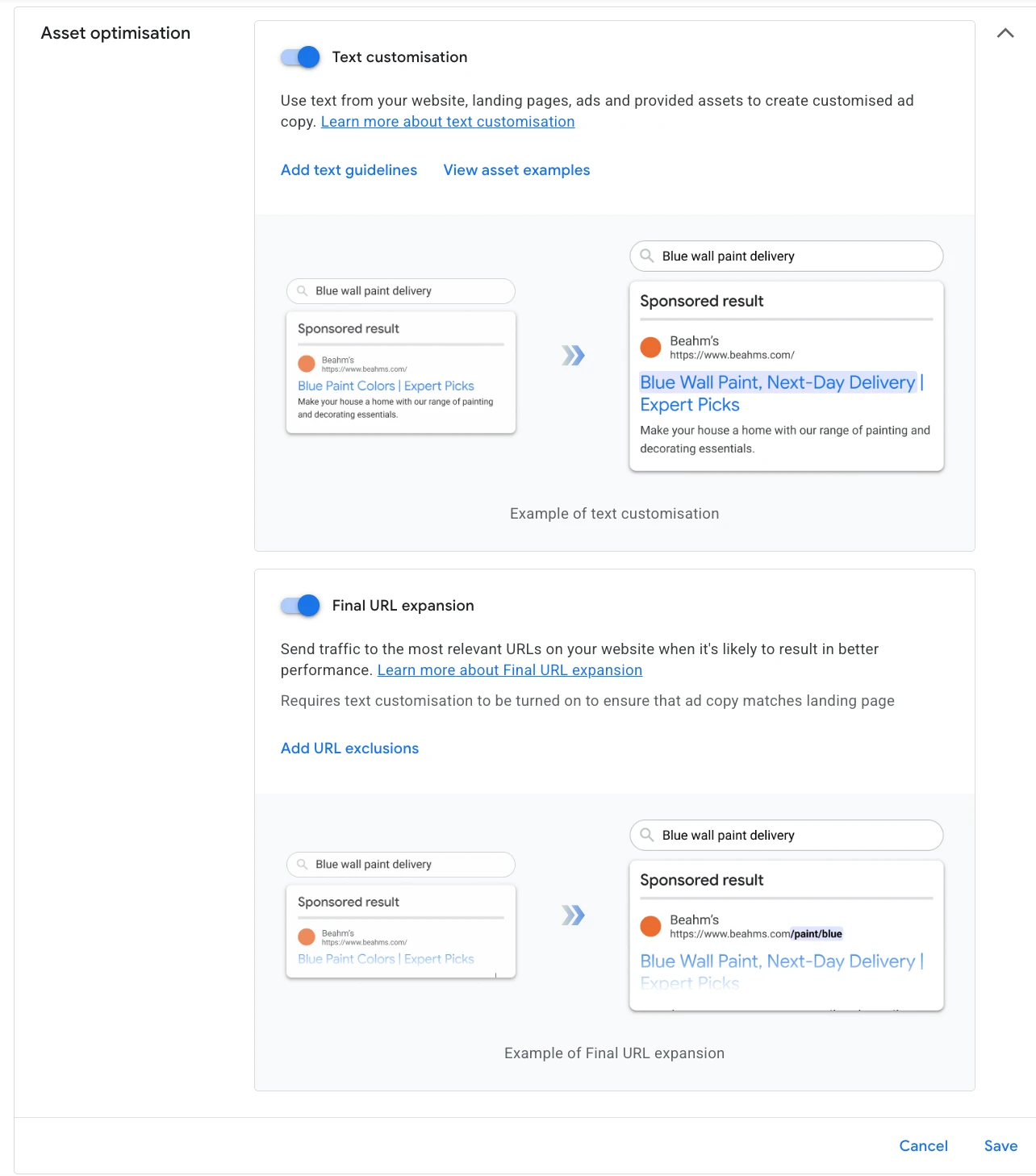
To keep it from running wild, Google exposes real controls: brand settings (brand inclusions at campaign and ad-group level, brand exclusions at campaign level), locations of interest (target by the geography a searcher is interested in, at ad-group level), URL inclusions and exclusions, and text guidelines to restrict messaging. URL exclusions are useful for blocking pages you do not want AI Max to use as landing pages; URL inclusions can guide which pages are eligible, but if final URL expansion is still enabled you should check the actual landing-page report rather than assume the URL is fully locked. These matter, and the containment steps below rely on them.
Crucially for measurement: the most direct way to judge AI Max is to segment the search-terms report by match type and source. AI Max traffic shows up as its own "AI Max" match type, with a source column telling you whether a match came from broad-match expansion or keywordless matching. That view exists and it matters, yet many advertisers still miss it.
The hype vs what our first-party data shows
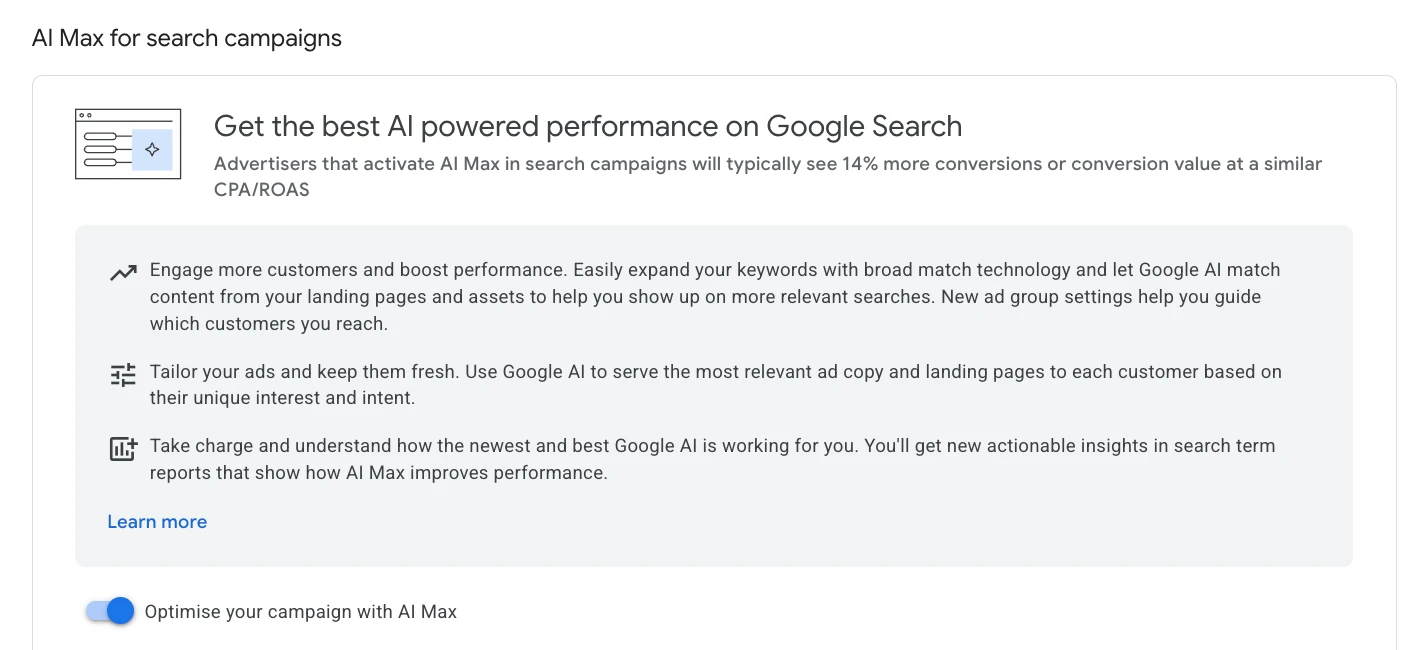
Google's headline claim is that advertisers activating AI Max "typically see 14% more conversions or conversion value at a similar CPA/ROAS" (2025 internal data, non-Retail). That is the pitch. Here is what actually happened across our portfolio when we segmented performance by search_term_match_type and compared the AI Max rows against the same account's tight Exact-match rows over a 90-day window.
Finding 1: AI Max ROAS landed below Exact ROAS in roughly 7 of every 8 ecommerce accounts with real revenue tracking and meaningful AI Max volume. Not marginally below, either: AI Max ROAS typically ran at about half the ROAS of the same account's Exact, on average, and sometimes as little as a fifth. It tied or beat Exact in only one account.
Finding 2: "AI Max = cheaper CPC" is a myth at scale. In about 3 of every 4 accounts, AI Max CPC was higher than Exact, often 1.5x to 3x the Exact CPC. It was cheaper in only a minority. The intuition that a broader, AI-matched net must be cheaper simply did not hold in the data.
Finding 3: real spend, zero return in the test window in several accounts. AI Max spent budget and returned no conversions at all over 90 days. Volume was small and some of those cells are genuinely still learning, but it is a live cost you are carrying while it figures itself out.
Put as a range rather than a row-by-row list: across most of those ecommerce accounts, the account's tight Exact ROAS ran at roughly two to five times AI Max's, most often about double, and it only tied Exact in a single account. The pattern is consistent across our sample. On well-covered accounts, switching AI Max on and letting it share the campaign with your Exact keywords pulls blended ROAS down, because the AI Max slice converts at a materially lower return, and only one account escaped that gravity.
When AI Max wins vs when it dilutes
The averages hide the variation, which is that the outcome is almost entirely decided by one thing: how good your existing keyword coverage already was.
The clear win: weak or mismatched coverage. In one campaign whose Exact keywords were poorly matched to how people actually searched for the product and retailer, AI Max beat Exact by roughly 6x ROAS at about a 5x to 6x lower CPA, and it drove around 77% of the campaign's conversion value. That is not a rounding-error edge; that is AI Max doing the job keywords were failing at, finding the converting queries a thin or mismatched list never captured. Weak coverage is AI Max's home turf.

The clear loss: AI Max left on inside brand campaigns. Brand is where AI Max most often underperforms in our data, and it is also where we most often find it quietly switched on, the one-click default nobody turned back off. Across an illustrative sample of strong retail and ecommerce brand campaigns in our book (an illustrative sample, not our full portfolio), AI Max had been left running inside the brand campaign itself, and in every one it was the weakest match type in that campaign. the brand Exact ROAS ran at roughly two to five times the AI Max ROAS, and AI Max's CPA was about 1.5x to 4.5x higher. Even the single biggest-volume case still came in at under half the brand Exact ROAS.
| Brand campaign (illustrative) | Brand Exact ROAS ÷ AI Max ROAS |
|---|---|
| Footwear brand | 2.2× |
| Apparel brand | 4.8× |
| Lifestyle brand | 3.7× |
| Sportswear brand | 1.8× |
| Homeware brand | 2.2× |
Read this as wrong campaign, not wrong tool. That expansion traffic can still be profitable in the right place; in one case the same kind of expansion ran around 9x ROAS once it was pulled into its own non-brand campaign. Bolted onto brand it does two bad things at once: it dilutes a campaign that was already winning cheaply, and it muddies your reporting so the brand ROAS no longer means what you think it means. The fix is mechanical, not clever: turn AI Max off in the brand campaign, and if you want the expansion, run it as a separate non-brand campaign with your brand terms added as negatives.
The honest part: non-brand is genuinely mixed. It would be tidy to say "brand off, non-brand on," but our own data will not let us. Across the handful of non-brand campaigns where AI Max had real volume, results split both ways. It won where Exact coverage was thin: a generic lead-gen campaign whose Exact keywords barely converted saw AI Max drive many times the conversions at a fraction of the CPA, and a symptom-based term that was unprofitable on Exact turned around under AI Max. But it lost where Exact was already working: the biggest-volume non-brand case ran at under half of Exact's ROAS with a worse CPA. Our non-brand sample is small and split, so we cannot honestly claim "non-brand is better" as a rule; the only claim the data supports is that AI Max wins where coverage is weak. (One of those lead-gen wins had loose conversion counting, so lean on the pattern, not any single number.)
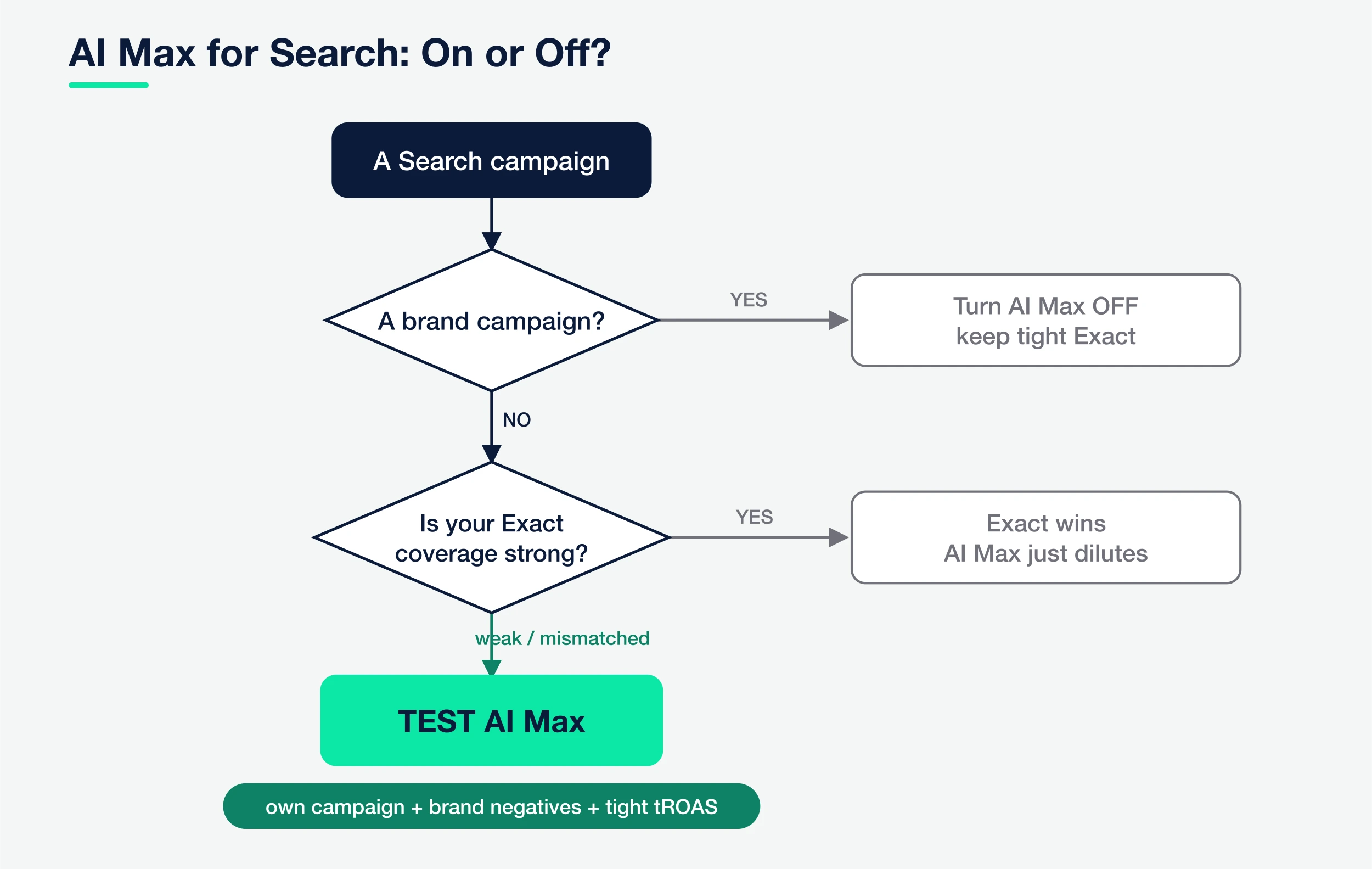
So the reconciliation is simple, and it is the whole article in a few lines:
- Weak or mismatched Exact coverage (thin lists, product or retailer terms that don't match how people search, generic lead-gen where Exact barely converts) → test AI Max: this is the one place it reliably produces a return.
- Brand → leave it off: in our data, this is the clearest zone where your Exact already wins cheaply.
- Well-built non-brand → Exact usually still wins: do not treat non-brand as an auto-on switch. Judge it campaign by campaign on whether your Exact is already capturing that demand.
- Judge on the match-type segment, never blended. A blended campaign number hides which side is actually carrying you.
One more piece of context: even where it is switched on, AI Max is still a small slice of clicks in almost every account, usually single-digit percent of Search clicks, the largest around 18%. Most accounts are still in test or expansion mode with it, which is exactly the right posture. The mistake is not testing AI Max; the mistake is turning it on across your best campaigns and trusting the blended number.
If you're an Exact-only advertiser
One honest caveat about the numbers above, and it matters. Our own portfolio is deliberately Exact-dominant, well over 90% Exact with near-zero raw broad or phrase. So the "AI Max ROAS is about half of Exact" comparison is really "expansion and discovery traffic versus a hand-curated Exact list." That is not evidence that AI Max's matching algorithm is bad. It is the expected result: discovery traffic is lower-intent than terms you personally hand-picked and proved, which is the very reason disciplined advertisers avoid raw broad and phrase in the first place. Read those numbers as "curated beats uncurated," not "AI Max is a broken algorithm," because those are two different claims and only the first is what our data supports. Our data does not prove that AI Max is weaker than keyword targeting in general. It shows that, in Exact-led accounts, uncontained expansion traffic usually underperforms proven Exact demand unless it is pointed at real coverage gaps.
That reframing surfaces the real strategic upside for an Exact-only shop. AI Max is best understood as the smarter, contained successor to broad match. It gives you keyword-optional expansion, the discovery you have been deliberately forgoing, but wrapped in the controls raw broad match never had: brand exclusions, a tight tROAS or tCPA leash, and per-match-type search-term reporting so you can see exactly what it matched. If you have consciously avoided broad and phrase because they run loose, a ring-fenced AI Max campaign is a lower-risk way to probe for converting demand beyond your Exact list than opening raw broad match ever was.
So use it as a discovery engine, not a replacement. The workflow that fits an Exact-first account:
- Run AI Max as a contained probe: its own campaign, small budget, tight target, brand negatived out.
- Read the search-term report by match type and let the AI Max rows tell you which query clusters actually converted.
- Harvest the winners back into Exact keywords, graduating each proven query into your trusted bucket where it runs at full-intent ROAS.
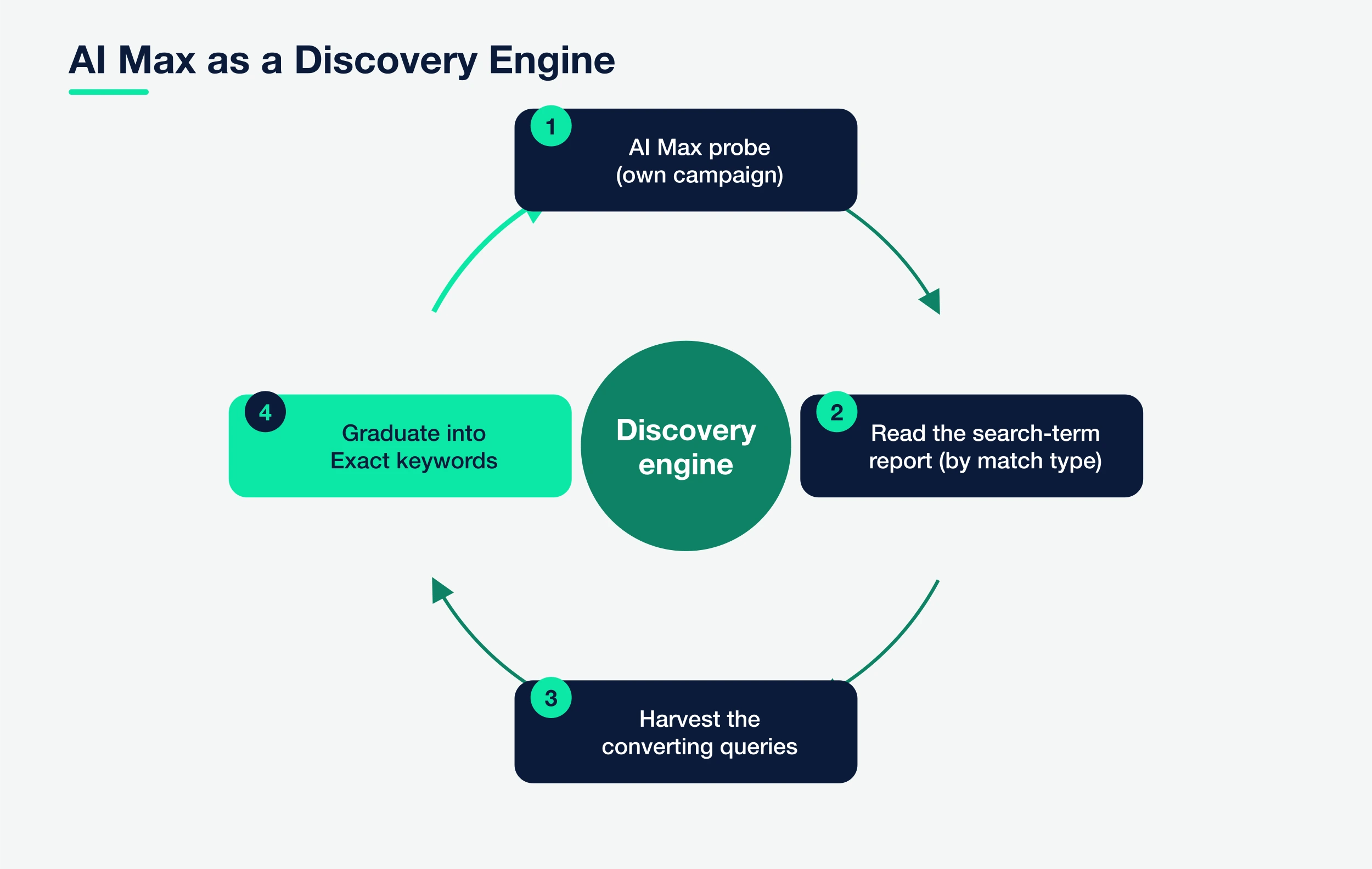
Done this way, AI Max feeds your Exact list instead of competing with it. The lower blended ROAS on the AI Max campaign is the price of discovery, and the payoff is a steady stream of new, proven Exact terms you would never have written yourself.
How to contain the test
AI Max should be treated as a controlled test, not a default switch. Contained, it finds you incremental converting demand. Uncontained, it can drag down campaigns that were already working. Here is how we run it:
- Give it its own campaign. Do not bolt AI Max onto your brand or best-performing Search campaigns. Run it as a separate, ring-fenced campaign so its lower-ROAS traffic never blends into and drags down your winners.
- Negative out your brand terms. Add brand terms as campaign or account negatives on the AI Max campaign so it cannot cannibalise brand demand at a lower ROAS than your clean brand Exact would have delivered. Use the brand settings control as a second layer.
- Tight target from day one. Set a firm tCPA or tROAS from the start and give it a small budget. Do not let a keywordless, expansion-heavy campaign run on maximise-clicks logic.
- Work the search-terms report weekly. Filter to the AI Max match type, read what it is actually matching, and pour negatives back in fast. This is the single highest-leverage habit; the AI Max row plus its source column is where you catch dilution early.
- Point it at the gaps, not the strengths. Keep brand and your well-covered terms on tight Exact. Aim AI Max at non-brand, product, retailer and thin-list areas, the coverage holes, where the evidence says it produces a return.
- Give it a learning window before you judge. Small-volume, zero-conversion cells are often just learning, not failing. Do not kill it on week one, but do keep it contained while it settles.
Should you just set a higher tROAS?
The natural push-back is: if AI Max dilutes ROAS, can I not just set a tighter tROAS and force it to behave? Mostly yes, a tighter target is the main lever that makes AI Max efficient. But there is a catch that trips almost everyone up: tROAS is a campaign-level setting, not a match-type one. While AI Max is fused inside your brand campaign, you cannot tighten only the AI Max slice; raising the target chokes your brand Exact along with it, and you end up losing cheap brand conversions to fix an expansion problem. If you only want to test whether AI Max helps, a standard campaign experiment can A/B test AI Max on versus off inside the existing campaign, so separation is not always required just to test. But for long-term control, separation is usually cleaner. Once you need a different budget, tROAS, brand-negative setup or reporting view for expansion traffic, AI Max should be ring-fenced in its own campaign, and only then does a tight tROAS govern just the expansion.
Two failure modes to avoid once it is separated:
- Set it too high and AI Max may not get enough traffic to learn. Push the target too hard and the system stops exploring, and you lose the entire reason you ran AI Max in the first place: discovery. If the job is finding new demand, give it room; if the job is efficiency on demand you already understand, tighten it.
- tROAS needs enough conversion signal. Value-based bidding needs enough conversion value signal to work reliably. As a practical rule, we would be cautious with very small campaigns and would not expect tROAS to behave well without steady conversion volume; on low volume a tCPA or a manual cap is often steadier until it earns enough data.
Match the target to the job. Discovery wants room to explore; efficiency wants it tight. The one thing you cannot do is govern AI Max properly while it is still riding inside a campaign built for something else.
How to measure it properly
The reason most advertisers believe AI Max is "working" is that they are reading the blended campaign ROAS, which folds AI Max traffic in with their tight keyword traffic. If your Exact keywords are carrying a 6x and AI Max is running a 2x, the blend still looks like a healthy 5x, and you conclude AI Max is fine. It is not fine; it is being subsidised by your keywords.
Measure it the honest way:
Segment by
search_term_match_type. Pull the AI Max rows out and compare them directly against the same account's Exact / near-Exact rows. That is the comparison every number above is built on, and it is the only one that tells you which side is actually profitable.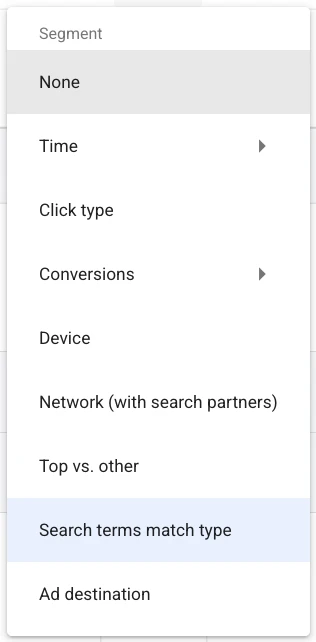
Never judge AI Max on a blended number. Blended hides the dilution by design.
Reconcile against your CRM and real sales, especially for lead-gen, where a low-intent expansion click can complete a form without ever intending to buy. Platform-reported conversions flatter AI Max the same way they flatter PMax on lead-gen.
Watch CPC by match type too, not just ROAS. The "cheaper CPC" assumption is where a lot of AI Max budget quietly leaks.
The Hong Kong and Malaysia angle
For Hong Kong and Malaysia advertisers specifically, two things make containment more important, not less.
Bilingual search terms make expansion messier. HK and MY users search in English, Traditional Chinese and romanised mixes, often in the same session. AI Max's keywordless expansion will happily match across all of that, which is powerful for a retailer with thin coverage but dangerous on a brand campaign where a loose Chinese or English variant can pull in unrelated intent. Read the AI Max search-terms row even more closely here.
Thin-market accounts are where AI Max actually helps. Many HK and MY accounts run smaller keyword lists than a large US account would, simply because the search volume is thinner and nobody built out the long tail. That is precisely the weak-coverage situation where our data shows AI Max wins. If your account is a lean lead-gen or niche retailer setup, a contained AI Max campaign pointed at your coverage gaps is worth a genuine test, provided you hold it to a tight target and reconcile the leads against real sales.
For ecommerce, keep your brand and best product terms on tight Exact and let a separate AI Max campaign hunt the gaps. For lead-gen and services, be stricter still: high-intent Search stays your engine, and any AI Max test runs on a tROAS or tCPA with CRM reconciliation, because expansion into low-intent queries is exactly how lead-gen accounts fill up with junk. For the underlying costs, see our Google Ads cost in Hong Kong guide, and for the wider Search fundamentals, our SEM ultimate guide.
FAQ
Should I turn on Google Ads AI Max for Search? Only in a contained way, and only after you know your coverage. If your account already has clean, well-built Exact-match keywords, especially on brand, AI Max tends to dilute ROAS in our first-party data. If your Exact coverage is genuinely thin or mismatched, AI Max can find converting queries your list misses and is worth a ring-fenced test, but test rather than assume: this is not "brand off, non-brand on." A well-built non-brand campaign will often still lose to Exact, so judge it campaign by campaign on whether your Exact is already capturing that demand. And never switch it on across your best campaigns and trust the blended number.
Is AI Max cheaper than keyword targeting? Not reliably. In about three of every four accounts we measured, AI Max CPC was actually higher than tight Exact-match, often 1.5x to 3x higher. The idea that a broader AI-matched net must be cheaper did not hold in the data. Watch CPC by match type, not just ROAS.
Does AI Max increase conversions? It can add incremental conversions from queries your keywords never covered, which is real value on weak-coverage accounts. But across our portfolio those extra conversions usually came at a lower ROAS than Exact, roughly half the ROAS of Exact in most ecommerce accounts, sometimes less. More conversions is not the same as more profit; judge it on ROAS by match type.
How do I measure AI Max properly? Segment your reporting by search-term match type and compare the AI Max rows directly against the same account's Exact-match rows. Do not read the blended campaign ROAS, which hides AI Max dilution behind your keyword performance. Reconcile conversions against your CRM, especially for lead-gen, and work the AI Max search-terms report weekly to feed negatives back in.
Can I just set a higher tROAS to fix AI Max? A tighter tROAS is the main lever, but it is a campaign-level setting, not a match-type one, so you cannot tighten only the AI Max slice while it is fused inside a brand campaign; you would choke your brand Exact too. If you only want to test AI Max, a standard campaign experiment can A/B test it on versus off inside the existing campaign; but for long-term control, separating it into its own campaign is cleaner, and then a tight tROAS governs only the expansion. Watch two traps: set the target too high and AI Max may not get enough traffic to learn and stops discovering; and value-based bidding needs steady conversion volume to behave, so a very small AI Max campaign may run steadier on tCPA until it builds up data.
Will AI Max cannibalise my brand campaign? It can, if you let it run over brand terms, and it usually does so at a lower ROAS than your clean brand Exact would have delivered. Run AI Max in its own campaign, add your brand terms as negatives, and use Google's brand settings control so it stays pointed at the coverage gaps instead of stealing demand you already own cheaply.
Want us to work out whether AI Max is helping or quietly diluting your account, by match-type segment rather than the blended number? Kick Ads has run Google Ads as a certified Google Partner since 2017, deciding with first-party data rather than the platform pitch. See our Google Ads service or talk to us.

About the author
Frankie Chan · Co-Founder, Kick Ads
Frankie is an ex-Googler and paid media strategist. He has managed Google Ads and Meta Ads for ecommerce and lead generation businesses across Hong Kong and Malaysia since 2017, working closely on strategy, reporting and client growth planning.