
Why Is Your Brand Keyword CPC So High?
By Terrence Chung, Co-Founder · Updated 14 July 2026 · 6 min read
Jump to section
- Brand keywords are usually the cheapest — but not always
- Cause 1: The wrong keyword match type
- Cause 2: Competitors are bidding on your brand
- Cause 3: A low overall Quality Score
- Cause 4: The wrong budget or bidding strategy
- Case study: Brand CPC cut 42% in two months
- Should you bid on your own brand?
- Conclusion
- FAQ
Cost-per-click (CPC) is what you pay each time someone clicks your ad, and it's one of the main components of what Google Ads costs in Hong Kong. Brand keywords — the ones containing your brand name or closely related terms — should be the cheapest in the account: the person searching already knows you, so intent and relevance are high, Quality Score follows, and CPC drops. So why do your brand keywords sometimes cost more than they should? This guide breaks down the four most common causes, and the fix for each.
Brand keywords are usually the cheapest — but not always
Quick answer: Brand keywords are usually the cheapest in your account: across the accounts we manage at Kick Ads, brand CPC runs a median of roughly 40% below generic keywords. But it isn't a given — we've also seen individual accounts where brand CPC runs about 30% higher than generic, and that's normally a warning sign.
In other words: if your brand CPC is clearly high, it's usually telling you something is off — competitors are bidding, match types are too broad, Quality Score is low, or the bidding strategy is wrong. Let's take them one at a time.
Cause 1: The wrong keyword match type
Quick answer: Match types that are too broad let your brand ads show on a flood of unrelated searches, drawing expensive clicks that never convert and dragging your average CPC up.
Match type decides how closely your keyword has to line up with a search query: Broad Match, Phrase Match and Exact Match. On broad match, a brand term can trigger on queries that have nothing to do with your brand — burning budget.
The fix: Lead with Phrase Match and Exact Match on brand keywords to balance coverage against relevance, then pair them with negative keywords to exclude irrelevant terms. For a deeper look at the trade-offs of each match type, see our complete guide to keyword match types.
Cause 2: Competitors are bidding on your brand
Quick answer: This is the most common reason brand CPC spikes — when a competitor bids on your brand keywords, the cost of the whole auction rises, and you pay more just to hold your own brand terms.
In Google Ads, a competitor can legally bid on your brand name (trademarks are governed separately, but ordinary brand terms are fair game). When someone does, you have to raise your bid to stay in the top spot for searches on your own brand — and CPC rises with it.
The fix: Keep running your own brand ads to hold the placement (giving up the auction is usually more expensive — more on that below); use ad assets and tighter, more relevant copy to lift Quality Score and pull cost down; and if a competitor is misusing a registered trademark, file a trademark complaint with Google.
Cause 3: A low overall Quality Score
Quick answer: A low Quality Score usually pushes CPC up — even on brand terms, weak ad relevance or a poor landing-page experience means you pay more for the same position.
Quality Score is a 1–10 diagnostic built from three real-time quality signals — expected click-through rate, ad relevance and landing-page experience. It's those underlying signals, not the score itself, that feed Ad Rank in the auction: when they're weak, you pay a higher CPC for the same position, and a low Quality Score is simply the proxy flagging it. Brand terms usually score well, but if your ad copy and landing page don't match the intent behind a brand search, the signals — and the score — drop all the same.
The fix: Make sure your ad copy speaks directly to brand-search intent, your landing page matches the ad's message, and you're using ad assets well. Every level you gain on Quality Score typically lowers your CPC.
Cause 4: The wrong budget or bidding strategy
Quick answer: The wrong bidding strategy — forcing a Target ROAS before you have the data, or chasing brand terms with Maximise Clicks — makes the system pay too much per click.
Brand terms should convert efficiently, at low cost. But apply an unsuitable automated bidding strategy, or let brand and generic keywords compete for the same budget, and CPC can climb.
The fix: Split brand campaigns out and give them their own budget so they don't get mixed in with generic terms. Start bidding from a steadier goal — Maximise conversions with a target CPA, for instance — and only optimise further once you've built up enough conversion data.
Case study: Brand CPC cut ~42% in two months
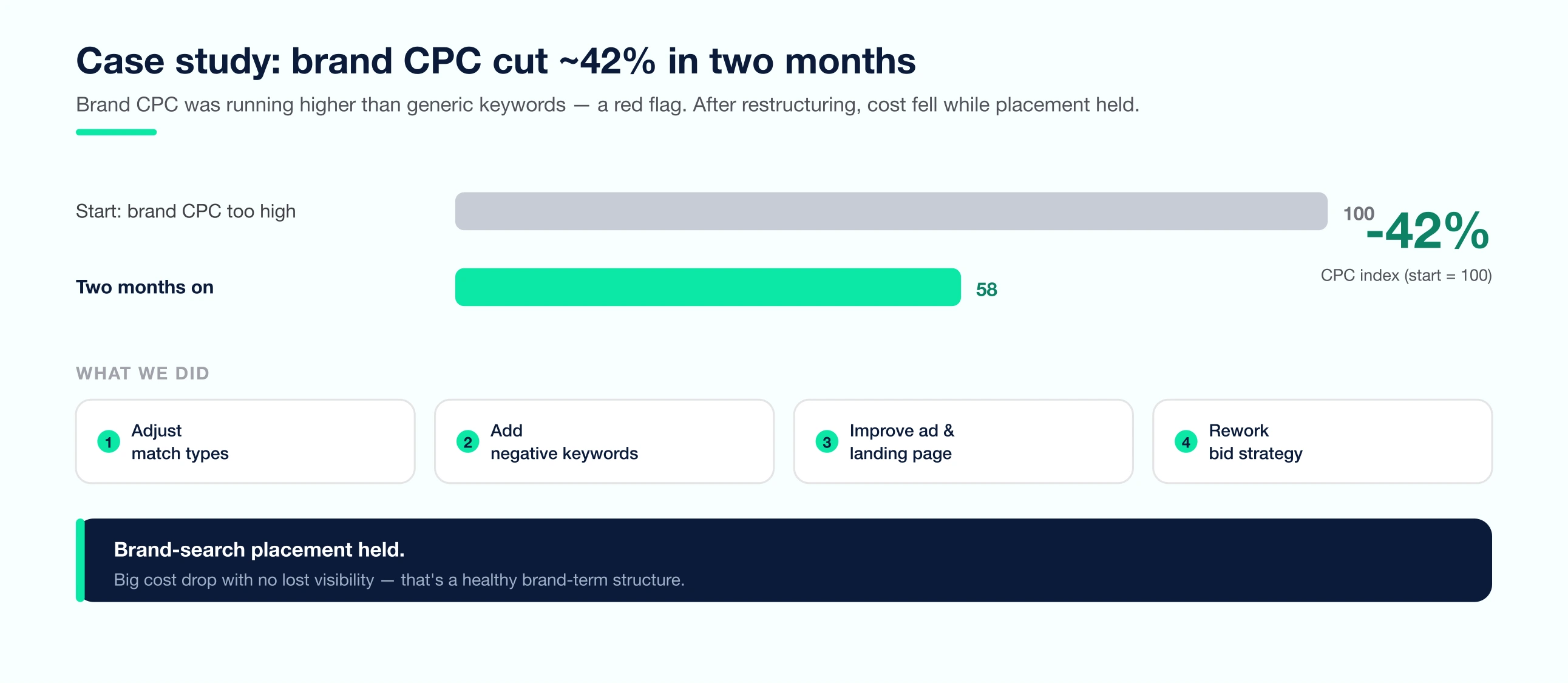
We once helped a client with brand keywords that were costing too much. At the start, their brand CPC was actually higher than their generic keywords — a red flag in itself. After reviewing the account, we adjusted match types, added negative keywords, improved the relevance of the ads and landing page, and reworked the bidding strategy. Two months on, brand CPC had fallen by roughly 42%, while holding the placement on brand searches.
Should you bid on your own brand?
Quick answer: In most cases, yes. Brand terms convert well and cost little, they hold your placement, control your messaging and block competitors from intercepting your customers — giving up the auction rarely pays off.
A common question: "I already rank first organically — do I still need to buy my own brand terms?" In most cases, the answer is yes. A competitor may be sitting right above you; paid ads let you occupy more of the page, control the headline and links, and bring in high-intent conversions at very low cost. The one scenario worth testing a pause on is when you completely dominate organic search and you've confirmed no competitor is bidding on your brand — and even then, keep monitoring, so you can switch straight back on the moment a rival moves in.
Conclusion
Brand keywords should be the cheapest, most efficient terms in your account. When they get expensive, it's usually not "normal" — there's a trail to follow: match types, competitors, Quality Score or bidding strategy. Check each one, treat the actual cause, and you can pull brand CPC back to where it belongs — and put the budget you save toward winning genuinely new customers.
FAQ
Why is my brand keyword CPC so high? The most common cause is competitors bidding on your brand terms, which raises the cost of the whole auction; after that come match types that are too broad, a low Quality Score, or the wrong bidding strategy. Brand terms should be your cheapest, so a high CPC usually means something is off.
Are brand keywords usually cheaper than generic keywords? Yes. Across the accounts we manage at Kick Ads, brand CPC runs a median of roughly 40% below generic keywords, because searchers have high intent, high relevance and a high Quality Score. There are exceptions in individual accounts, and if brand CPC is actually higher, it's worth checking why.
Can competitors bid on my brand name? Yes. Ordinary brand terms can be bid on in Google Ads; but if a registered trademark is being misused, you can file a trademark complaint with Google. The most effective way to hold your brand placement is still to keep running your own brand ads.
I already rank first organically — do I still need to buy brand terms? In most cases, yes. Paid ads let you occupy more of the page, control your messaging, block competitors and bring in high-intent conversions at low cost. Only when you fully dominate organic search and no one is bidding on your brand is it worth testing a pause.
How do I lower my brand keyword CPC? Use Phrase and Exact Match, add negative keywords, lift the Quality Score of your ads and landing page, and split brand campaigns out with a suitable bidding strategy. Keep running brand ads to hold the placement — it usually pays off more than giving up the auction.
Not sure whether your brand terms — or the rest of your account — are costing more than they should? Kick Ads is a certified Google Partner working with SMBs across Hong Kong and Malaysia. Get a free Paid Media Health Check — no sales pitch, just honest findings.

About the author
Terrence Chung · Co-Founder, Kick Ads
Terrence is an ex-Googler, paid media and SEM trainer. He has managed Google Ads for ecommerce and lead generation businesses across Hong Kong and Malaysia since 2017, working closely on account strategy and optimisation direction.