
Google Ads Quality Score: Check & Improve It
By Frankie Chan, Co-Founder · Updated 13 July 2026 · 5 min read
Jump to section
Quality Score is one of the most overlooked metrics in Google Ads, yet it directly shapes what your ads cost. In the same auction slot, advertisers with a higher Quality Score often pay less. This guide breaks down what Quality Score is, the three components behind it, how to check it, and six practical ways to improve it.
What is Quality Score?
Quick answer: Quality Score is Google's 1–10 rating of how relevant and useful your keywords, ads and landing page are to a searcher. The higher the score, the more useful Google judges your ad to be — which earns you a better Ad Rank and a lower cost per click.
Quality Score isn't a vanity metric — it has a real effect on your costs. A low score means you pay more to win the same position a competitor holds; a high score means you buy the same, or better, visibility with less budget.
The three components of Quality Score
Quick answer: Quality Score is built from three components — expected click-through rate (how likely your ad is to be clicked), ad relevance (how closely your ad matches the search intent) and landing page experience (how relevant and easy to use your page is once someone clicks).
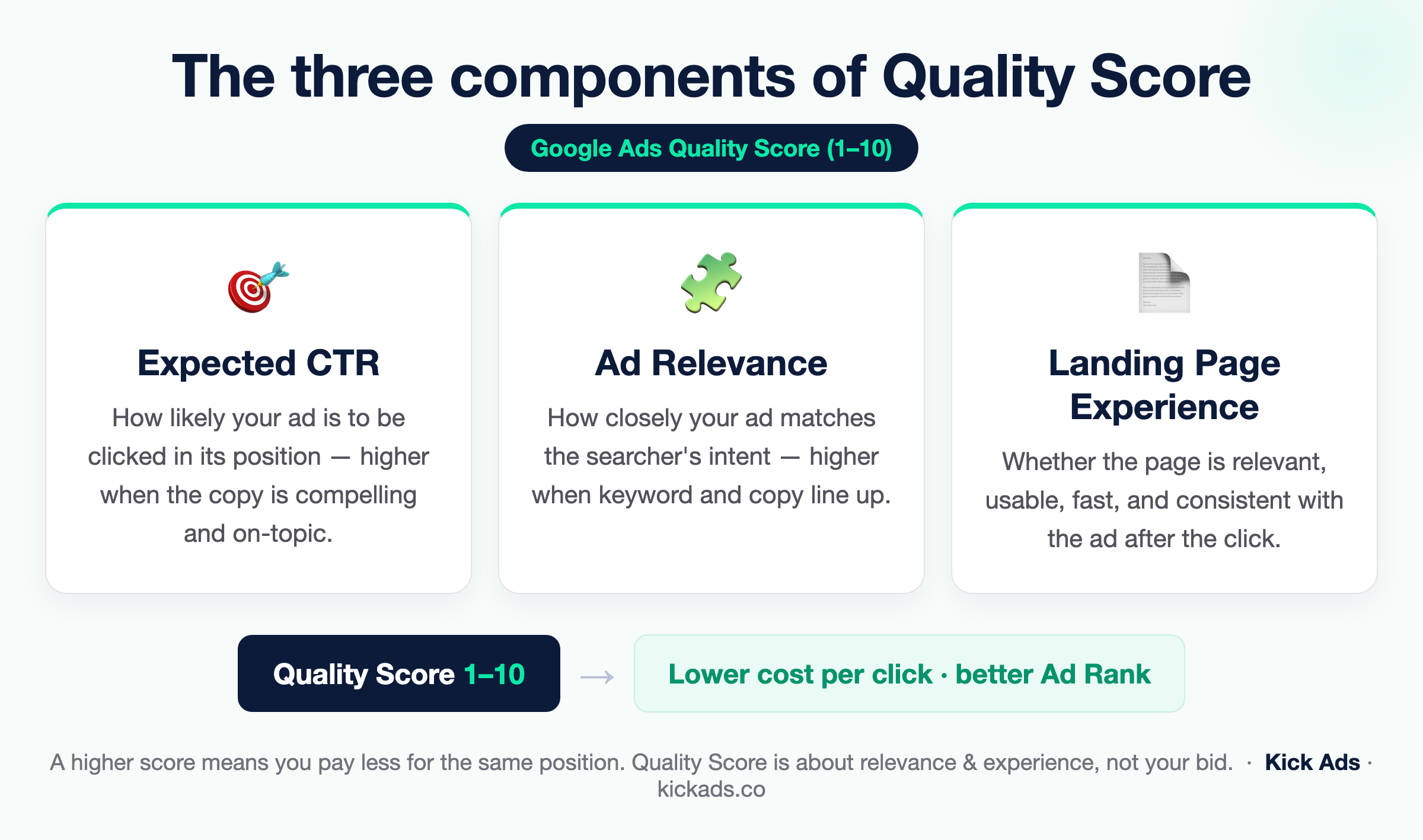
- Expected CTR: how likely your ad is to be clicked in its position. The more compelling and on-topic your copy, the higher this rates.
- Ad relevance: how closely your ad matches the searcher's intent. The tighter the alignment between your keywords and ad copy, the higher your relevance.
- Landing page experience: whether the page someone lands on after clicking is relevant, easy to use, fast to load, and consistent with the ad.
Why does Quality Score matter?
Quick answer: The quality signals behind your Quality Score work alongside your bid to determine your Ad Rank — so a strong score typically lets you win a better position at a lower bid, which lowers your cost per click.
This is why the highest bidder doesn't always rank first: Google wants to show the ad that is most useful to the searcher, not simply the one that pays the most. Improving your Quality Score is often far more cost-effective than raising your bid — and it's one of the biggest levers you have over how much Google Ads actually costs in Hong Kong.
How to check your Quality Score
Quick answer: On the Keywords page in Google Ads, add the "Quality Score" column to see each keyword's 1–10 score, along with an "Above average / Average / Below average" rating for expected CTR, ad relevance and landing page experience.
Alongside the Quality Score itself, you can add columns for all three components to pinpoint which one is dragging the score down. To track changes over time, segment the report by date and watch how Quality Score moves before and after your changes — a useful way to confirm whether your optimisations are actually working.
Six strategies to improve your Quality Score
Quick answer: The key to a higher Quality Score is tight alignment between your keywords, ad copy and landing page, backed by continual improvements to the user experience.
- Tighten your ad group themes: keep each ad group focused on one closely related set of keywords, so your ad copy can respond precisely and lift relevance.
- Put keywords in your ads: make sure your headlines and descriptions include the terms people are searching, which directly raises ad relevance and expected CTR.
- Use negative keywords: block irrelevant searches so unrelated impressions and clicks don't drag your score down.
- Optimise your ad copy and assets: add clear calls to action, offers, selling points and ad assets to make your ad more clickable.
- Improve your landing page experience: ensure the page is consistent with the ad, loads fast, is mobile-friendly, and has a clear call to action.
- Test and monitor continually: use Responsive Search Ads to test different copy, and review the three component ratings regularly so you can fix the right problem.
Common myths
Quick answer: You can't buy a higher Quality Score by raising your bid, and it doesn't simply "disappear" if you pause low-scoring keywords — it reflects relevance and experience, so the only way to improve it is to optimise.
One common misconception is that "spending more will lift your Quality Score" — in fact the opposite is true. Quality Score is not affected by your bid; it depends only on relevance and experience. Another is to fixate on "hitting a 10", when the more practical goal is to find the keywords held back by a below-average component and improve them one by one.
Conclusion
Quality Score is a mirror Google holds up to show how well your ads match what searchers want. Rather than simply bidding more, align your keywords, ads and landing page — as the score rises, your cost per click falls naturally, and the same budget buys you more, and better, visibility.
FAQ
What is Google Ads Quality Score? Quality Score is Google's 1–10 rating of how relevant and useful your keywords, ads and landing page are, built from three components — expected CTR, ad relevance and landing page experience — and these signals shape your Ad Rank and cost per click.
How does Quality Score affect ad costs? The quality signals it measures work with your bid to determine your Ad Rank. A high score lets you win the same position at a lower bid, effectively lowering your cost per click; a low score means you pay more to hold the same rank.
How do I check a keyword's Quality Score? On the Keywords page in Google Ads, add the "Quality Score" column to see each keyword's 1–10 score and the rating for each of the three components; segment by date to view historical changes.
How do I improve my Quality Score? Tighten your ad group themes, put keywords in your ads, use negative keywords, optimise your copy and ad assets, improve your landing page experience, and continually test and monitor the three component ratings.
What happens if my Quality Score is low? A low Quality Score raises your cost per click and lowers your Ad Rank — you pay more to win the same position a competitor holds. Improving relevance and experience fixes it.
Wondering how much room your Search account has to improve? Kick Ads runs a free Paid Media Health Check for businesses in Hong Kong and Malaysia — no sales pitch, just honest findings.

About the author
Frankie Chan · Co-Founder, Kick Ads
Frankie is an ex-Googler and paid media strategist. He has managed Google Ads and Meta Ads for ecommerce and lead generation businesses across Hong Kong and Malaysia since 2017, working closely on strategy, reporting and client growth planning.